
A quiet country confession that turns a restless soul into a mirror of loneliness, pride, and the long road toward emotional surrender
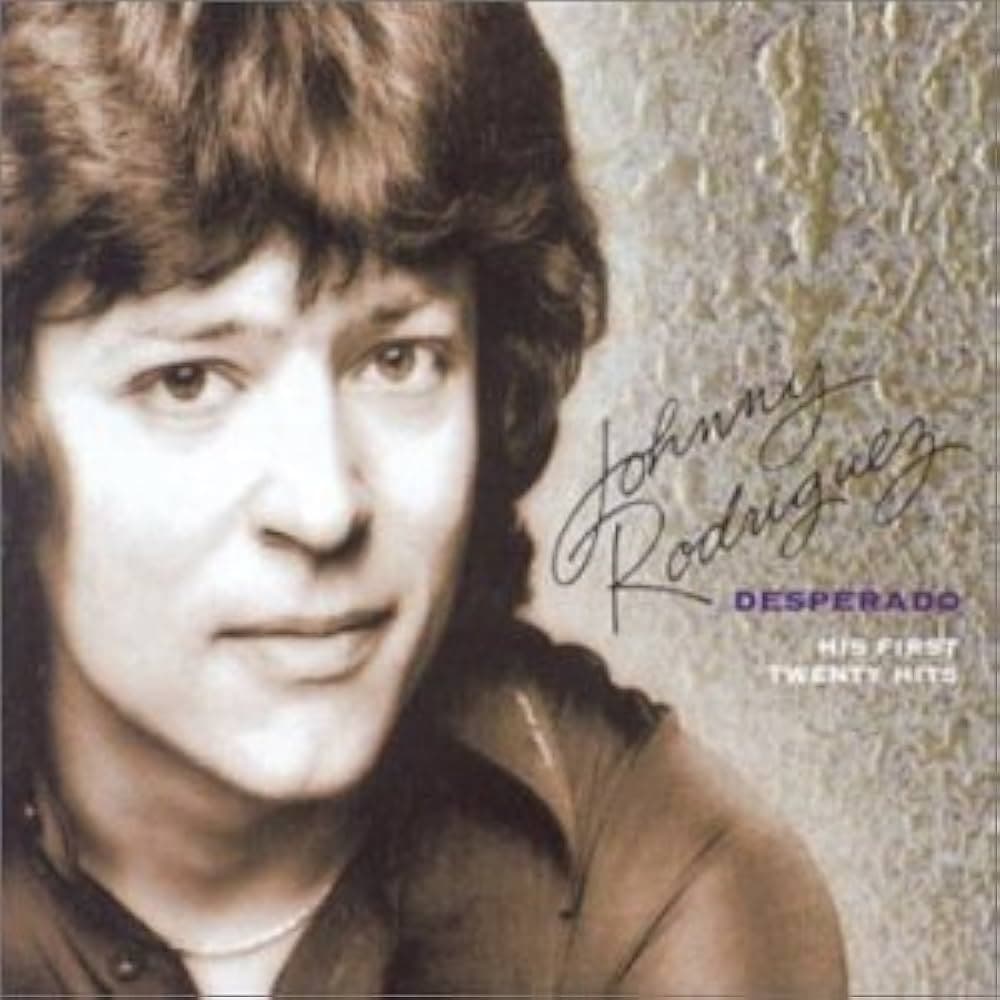
Desperado, recorded by Johnny Rodriguez in 1974, stands as one of the most understated yet emotionally revealing moments in his catalog. Released as a single from the album Love Put a Song in My Heart, the song reached No. 17 on the Billboard Hot Country Singles chart, a modest position by commercial standards, yet one that understated the deeper cultural and emotional resonance the recording would come to carry over time. While widely known as a composition by Glenn Frey and Don Henley of Eagles, Johnny Rodriguez’s interpretation transformed the song into something distinctly country, grounded not in Western mythology, but in lived emotional restraint.
By the mid nineteen seventies, Johnny Rodriguez had already established himself as one of country music’s most compelling voices. His phrasing carried a natural melancholy, shaped by hardship and personal history rather than theatrical gesture. When he approached Desperado, he did not attempt to imitate the dramatic sweep of the original version. Instead, he stripped it down, allowing the song to breathe as a quiet conversation rather than a statement. This decision proved crucial. In his hands, Desperado became less about a romanticized outlaw and more about a man standing at the edge of his own emotional defenses.
The song’s narrative centers on isolation, pride, and the refusal to let anyone close enough to cause pain. These themes aligned naturally with Johnny Rodriguez’s vocal persona. His delivery avoids confrontation. There is no pleading, no raised voice. Each line is offered gently, as if spoken late at night when honesty feels safer. This restraint gives the song its power. The listener is not told what to feel, but is invited to recognize something familiar in the quiet ache of the melody.
Musically, Desperado in Johnny Rodriguez’s version is anchored in traditional country arrangement. Acoustic guitar, soft steel lines, and an unhurried tempo create an atmosphere of stillness. The production refuses excess. There are no dramatic crescendos, no orchestral flourishes. Instead, the focus remains firmly on the lyric and the voice carrying it. This simplicity allows the song’s emotional message to unfold slowly, reinforcing its themes of patience, vulnerability, and the cost of emotional distance.
The album Love Put a Song in My Heart marked a period of introspection in Johnny Rodriguez’s career. While earlier hits often leaned into romantic optimism or gentle heartbreak, this record explored more complex emotional terrain. Desperado fit naturally within that context. It was not a song about loss already suffered, but about loss waiting quietly in the future if pride remains unchallenged. That subtle warning gives the song a reflective weight that deepens with time.
What distinguishes Johnny Rodriguez’s Desperado is its refusal to dramatize masculinity. The character here is not glorified for his independence. He is portrayed with empathy, but also with concern. The song suggests that strength does not lie in emotional withdrawal, but in the courage to let someone see beyond the armor. This perspective resonated strongly with listeners who understood that life often teaches its hardest lessons not through grand failures, but through small, repeated refusals to open up.
Although the single did not dominate the charts, its endurance lies in its honesty. Over the years, Desperado has become one of those recordings that feels increasingly relevant as the listener’s own experiences accumulate. It speaks not to youth, but to reflection. To the realization that time moves forward whether or not we choose to engage fully with it.
In the broader landscape of country music interpretations of pop and rock material, Johnny Rodriguez’s Desperado remains a benchmark of how a song can be reshaped without losing its soul. By grounding it in quiet realism and emotional humility, he revealed new layers within a familiar composition. His version does not ask for attention. It waits patiently, trusting that those who recognize themselves within its lines will stay long enough to listen.
Ultimately, Desperado endures not because of chart placement, but because it captures a universal moment of self recognition. A moment when solitude begins to feel less like freedom and more like a closed door. In Johnny Rodriguez’s voice, that realization is not frightening. It is simply true.