
A Gentle Farewell Wrapped in Strings — Where Memory and Melody Promise Reunion Beyond Time
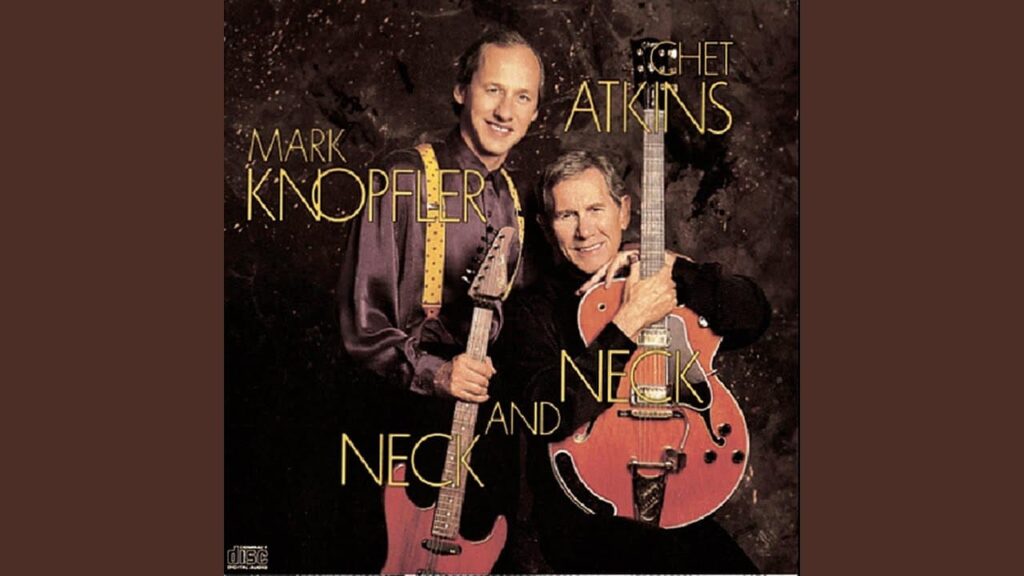
When Chet Atkins and Mark Knopfler joined forces for “I’ll See You In My Dreams,” they were not chasing chart dominance or radio trends. Released in 1990 as part of their collaborative album “Neck and Neck,” the track was a quiet, elegant conversation between two masters of the guitar. The album itself reached No. 27 on the Billboard 200 and climbed to No. 1 on the Billboard Top Country Albums chart — a remarkable achievement for a largely instrumental project rooted in craftsmanship rather than commercial spectacle.
Originally written by Isham Jones with lyrics by Gus Kahn in 1924, “I’ll See You In My Dreams” had already enjoyed a long and distinguished life in American popular music. It was first a major hit for Isham Jones’ orchestra in the 1920s and later recorded by artists across generations, from jazz ensembles to crooners. The song’s lyrical sentiment — a vow to reunite with a loved one in dreams when earthly presence is no longer possible — has always carried a quiet poignancy. By the time Atkins and Knopfler interpreted it, the piece felt less like nostalgia and more like reverence.
What makes this 1990 recording so special is its restraint. Chet Atkins, already a 14-time Grammy winner and a central architect of the Nashville Sound, brought his signature fingerstyle precision — warm bass lines walking steadily beneath luminous melody notes. Mark Knopfler, known worldwide as the voice and guitar force behind Dire Straits and classics like “Sultans of Swing” (which reached No. 4 on the UK Singles Chart and No. 4 on the Billboard Hot 100 in 1979), approached the tune not as a rock star, but as a student honoring a mentor. Knopfler had long cited Atkins as a profound influence, and this collaboration was both musical partnership and heartfelt tribute.
Their version of “I’ll See You In My Dreams” dispenses with lyrics entirely. And yet, somehow, the story remains intact. The guitars speak softly, almost conversationally. Atkins’ Gretsch tone is rounded and reassuring, while Knopfler’s phrasing — instantly recognizable even without vocals — adds a slightly blues-tinged melancholy. There is no rush, no dramatic flourish. Instead, each note lingers just long enough to feel like a memory being gently turned over in the mind.
By 1990, both men were at reflective stages in their careers. Atkins had already been inducted into the Country Music Hall of Fame in 1973 and had spent decades shaping the sound of American country music from behind the console as well as in front of a microphone. Knopfler, meanwhile, had moved beyond the arena-rock heights of Dire Straits’ 1985 blockbuster album “Brothers in Arms,” which had topped charts in both the UK and the US. In collaborating with Atkins, he seemed to be reconnecting with the foundational influences that first made him fall in love with the guitar.
The meaning of “I’ll See You In My Dreams” resonates deeply precisely because it avoids sentimentality. It acknowledges absence but refuses despair. The promise of reunion — even if only in dreams — suggests that love is not extinguished by distance or time. In the hands of Atkins and Knopfler, that promise feels mature, seasoned by experience. This is not youthful longing; it is acceptance wrapped in gratitude.
Listening now, decades later, the recording feels almost sacred in its simplicity. There is something profoundly moving about two virtuosos choosing subtlety over virtuosity. They could have dazzled. Instead, they conversed. The spaces between notes carry as much meaning as the notes themselves.
“Neck and Neck” would go on to win the Grammy Award for Best Country Instrumental Performance in 1991, affirming what careful listeners already knew: this was more than a side project. It was a meeting of musical minds across generations, united by respect for melody, tone, and emotional truth.
In “I’ll See You In My Dreams,” Chet Atkins and Mark Knopfler remind us that some songs are not meant to be reinvented — only understood. And sometimes, when words fall short, six strings can carry the weight of farewell more gracefully than any lyric ever could.