
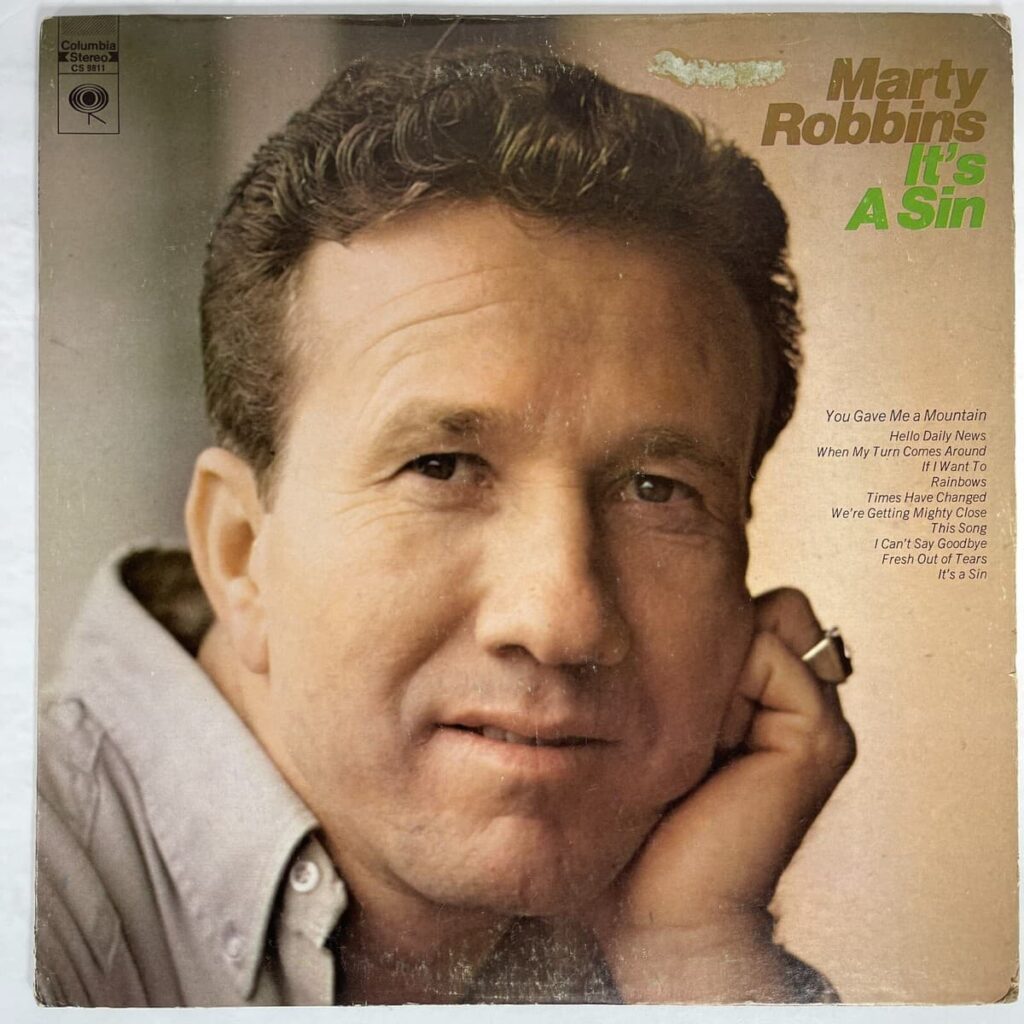
Marty Robbins – I Can’t Quit: A Haunting Refrain of Eternal Longing and the Chains of Memory
For those of us who carry the dust of the mid-20th century on our boots, the voice of Marty Robbins isn’t just a sound; it is a landscape. Released in August 1956 as the compelling B-side to the legendary “Singing the Blues,” “I Can’t Quit (I’ve Gone Too Far)” reached number 7 on the Billboard C&W (Country & Western) Jockeys chart, carving out its own space in the hearts of listeners. While its upbeat companion topped the charts, this poignant ballad captured a specific kind of heartache that resonated deeply with a generation navigating the complexities of devotion and regret.
This song is a masterclass in the “tear in the voice” technique that made Marty Robbins a legend long before he became the “Gunfighter” of the West. Recorded during the Columbia Records sessions that helped define the Nashville Sound, the track is anchored by a profound, almost desperate sincerity. It speaks to the universal experience of being tethered to a ghost—the realization that while a relationship has ended in the physical world, it remains an unbreakable loop within the mind, a sentiment that feels as heavy today as it did nearly seventy years ago.
The Story Behind the Echoes
In the mid-1950s, Marty Robbins was an artist of incredible versatility, shifting effortlessly from rockabilly to Hawaiian melodies. However, with “I Can’t Quit,” he tapped into a more vulnerable, introspective vein of country music. Written by Robbins himself, the song showcases his burgeoning talent as a songwriter who could articulate the silent struggles of the human spirit. In an era where society often demanded stoicism, Marty used his velvet-smooth baritone to admit a truth many felt but few spoke: sometimes, the heart simply refuses to surrender.
A Reflection on Enduring Devotion
The meaning of “I Can’t Quit” transcends a simple breakup; it is an exploration of psychological exile. The lyrics describe a man who has traveled “too far” down the road of loving someone to ever find his way back to himself. For an audience that values the sanctity of “forever,” this song explores the darker side of commitment—the inability to move on when the heart remains stubbornly loyal to a memory.
As we look back through the lens of decades, the song feels like a precious time capsule. It reminds us of a period when lyrics didn’t need to be complex to be profound; they only needed to be true. The gentle, mournful steel guitar and the steady rhythm create a sanctuary for the listener to revisit their own “ones that got away.” It is a song for the quiet hours, for the reflection in the windowpane, and for anyone who understands that some loves are not meant to be outgrown, but simply carried until the end. This is not just a song from 1956; it is a companion for the long journey of memory.
 Music Legend