
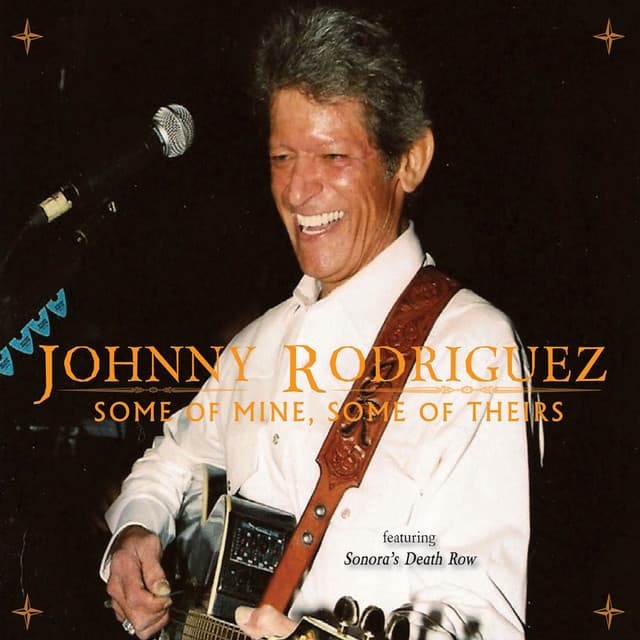
A quiet, aching reflection on love that never quite belongs to you, carried by a voice that understands longing better than most.
When Johnny Rodriguez recorded Something, he was stepping into sacred musical territory while making it unmistakably his own. Originally written by George Harrison and released by The Beatles in 1969, Something had already earned its place as one of the most revered love songs of the twentieth century. Rodriguez’s version, released in 1973 on the album All I Ever Meant to Do Was Sing, did not aim to compete with its origin. Instead, it approached the song from a different emotional landscape, one shaped by country music’s plainspoken honesty and lived-in sorrow.
Upon its release as a single, Something reached No. 12 on the Billboard Hot Country Singles chart, a notable achievement for a reinterpretation of such a well-known pop standard. At a time when crossover material was often viewed with skepticism in traditional country circles, Rodriguez’s recording was embraced for its sincerity and restraint. The chart performance reflected not novelty, but trust in a singer who had already proven his ability to convey emotional truth without excess.
The story behind Johnny Rodriguez choosing Something is rooted in his artistic identity. By the early 1970s, Rodriguez had emerged as one of country music’s most distinctive voices, known for blending traditional country feeling with subtle pop influences. Songs like Ridin’ My Thumb to Mexico and You Always Come Back (To Hurting Me) established him as an interpreter of emotional complexity, particularly when it came to love marked by distance, doubt, and quiet regret. Something fit naturally into that emotional world.
Unlike the lush orchestration of the Beatles’ original recording, Rodriguez’s version strips the song down to its emotional core. The arrangement leans on gentle acoustic textures, understated steel guitar, and a steady rhythm that never intrudes on the vocal. This simplicity allows the lyrics to breathe. Lines that once felt romantic and idealized now sound reflective, even cautious, as if the narrator understands that devotion does not guarantee fulfillment.
Johnny Rodriguez’s vocal performance is the heart of the recording. He does not reach for grandeur. Instead, he sings Something with a soft restraint, his phrasing colored by pauses and subtle inflections that suggest hesitation. There is a sense that the love being described is deeply felt but never fully possessed. In this interpretation, admiration carries an undercurrent of acceptance, an understanding that love sometimes exists without resolution.
The meaning of Something, through Rodriguez’s voice, shifts gently but decisively. It becomes less about celebration and more about recognition. The song speaks to the mysterious pull one person can have over another, even when circumstances remain unspoken or unchangeable. The word “something” itself takes on greater weight, standing in for all the emotions that cannot be named directly. In the context of country music, this ambiguity feels honest rather than evasive.
The album All I Ever Meant to Do Was Sing provided the perfect setting for such a song. The record reflected Rodriguez’s growing confidence as an interpreter rather than a storyteller bound to autobiography. While many of his hits were grounded in narrative realism, Something allowed him to explore emotional universality. The album was not his most commercially dominant release, but it has since been recognized for its cohesion and emotional maturity.
Historically, Rodriguez’s version of Something occupies an important place in the tradition of country artists engaging with pop songwriting. Rather than altering the song to fit genre expectations, he allowed country music’s emotional directness to illuminate the song’s quiet ache. This approach earned respect from listeners who valued authenticity over strict boundaries.
Listening to Something today, the recording feels timeless precisely because it avoids spectacle. It is not dramatic, not declarative. It lingers. Johnny Rodriguez sings as if he understands that some feelings are strongest when left unresolved. There is no promise of permanence, only acknowledgment of connection.
In the broader arc of his career, Something stands as a reminder of Rodriguez’s greatest strength: his ability to inhabit a song without overtaking it. He brings his own history, his own emotional vocabulary, but he never forces them forward. The result is a performance that feels intimate, reflective, and deeply human.
Something, as interpreted by Johnny Rodriguez, remains a quiet conversation between memory and desire. It does not ask for attention. It waits patiently, confident that those who recognize its emotional truth will hear it clearly, even decades later.