
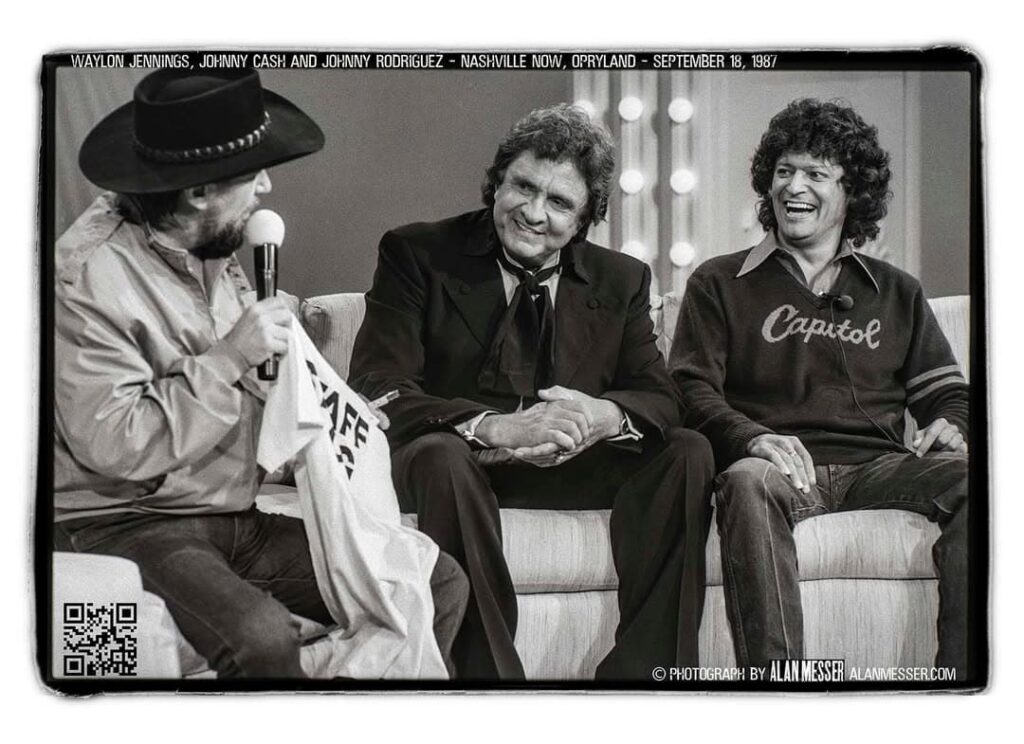
A rare television gathering where three distinct country voices came together, revealing how shared values could matter more than fame, charts, or eras.
On September 18th, 1987, the stage of “Nashville Now”, hosted by the ever thoughtful Ralph Emery at the Opryland TV Studios, became a meeting place for three artists whose paths through country music had been strikingly different, yet deeply connected by sincerity and conviction. That evening, WAYLON JENNINGS, JOHNNY CASH, and JOHNNY RODRIGUEZ appeared together to promote the “Rock For The Animals” charity concert, scheduled to take place at Monthaven in Hendersonville, now known as Hendersonville Arts. The concert was produced by Hugh Waddell, longtime assistant to Johnny Cash, whose quiet organizational role mirrored Cash’s lifelong commitment to causes rooted in compassion.
By the late 1980s, each of these men represented a different chapter of country music history. Johnny Cash, already an institution, had just reaffirmed his relevance with the 1987 album “Johnny Cash Is Coming to Town”, which climbed to No. 2 on the Billboard Top Country Albums chart. His presence on the show carried the weight of decades spent giving voice to the voiceless, whether through prison concerts, spiritual recordings, or songs that refused to look away from human struggle.
Waylon Jennings, the unmistakable architect of the outlaw movement, arrived at this moment with hard earned clarity. Having survived both industry battles and personal demons, Jennings in 1987 stood as a man who no longer needed to prove anything. His music had already redrawn the boundaries of country expression. His appearance alongside Cash felt less like a reunion of rebels and more like a conversation between survivors who understood the cost of independence.
Adding a quieter but no less meaningful dimension to the evening was Johnny Rodriguez. Often described as one of country music’s most emotionally direct voices of the 1970s, Rodriguez brought a sense of vulnerability that contrasted beautifully with the rugged authority of Cash and Jennings. His career had been defined by songs that spoke plainly about loneliness, devotion, and the ache of belonging. Hits like “Ridin’ My Thumb to Mexico” and “You Always Come Back (To Hurting Me)” had earned him multiple Top 10 positions on the Billboard Hot Country Singles chart, including several No. 1 hits in the early 1970s. By 1987, Rodriguez was no longer at the center of commercial attention, but his artistry carried the quiet dignity of someone who had already said what mattered.
The purpose of their shared appearance was the “Rock For The Animals” benefit concert, an event that reflected a side of country music often overlooked. This was not rebellion for its own sake, nor nostalgia packaged for profit. It was a simple appeal to responsibility. Johnny Cash’s concern for animal welfare fit seamlessly into his broader moral worldview. Waylon Jennings, once known for defying limits, now lent his name to a cause defined by care rather than confrontation. Johnny Rodriguez, whose songs had always centered on empathy, seemed a natural presence in a conversation about protection and kindness.
What made this moment resonate was its restraint. There were no exaggerated declarations, no attempts to sell an image. Under Ralph Emery’s steady guidance, the conversation unfolded with calm honesty. Each artist spoke not as a spokesman, but as a human being explaining why the cause mattered. The absence of chart promotion only strengthened the moment. This was music stepping away from commerce and returning to conscience.
In hindsight, this 1987 Nashville Now appearance feels like a quiet footnote that carries surprising emotional weight. Three voices from different corners of country music sat side by side, united not by sound or style, but by an understanding that music, at its best, should leave the world a little more humane than it found it. It was not a moment defined by rankings or radio play, but by something far more enduring the shared belief that a song, and the people behind it, could still stand for mercy, responsibility, and truth.