
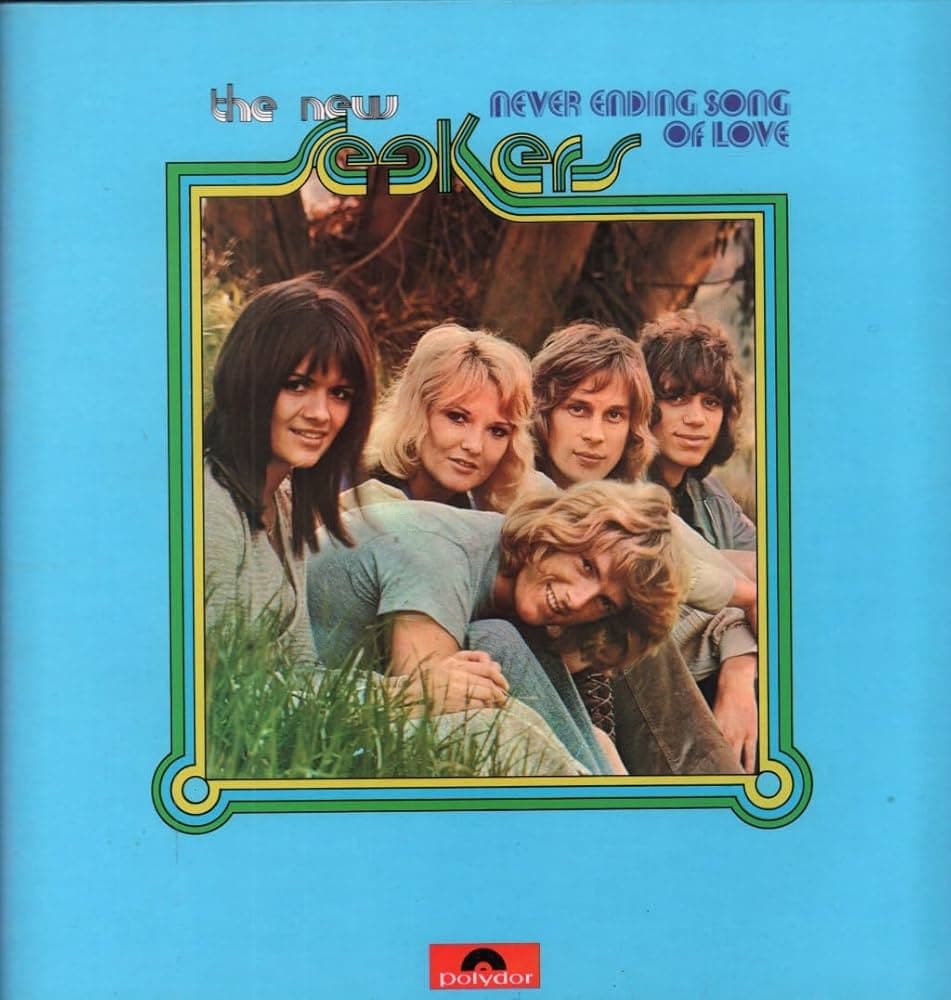
A gentle celebration of devotion, where simple words and bright harmonies turn love into something timeless and reassuring
When The New Seekers released “Never Ending Song of Love” in 1971, they delivered a radiant, harmony-soaked anthem that would become one of the defining pop singles of the early 1970s. The song climbed to No. 2 on the UK Singles Chart and reached No. 13 on the Billboard Hot 100 in the United States. In Canada, it soared all the way to No. 1, while also performing strongly across Europe and Australia. Included on their album Beautiful People, the single confirmed that The New Seekers were not merely a revivalist folk-pop ensemble, but a polished international act capable of bridging continents with melody alone.
Written by the legendary country songwriter Delaney Bramlett, “Never Ending Song of Love” had first been recorded by Delaney & Bonnie earlier in 1971. Yet it was The New Seekers who transformed it into a bright, radio-friendly celebration of optimism. Where the original carried a rootsy, Southern warmth, the New Seekers’ version shimmered with crisp production and buoyant vocal interplay. Their harmonies—clear, layered, and unpretentious—felt like sunlight breaking through a cloudy morning.
By 1971, the group was riding a wave of recognition. Formed in 1969 by Keith Potger after his departure from The Seekers, The New Seekers aimed to capture the same folk-pop spirit that had defined the mid-1960s, but with a slightly more contemporary polish. With vocalists like Lyn Paul and Marty Kristian, the group developed a signature blend—male and female voices intertwining in balanced harmony, never overpowering one another. That balance became the heart of “Never Ending Song of Love.”
The song’s structure is deceptively simple. A steady rhythm, bright acoustic guitar, and cheerful choral responses create an atmosphere of effortless joy. Yet beneath that simplicity lies something enduring. The lyrics speak of love not as a fleeting spark, but as a steady flame—“I’ve got a never ending love for you.” There is no drama, no heartbreak, no grand tragedy. Instead, there is reassurance. In an era marked by cultural upheaval and generational shifts, that reassurance mattered deeply.
The early 1970s were filled with music exploring protest, introspection, and social change. Against that backdrop, “Never Ending Song of Love” felt almost radical in its straightforward optimism. It did not demand attention; it invited participation. Its chorus is instantly singable, the kind that seems to rise naturally from memory even decades later. One can almost hear the echo of transistor radios, family gatherings, car journeys with windows down—moments where music was not just entertainment, but a shared companion.
Commercially, the single solidified the group’s momentum just before their global breakthrough with “I’d Like to Teach the World to Sing.” But artistically, “Never Ending Song of Love” captures something purer. It reflects a time when harmony groups still held a cherished place in popular music, when voices blended without digital enhancement, when emotion traveled through melody rather than spectacle.
Listening today, there is a comforting steadiness to “Never Ending Song of Love.” It does not age in the way trend-driven hits often do. Its arrangement feels organic; its sentiment, universal. The interplay between male and female vocals subtly mirrors the lyric’s message—partnership, mutual devotion, and shared expression. No single voice dominates. Love, the song suggests, is strongest when balanced.
What lingers most is the song’s sincerity. There is no irony in its delivery, no wink to the audience. The New Seekers sing as though they truly believe in the promise they are declaring. That authenticity, more than chart numbers, explains its endurance. It stands as a reminder that amid changing fashions and passing decades, the simplest truths—sung clearly and with conviction—can echo the longest.
In the end, The New Seekers offered more than a hit single in 1971. With “Never Ending Song of Love,” they gave listeners a melody that feels like a warm embrace—steady, familiar, and quietly everlasting.