
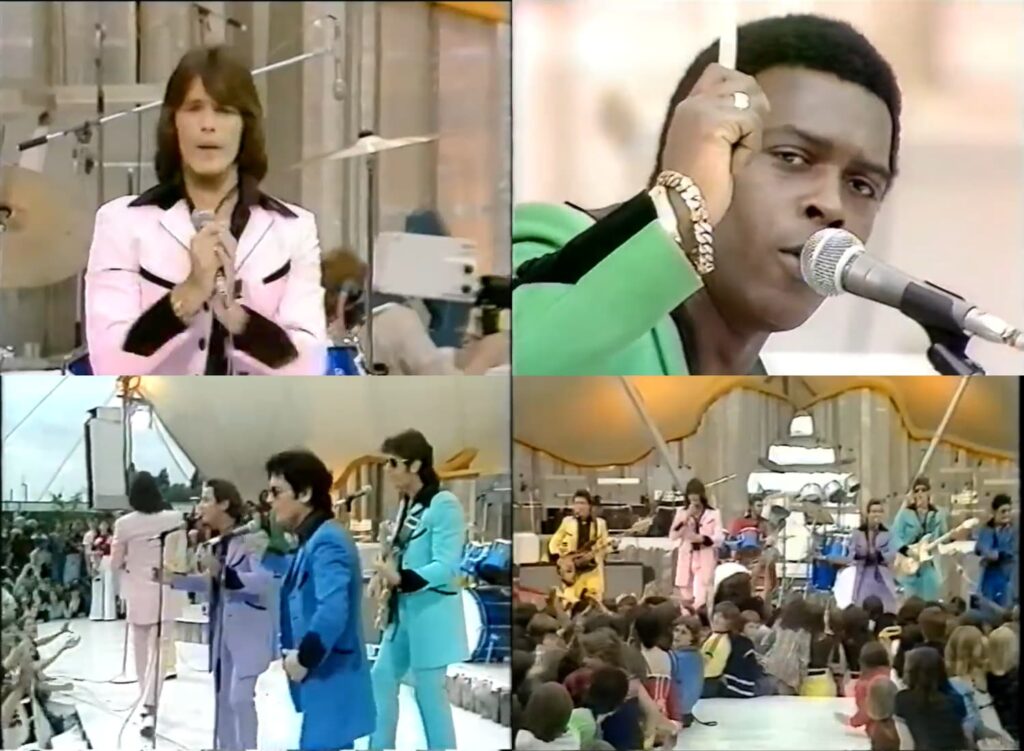
A borrowed melody reborn under softer lights, where romance lingers gently between memory and moonlight
When Showaddywaddy brought “Under the Moon of Love” to television on Pop at the Mill on August 27, 1977, they were not unveiling something entirely new. Instead, they were reviving a song that had quietly existed for over a decade and giving it a second life—one that would resonate far more deeply than its original moment ever allowed. By that summer, the single had already climbed to No. 1 on the UK Singles Chart, where it remained for three weeks, marking one of the band’s most significant commercial triumphs.
The song itself was first recorded in 1961 by Curtis Lee, produced by Phil Spector during his early experiments with what would later be known as the “Wall of Sound.” Lee’s version reached No. 46 on the Billboard Hot 100—a modest showing that hinted at potential but never fully realized it. In many ways, the song seemed destined to remain a footnote of its era, remembered only by those who had heard it when it first passed through the airwaves.
Yet Showaddywaddy saw something enduring within it. Their 1976 recording, included on the album “Red Star”, did not attempt to recreate Spector’s dense production. Instead, they simplified the arrangement, allowing the melody to breathe. The harmonies were clearer, the rhythm more grounded, and the emotional tone more direct. What emerged was not just a cover, but a reinterpretation shaped by affection rather than ambition.
On Pop at the Mill, that reinterpretation becomes even more intimate. The performance does not rely on spectacle. There is no urgency to impress. The band moves through the song with a kind of quiet confidence, as if they understand that its strength lies not in complexity, but in familiarity. Each note feels placed with care, each harmony balanced with restraint.
Lyrically, “Under the Moon of Love” is disarmingly simple. It speaks of young romance, of walking beneath the night sky, of moments that feel both fleeting and permanent. There is no dramatic conflict, no lingering uncertainty. Instead, the song captures a sense of presence—of being exactly where one wants to be, even if only for a short time.
What gives the song its lasting power is not the words themselves, but the atmosphere they create. There is a softness to the melody, a gentle rise and fall that mirrors the rhythm of memory. Listening to it now, one does not simply hear a love song. One recalls a feeling—something quiet, almost fragile, yet deeply rooted.
For Showaddywaddy, this recording represents more than a successful single. It reflects their broader role within the musical landscape of the 1970s. While many artists were pushing forward into new sounds and styles, they chose to look back—not as an act of resistance, but as a way of preserving something that still held meaning. Their music does not argue for the past. It simply reminds listeners that it is still there.
The success of “Under the Moon of Love” also speaks to timing. By the mid 1970s, there was a growing sense of nostalgia for the early days of rock and roll. Audiences were beginning to rediscover the simplicity and sincerity of that period, perhaps as a response to the increasing complexity of contemporary production. Showaddywaddy stepped into that space with clarity, offering songs that felt both familiar and renewed.
Watching the 1977 performance today, there is a quiet stillness that surrounds it. The stage may seem modest, the presentation unadorned, yet the emotional weight remains. It is not carried by grand gestures, but by subtlety—by the way the melody lingers, by the way the harmonies settle gently into place.
In the end, “Under the Moon of Love” is not simply a song about romance. It is about memory itself—how certain moments, no matter how small, remain untouched by time. And in the hands of Showaddywaddy, that memory is not only preserved, but shared once more, as if the night it describes has never truly ended.