
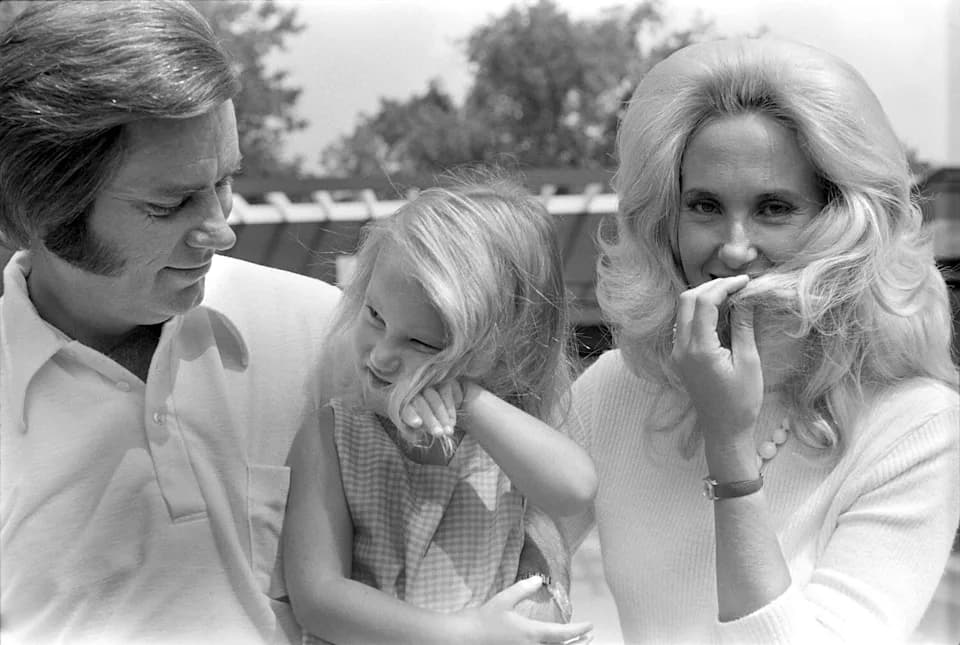
A love that never truly left, even when life forced it to break apart
In the final days of Tammy Wynette, there was no stage, no spotlight, no carefully written lyric to soften what needed to be said. Around two weeks before her passing in April 1998, she spoke quietly to her daughter, Georgette Jones, and in that moment, the story that had followed her for decades came back into focus with a clarity that time had never erased. She admitted, without hesitation, that George Jones was the love of her life.
It was not a statement wrapped in nostalgia or romantic illusion. By then, life had already shown its harsher truths. Their marriage, which lasted from 1969 to 1975, had been marked by turbulence, by addiction, by moments that could not be undone. Together, they created some of the most enduring duets in country music, songs like Golden Ring and We’re Gonna Hold On, recordings that climbed the charts and settled deeply into the fabric of American country music. “Golden Ring” reached No. 1 on the Billboard Hot Country Singles chart in 1976, a haunting irony for a song about a marriage that had already slipped beyond repair.
But what Tammy spoke of in those final weeks was not the marriage as it had been lived. It was something that remained after everything else had fallen away. Not the arguments, not the separations, not the years spent trying to rebuild a life elsewhere. What remained was the feeling that had never fully disappeared, even when circumstances made it impossible to hold onto each other.
There is something profoundly human in that kind of confession. It does not offer resolution. It does not tidy up the past into something easier to understand. Instead, it acknowledges that some relationships do not end in the way we expect them to. They change form, they fracture, they move into the distance, but they never completely leave.
Tammy Wynette’s voice had always carried that quiet ache. In songs like Stand by Your Man, which became her signature hit and topped the country charts in 1968, there was already a sense of devotion complicated by reality. That tension between love and hardship was not something she merely performed. It was something she lived.
By the time she spoke those final words to her daughter, there was no reason to reshape the truth. No expectation left to meet. Just a need to say, plainly, what had endured. George Jones, with all his flaws, all the distance, all the years that had passed, remained at the center of something she could not rewrite.
There was no last-minute reconciliation, no closing chapter that brought them back together. George himself would later speak of Tammy with a mixture of regret and tenderness, a recognition of what they had shared and what they had lost. Their story did not resolve. It lingered.
And perhaps that is why it continues to resonate. Not because it offers comfort, but because it reflects something that is rarely spoken aloud. That sometimes, even after everything has ended, after life has carried us far away from where we once stood, there are certain people who remain. Not in the way they were, but in the way they stay.