
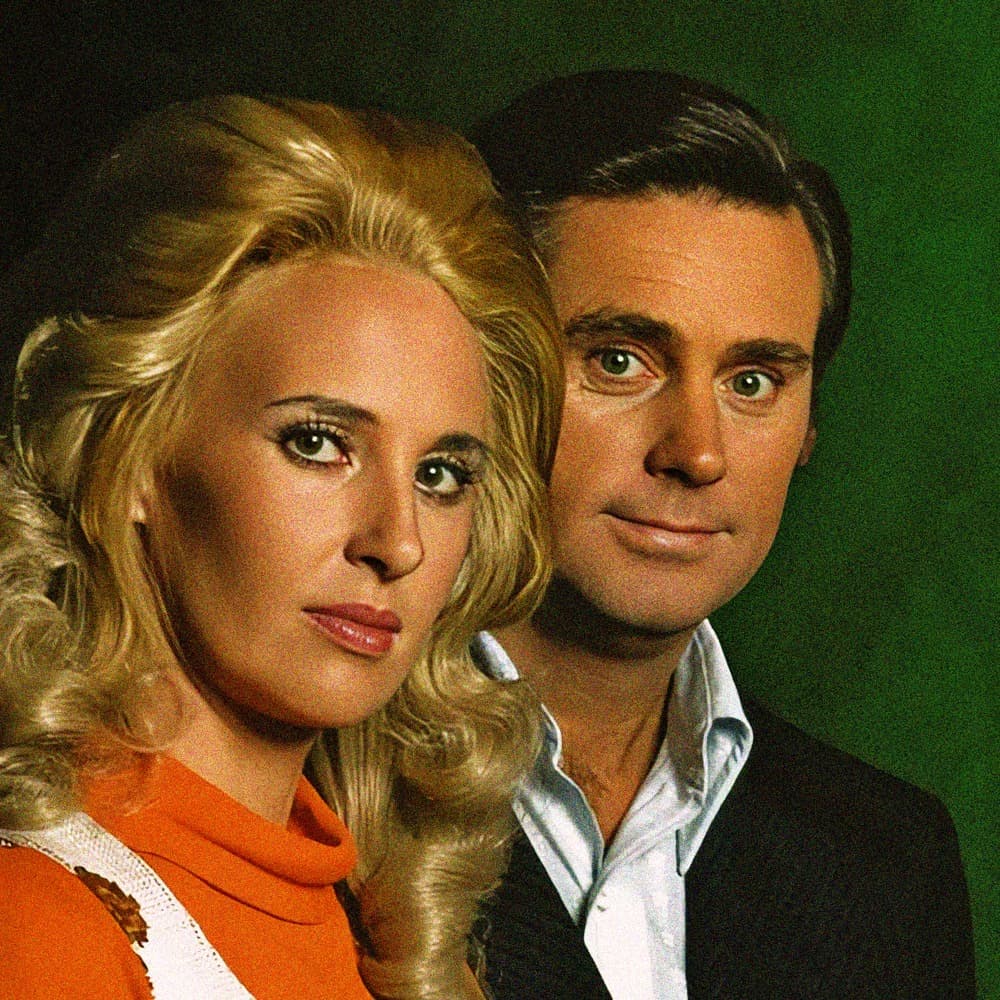
A quiet confession of love reclaimed, where broken promises meet the fragile courage to begin again
When George Jones and Tammy Wynette recorded “When True Love Steps In”, the song did not arrive with the force of a chart-topping declaration. It was never meant to dominate the airwaves or redefine the genre. Instead, it lived in a more intimate space—one that reflected the deeply complicated, often painful reality behind one of country music’s most storied partnerships.
Unlike their earlier duets such as “We’re Gonna Hold On” (No. 3 on the Billboard Hot Country Singles chart) or “Golden Ring” (No. 1 on the same chart in 1976), “When True Love Steps In” did not achieve major chart success. Yet, in many ways, its significance runs deeper. It belongs to a later chapter, a period when both artists had already lived through the rise and collapse of their marriage, carrying with them the weight of everything that had been said, and everything that had not.
By the time this song emerged, the public no longer viewed George Jones and Tammy Wynette simply as duet partners. They were something more complicated—symbols of love tested beyond endurance. Their relationship had been marked by devotion, conflict, separation, and reconciliation attempts that never quite found lasting ground. And it is within that emotional landscape that “When True Love Steps In” finds its voice.
The song itself speaks with a kind of quiet honesty that cannot be manufactured. It does not celebrate love in its early, effortless form. Instead, it addresses the moment when love returns—hesitantly, uncertainly—after everything has already fallen apart. There is no grand promise here, no certainty of resolution. Only the fragile belief that something real might still remain.
Musically, the arrangement is restrained, allowing the voices to carry the weight of the narrative. George Jones brings his unmistakable depth, a voice shaped by years of personal struggle and artistic mastery. There is a weariness in his delivery, but also a sincerity that feels unguarded. Tammy Wynette, in contrast, offers a clarity that cuts through that weight—a steadiness that does not deny pain, but refuses to be defined by it.
Together, their voices do something rare. They do not simply harmonize—they converse. Each line feels like a response, a continuation, a reflection of something left unresolved. It is not a performance built on perfection, but on truth. And that truth carries a kind of emotional gravity that cannot be easily replicated.
What makes “When True Love Steps In” so affecting is its refusal to simplify. Love here is not portrayed as salvation, nor as inevitable. It is presented as a possibility—one that arrives quietly, without certainty, and asks to be accepted despite everything that has come before.
Listening to the song now, there is an unmistakable sense of distance, yet also of closeness. The years have passed, the voices remain. And within those voices, there is something that time has not diminished. If anything, it has been deepened.
For George Jones and Tammy Wynette, this recording stands as a reflection rather than a statement. It does not attempt to rewrite their story. It acknowledges it. The pain, the mistakes, the moments of tenderness that survived in between.
There is also something profoundly human in that acknowledgment. The understanding that love, even when real, does not always find a way to endure in the form one hopes for. And yet, even after everything, the possibility of its return remains.
In the end, “When True Love Steps In” is not about reconciliation in the traditional sense. It is about recognition. The recognition of something that once existed, that may still exist, even if only in fragments.
And in the voices of George Jones and Tammy Wynette, that recognition feels as real as anything they ever recorded together—quiet, unresolved, and deeply, unmistakably true.