
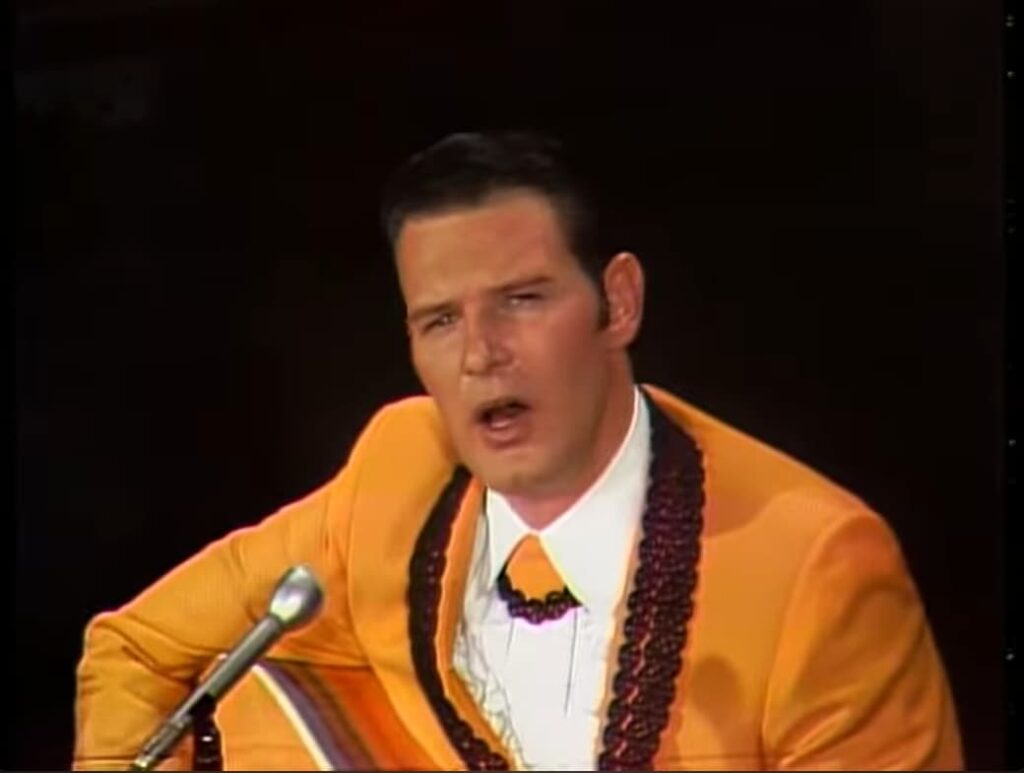
A moment of temptation held at the edge of surrender, where love is tested not by absence, but by quiet weakness
When David Houston released “Almost Persuaded” in 1966, it did not take long for the song to find its place at the very center of country music’s emotional landscape. The single rose to No. 1 on the Billboard Hot Country Singles chart, where it remained for an extraordinary nine weeks—an achievement that spoke not only to its popularity, but to its deep connection with listeners. It also crossed into the Billboard Hot 100, reaching No. 24, further confirming its wide appeal beyond the traditional country audience.
Written by Billy Sherrill and Glenn Sutton, “Almost Persuaded” is often cited as one of the defining examples of the “countrypolitan” sound—a style that blended traditional country themes with smoother, more polished production. Under Sherrill’s guidance, the song was carefully shaped to balance emotional intensity with a controlled, almost understated delivery. The result was something that felt both immediate and distant at the same time.
At its core, the song tells a simple story. A married man, away from home, finds himself on the verge of giving in to temptation. There is no dramatic confrontation, no raised voices, no clear turning point. Instead, the tension unfolds quietly, almost imperceptibly. The phrase “almost persuaded” carries the entire weight of the narrative. It is not about what happens, but about how close it comes to happening.
This restraint is what gives the song its lasting power. David Houston does not overstate the emotion. His voice remains steady, measured, as though carefully holding something back. There is a subtle vulnerability in that restraint—a sense that the struggle is internal, unresolved, and perhaps ongoing.
Musically, the arrangement reflects the evolving sound of mid 1960s country music. The instrumentation is smooth, with gentle backing vocals and a restrained rhythm section that supports rather than dominates. There is a softness to the production, yet beneath it lies a tension that never fully disappears. It is this contrast that defines the song’s atmosphere.
The success of “Almost Persuaded” extended beyond the charts. It earned David Houston a Grammy Award for Best Country & Western Vocal Performance, Male, and was named Song of the Year by both the Country Music Association and the Academy of Country Music. These accolades, while significant, only tell part of the story. The true impact of the song lies in its ability to capture a moment that feels universally understood, yet rarely spoken aloud.
There is something deeply reflective in the way the song approaches its theme. It does not judge, nor does it justify. It simply presents the moment as it is—uncertain, fragile, and deeply human. In doing so, it allows the listener to sit within that uncertainty, to recognize it without needing resolution.
Listening to “Almost Persuaded” now, there is a sense of stillness that surrounds it. The world it describes feels quieter, more contained, yet no less complex. The emotions are not heightened for effect. They are allowed to exist in their natural state, which makes them all the more powerful.
For David Houston, the song remains the defining moment of his career—a point where voice, material, and timing aligned with remarkable precision. It is not a performance built on vocal showmanship, but on control, on the ability to convey meaning without excess.
In the end, “Almost Persuaded” is not a story about betrayal. It is a story about the space just before it—the hesitation, the awareness, the fragile line between intention and action.
And in that space, David Houston finds something enduring. Not a resolution, but a truth that remains quietly present, long after the final note has faded.