
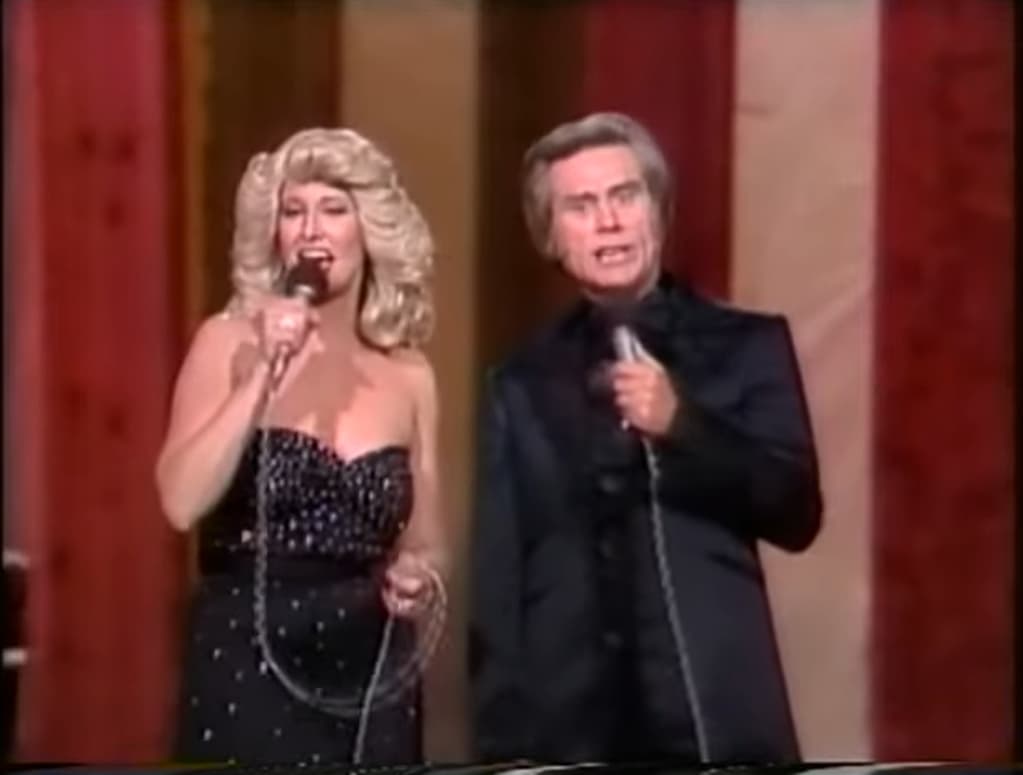
A love once broken, still echoing in every note—Tammy Wynette and George Jones turned a public reunion into something quietly personal, where history could not be erased, only remembered
On January 28, 1984, at the 41st Golden Globe Awards, the appearance of Tammy Wynette alongside special guest George Jones was more than a musical performance. It was, in many ways, a moment suspended between past and present—two voices that had once defined country music standing together again, not as husband and wife, but as something far more complicated: two people bound by history, by music, and by a story that never quite found a simple ending.
By that time, their duet “Golden Ring”—originally released in 1976—had already secured its place in country music history. The song reached No. 1 on the Billboard Hot Country Singles chart, becoming one of their most recognized collaborations. Drawn from the album “Golden Ring,” it told a simple story: a wedding band passed from hopeful beginning to quiet dissolution, and eventually back into a pawnshop display. It was a song about cycles—about love that begins with certainty and ends with silence.
But what gave “Golden Ring” its lasting weight was not just its chart success or its lyrical clarity. It was the undeniable parallel to the lives of the two people singing it. Tammy Wynette and George Jones had lived the story they were telling. Their marriage, once filled with promise, had unraveled under the pressures of addiction, absence, and emotional distance. By the time they stood together again in 1984, those wounds were no longer fresh—but they had not disappeared either.
There is something unmistakable in the way they deliver the song during that performance. The voices are still there—steady, unmistakable, carrying the same tonal richness that defined their earlier years. But there is also restraint. A kind of quiet distance that cannot be rehearsed. They do not lean into each other as they once might have. Instead, they stand side by side, connected through the music rather than through anything else.
And yet, that distance becomes part of the performance itself. Because “Golden Ring” was never meant to be sung as a celebration. It was always a reflection—a look back at something that once felt permanent. When Tammy Wynette delivers her lines, there is a softness that suggests acceptance rather than regret. When George Jones responds, there is a weight in his phrasing, as if each word carries more than just the story of the song.
For those who had followed their journey, the performance carried an additional layer of meaning. It was not simply about revisiting a successful duet. It was about witnessing two people who had moved through love, loss, and separation, finding a way to stand together again—if only for a few minutes, if only within the boundaries of a song.
In the broader landscape of country music, “Golden Ring” remains one of the most honest portrayals of a relationship ever recorded. There are no grand gestures, no dramatic resolutions. Just a beginning, a middle, and an end. And in that simplicity lies its truth. Not every love story is meant to last. Some are meant to be remembered.
The 1984 Golden Globe appearance does not attempt to rewrite that truth. If anything, it reinforces it. There is no effort to recreate what once was. No attempt to suggest that time has undone the past. Instead, there is an understanding—quiet, unspoken—that some things remain exactly as they are, no matter how much time passes.
And perhaps that is why the performance lingers. Not because it offers closure, but because it does not. It allows the story to remain open, unresolved, just as it was in real life.
When the final notes fade, what remains is not just the memory of a song, but the feeling of something once shared, now carried separately. And in that space between what was and what is, Tammy Wynette and George Jones leave behind something more enduring than harmony—an honesty that does not need to be explained, only felt.