
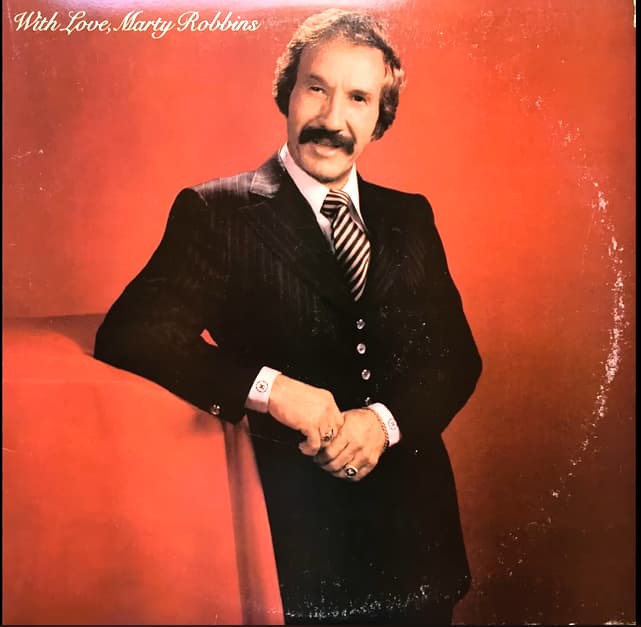
El Paso City — a haunting echo of a past life’s regret, carried on the wings of memory.
When I listen to El Paso City, by Marty Robbins, I sense a quiet, wistful longing — as though the very air above the skyline of El Paso trembles with ghosts of a story unfinished. Released on March 19, 1976 as the title track of the album El Paso City, the song soared to become Robbins’s 15th No. 1 on the U.S. country singles chart, staying atop for two weeks and lingering on the charts for 11 weeks.The album itself would go on to reach No. 1 on the country album chart and remain there for 28 weeks.
It is remarkable that a man so deeply associated with his signature Western ballad from 1959 — the epic El Paso — could return nearly two decades later and renew that legend not with brash novelty, but with a softer, spectral re-imagining. Indeed, El Paso City is not merely a sequel: it is a meditation, an invocation. Robbins wrote it during a flight over El Paso — reportedly in precisely the amount of time it takes to sing the song (roughly four minutes and fourteen seconds). The lyrics do not plunge us once more into the gunfights and desperate love of the cowboy and Feleena. Instead, they place us in the cabin of a moving airplane, soaring above the dusty land — and yet the past unfurls in memory, as vivid and persistent as the desert wind.
In El Paso City, the narrator — hearing a familiar melody “long ago” — is overwhelmed by déjà vu. He questions whether he might actually be the very cowboy from Robbins’s earlier saga: “Could it be that I could be the cowboy in this mystery,” he wonders. The arrangement itself subtly weaves in riffs and themes from “El Paso” and its companion ballad (the 1966 “Feleena (From El Paso)”), creating a ghostly bridge between past and present.
There is a deep poignancy in that choice. For a listener who first encountered “El Paso” — perhaps on a vinyl spinning slowly in a smoky living room, or over a crackling radio speaker — El Paso City emerges not as a bold re-imagining, but as a haunted reflection. The gunshots and desperation of the original are gone; in their place is a sorrowful nostalgia, the ache of a life that might have been, and the bittersweet suggestion that some souls wander eternal, bound by memory as much as fate.
Beyond the music, the timing adds meaning. By 1976, Robbins was no longer a young troubadour but a veteran whose catalogue spanned decades. That he returned to the El Paso story then — as though revisiting an old wound, tender and unhealed — speaks volumes. The success of the single, launching straight to No. 1, seems almost like an audience embracing not just a melody, but a shared memory: of longing, of loss, of the passage of time.
For the older listener — the one whose own memories spin alongside these songs — El Paso City may awaken long-buried emotions: the wistfulness of youth, the sadness of time lost, the enduring hope that love, memory, identity transcend lifetimes. It doesn’t thunder or gallop. Instead, it drifts: like dust in desert wind, like the faint echo of a ballad heard long ago, or the soft rustle of the wings of a migrating bird.
In that drifting lies its power. El Paso City is not merely a sequel, not simply a hit single. It is a hymn to memory, an elegy for a love and a life that might exist beyond time — carried in the voice of Marty Robbins, rich and resonant, as if he sings not just with lungs, but with the heart of the desert itself.