
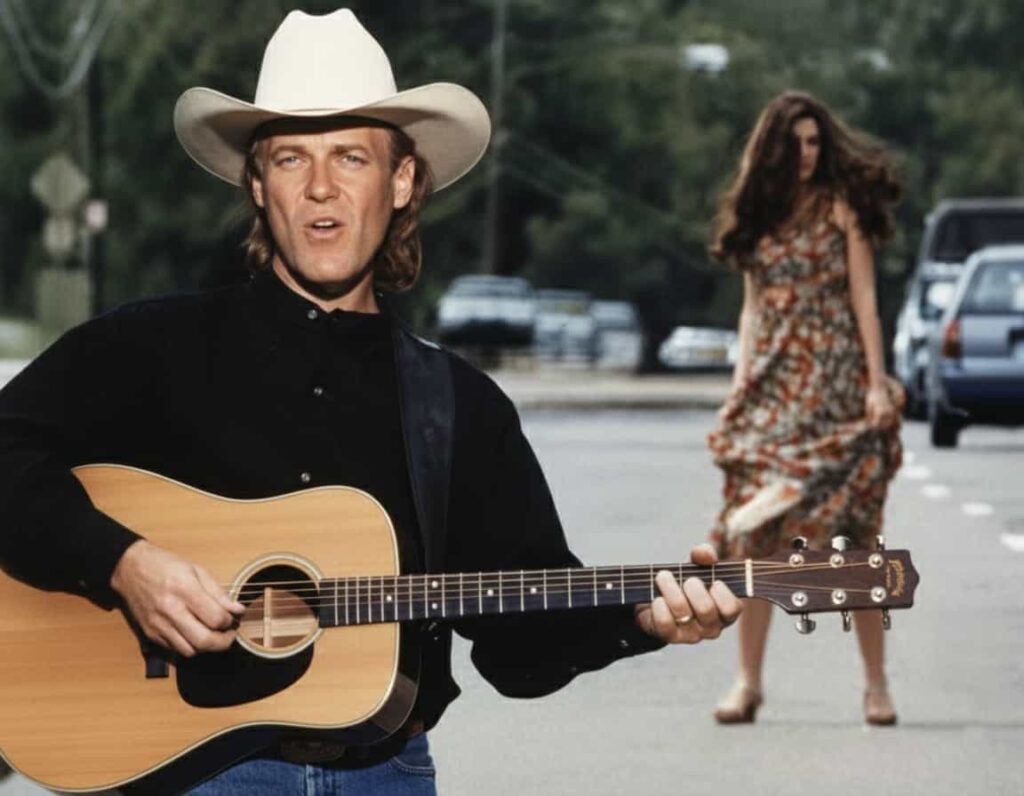
Wherever She Is — a wistful echo of love that lingers, no matter how far she wanders
When Ricky Van Shelton released Wherever She Is in 1994 as the lead single from his album Love and Honor, it quietly slipped into the U.S. country charts peaking at #49 on the Billboard Hot Country Singles chart.
Though it did not become a major hit, the song bears emotional weight. Written by songwriters James House and John Jarrard, “Wherever She Is” painted a portrait of longing and loss a man speaking to the empty spaces where his beloved once stood, haunted by memories, yet holding onto the hope that “wherever she is,” she still carries his heart.
“Wherever She Is” appears on Love and Honor, the final album Ricky released under the label Columbia Records. Notably, this album marked a change in his creative team: it was his first not produced by his longtime collaborator, producer Steve Buckingham. Instead, production went to Blake Chancey and Paul Worley a shift that contributed to a different sonic direction.
It is worth reflecting on this change and what it symbolized at that moment of Shelton’s career. By 1994, a few years after his string of chart-topping successes in the late 1980s and early 1990s, Ricky was entering a slightly quieter phase. His earlier singles songs like “Somebody Lied,” “I Am a Simple Man,” or “Living Proof” had resonated widely, many reaching #1.
“Wherever She Is,” in contrast, arrived with a hush rather than a fanfare. Its modest chart position may suggest it wasn’t embraced by radio or commercial country audiences as strongly as his earlier works. Yet there is something deeply poignant in that very softness: it doesn’t crowd the listener; instead, it offers a space for reflection. For someone past youth, for someone who has lived and loved and lost, the gentle ache embedded in the melody becomes almost a companion.
Listening now, decades later, one can almost hear the echoes of dusty highways, the low hum of a pickup truck’s engine on a lonely road, and the silent ache of a heart waiting for return, for closure, or perhaps for acceptance. The lyrics sketch a woman with “deep blue eyes,” a “Tennessee drawl,” an “innocent face” all evoking a sense of rural simplicity and an almost naïve charm. Then, he confesses how she “disappeared in the dark,” leaving him not with anger, but sorrow, confusion, and an enduring love.
That emotional landscape love lost, memories cherished, longing unending resonates especially with those who have lived through similar quiet heartbreaks. Perhaps not dramatic, not explosive, but real. It’s the kind of love that lingers at dusk, when the day fades and the mind wanders the kind of love that doesn’t come with closure but with gentle sorrow and acceptance.
In the broader arc of Ricky Van Shelton’s career, “Wherever She Is” may not stand as his greatest commercial triumph. But it reveals a different facet of the man: not the powerful baritone that dominates honky-tonk dance floors, not the radio-friendly singalong but the vulnerable soul of a storyteller. A man who knows that sometimes love isn’t about holding on or winning back, but simply letting memory carry the weight, and letting the heart remember.
For older listeners, those who have loved and lost, who have longed and waited, this song may act as a gentle companion a melody to sit with over a cup of something warm, a memory to hold close on a quiet evening. “Wherever she is,” the song whispers “she still has my heart.”
If you like, I can write a second version of this introduction in a more nostalgic, reflective style perhaps even with a little more detail about the era 1990s country music context.
 Music Legend