
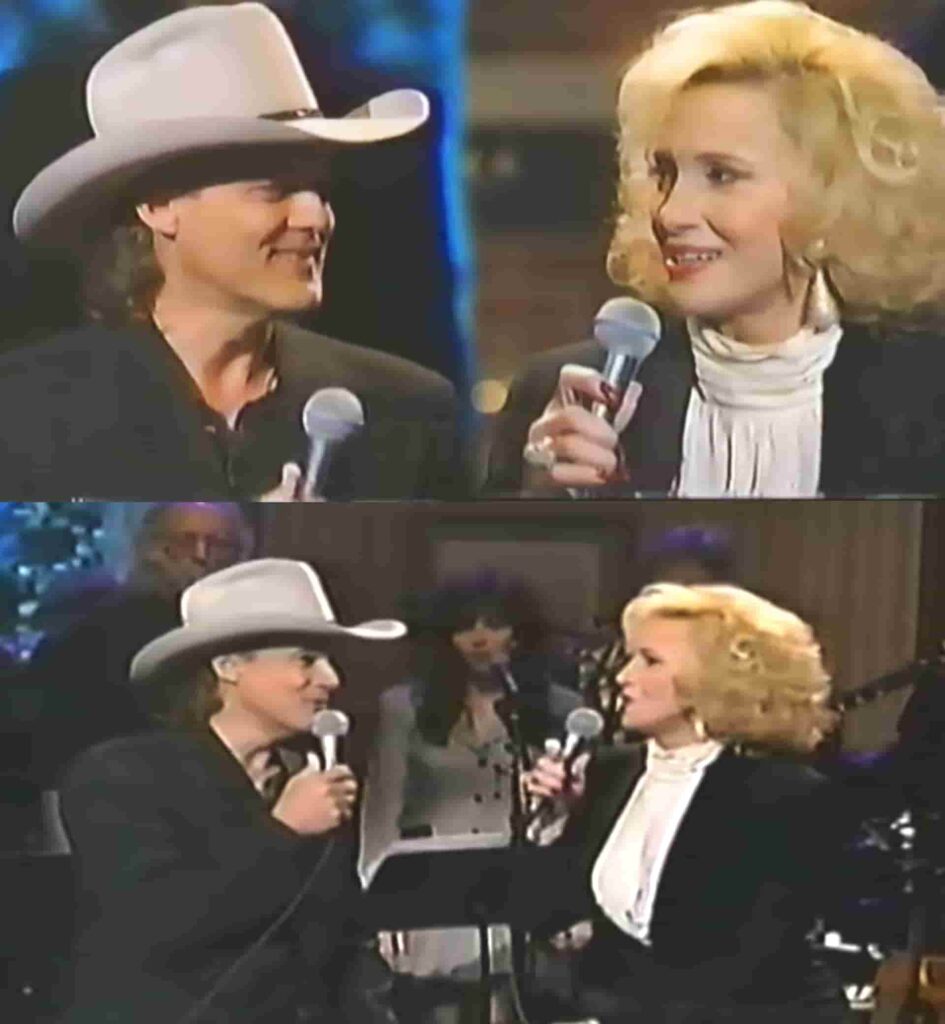
A Quiet Promise of Devotion, Where Two Country Voices Meet Memory and Grace
Few country songs understand the power of closeness as profoundly as “Near You.” In its essence, this is not a song about passion in its loudest form, but about presence, loyalty, and the unspoken comfort of simply being beside someone through time. When Ricky Van Shelton and Tammy Wynette performed “Near You” together on May 11, 1995, on the TNN television special Tammy Wynette and Friends, the moment felt less like a performance and more like a shared recollection gently offered to the audience.
Originally written by Francis Craig and Kermit Goell, “Near You” first found success in 1947 when the Francis Craig Orchestra took it to No. 1 on the Billboard charts. Yet the version that reshaped its legacy for country music arrived forty years later. In 1987, Tammy Wynette recorded “Near You” for her album Higher Ground, released by Epic Records. Against expectations in an era increasingly driven by slick production and youthful energy, the song climbed to No. 1 on the Billboard Hot Country Singles chart, becoming one of the defining late-career triumphs of her life. That chart position mattered, not as a statistic, but as confirmation that sincerity still resonated deeply.
By the time of the 1995 duet, Tammy Wynette was no longer simply a hitmaker. She was an institution. Her voice carried decades of lived experience, public heartbreak, resilience, and quiet dignity. Ricky Van Shelton, meanwhile, had already stepped away from the peak of his recording career. In the late 1980s and early 1990s, he had been one of country music’s most reliable traditionalists, earning multiple No. 1 hits and building a reputation for emotional restraint rather than showmanship. His presence beside Wynette was understated, respectful, and deeply aware of the song’s emotional weight.
What makes this duet extraordinary is how little it tries to impress. There is no vocal competition, no attempt to modernize the arrangement, and no dramatic reinterpretation. Instead, the performance leans into the song’s original meaning. “Near You” speaks of love as constancy rather than excitement. The lyrics revolve around a single idea. Happiness is found not in distance or ambition, but in closeness. It is a sentiment that gains power with age, as time teaches that endurance often matters more than intensity.
In this performance, Tammy Wynette sings with a voice shaped by survival. There is fragility, but also steadiness. Each line feels measured, as though chosen carefully from memory rather than rehearsed. Ricky Van Shelton responds with restraint, allowing space instead of filling it. His harmony does not overshadow. It supports. That balance gives the duet its emotional authority.
The television setting matters as well. Tammy Wynette and Friends was not designed as a spectacle. It was a gathering. The TNN audience understood these artists not as celebrities, but as companions through decades of listening. When “Near You” unfolds on that stage, it becomes a shared reflection on loyalty, companionship, and the quiet agreements made over a lifetime.
The meaning of “Near You” lies in its refusal to dramatize love. It does not promise perfection or permanence without effort. Instead, it offers something simpler and harder earned. The comfort of being close. The relief of not being alone. The reassurance that someone remains, even when the world shifts.
In retrospect, this duet stands as a gentle marker in country music history. It connects the postwar popular song tradition, the classic Nashville sound, and the neotraditional revival of the late twentieth century in a single, unhurried moment. More importantly, it reminds us that the most enduring songs do not shout their importance. They wait patiently, confident that their truth will be recognized by those who have lived long enough to understand it.
In that sense, Ricky Van Shelton and Tammy Wynette did not merely perform “Near You.” They bore witness to it.
 Music Legend