
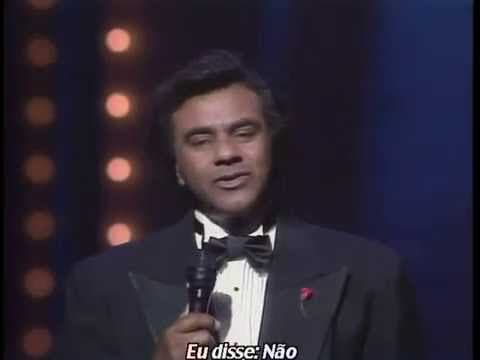
A quiet stand against temptation where restraint becomes its own form of heartbreak
Released in 1957, I Said No arrived at a crucial early moment in the career of Johnny Mathis, when his voice was beginning to redefine what intimacy in popular music could sound like. Issued as a single during the same breakthrough period that brought him national attention, the song reached number 69 on the Billboard Hot 100, a modest chart position that belied its emotional depth. While it never became one of his most commercially celebrated hits, I Said No remains an important piece of the emotional architecture that shaped Johnny Mathis as an artist whose greatest strength lay not in spectacle, but in sincerity.
By the late 1950s, Johnny Mathis was emerging as a singular presence in American popular music. His voice carried a softness that stood apart from the bravado of rock and roll and the theatrical polish of traditional pop. There was an inward quality to his singing, as though each song was being spoken to one person rather than a crowd. I Said No fits squarely within this sensibility. It is not a song about dramatic betrayal or public confrontation. Instead, it centers on a private moral moment, a decision made quietly, and the emotional cost that follows.
The story told in I Said No is deceptively restrained. The narrator faces temptation, an invitation to cross a line that would offer immediate comfort or desire. He refuses. The title itself is stark and final, yet the song makes clear that saying no does not bring peace. Instead, it brings longing, doubt, and a lingering sense of loss. This tension gives the song its power. The refusal is not heroic. It is human. It suggests that doing the right thing can still leave behind an ache that does not easily fade.
What makes I Said No especially compelling is how Johnny Mathis delivers this emotional conflict. His vocal approach is gentle and controlled, never pushing the drama beyond what the story requires. There is a vulnerability in his phrasing that suggests the decision was not easy and still weighs heavily on him. He does not sound triumphant. He sounds reflective, as though replaying the moment in his mind, wondering what might have happened had he chosen differently.
Musically, the arrangement mirrors this emotional restraint. The orchestration is subtle, allowing space around Mathis’s voice rather than crowding it. The melody moves slowly, almost cautiously, reinforcing the idea of hesitation and careful thought. There are no sharp turns or sudden crescendos. Everything about the song feels measured, as if the music itself understands the gravity of a choice that cannot be undone.
In the context of Johnny Mathis’s early recordings, I Said No reveals an artist already drawn to emotional nuance. While many songs of the era leaned heavily into clear moral lessons or sweeping romantic declarations, this song occupies a gray area. It acknowledges that restraint can be painful, that integrity does not erase desire. This honesty set Mathis apart and helped establish the emotional credibility that would define his later classics.
Although I Said No did not dominate the charts, its presence during Mathis’s formative years mattered. It contributed to a body of work that trusted listeners to appreciate subtlety. Over time, songs like this helped build his reputation as a singer who respected silence as much as sound, and understatement as much as passion.
Listening to I Said No today feels like revisiting a moment of quiet resolve, one that many recognize not because it was dramatic, but because it was real. The song captures that lingering pause after a difficult choice has been made, when the world moves on but the heart remains still. In giving voice to that pause, Johnny Mathis created a song that continues to resonate, not as a declaration, but as a confession.
I Said No stands as a reminder that some of the most lasting songs are not the loudest or the most celebrated. They are the ones that tell the truth softly, trusting that those who hear them will recognize their own reflections in the silence between the notes.