
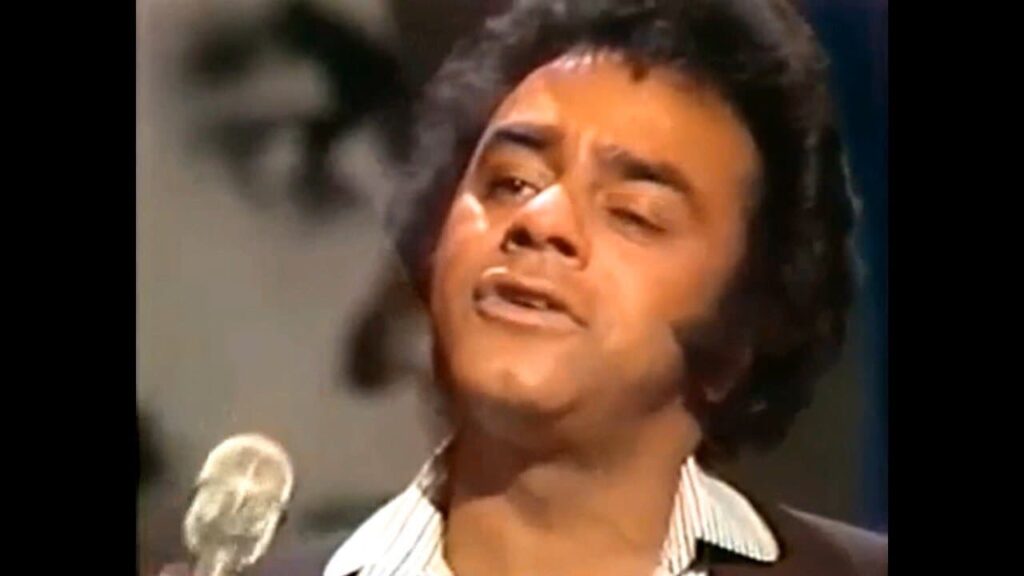
A timeless longing for hope and escape, carried gently by a voice that understands yearning better than spectacle
When Johnny Mathis recorded Over the Rainbow, he was not attempting to compete with history. By the time his version appeared, the song had already become one of the most sacred standards in American popular music, forever linked to Judy Garland and The Wizard of Oz. Mathis approached it differently. He did not try to reinterpret its legacy. He simply stepped inside it, trusting restraint, tone, and emotional patience to do what excess never could.
Over the Rainbow appeared on Johnny Mathis’s 1958 album Open Fire, Two Guitars, a concept record arranged by Johnny Mandel that placed Mathis’s voice against a warm, cinematic backdrop of layered guitars. While the song was not released as a standalone single and therefore did not chart independently on the Billboard Hot 100, the album itself was a significant success. Open Fire, Two Guitars reached the Top 5 on the Billboard Pop Albums chart and became one of the defining records of Mathis’s early career, helping solidify his reputation as a singer of rare emotional control and elegance.
By the late 1950s, Johnny Mathis was already a dominant presence in popular music. Hits like Chances Are and It’s Not for Me to Say had placed him at the center of a new kind of romantic pop, one built not on bravado but on vulnerability. His decision to record Over the Rainbow felt natural within that context. This was a singer whose entire artistic identity revolved around longing, tenderness, and the quiet spaces between notes.
The song itself, written by Harold Arlen and E. Y. Harburg in 1939, has always been about more than fantasy. Beneath its imagery of blue skies and distant horizons lies a deeply human ache for belonging and peace. It was written at a time of global uncertainty, and that emotional undercurrent has never faded. Each generation hears its own unspoken desires within its melody.
Mathis’s interpretation honors that emotional lineage. His vocal delivery is measured and unhurried, almost conversational. He resists dramatic crescendos, choosing instead to let the melody unfold naturally. The phrasing feels intimate, as if the song were being sung to one person rather than a room. There is no sense of performance for effect. Every note sounds considered, held just long enough to register feeling, then released.
The arrangement on Open Fire, Two Guitars plays a crucial role in shaping this mood. The guitars shimmer softly, creating a sense of distance and space, like light reflected across water. This instrumental choice removes the song from theatrical settings and places it somewhere quieter, more reflective. It becomes less about spectacle and more about memory.
What gives Johnny Mathis’s Over the Rainbow its lasting resonance is not technical perfection, though his technique is impeccable. It is emotional clarity. His voice carries no irony, no attempt to modernize or reinvent. Instead, it accepts the song’s vulnerability fully. The hope expressed here is fragile, aware that dreams are not guarantees. That awareness makes the longing feel earned.
Within Mathis’s broader catalog, this recording stands as a quiet pillar. It reflects his lifelong commitment to emotional honesty over trend chasing. While many singers approached standards as showcases, Mathis treated them as conversations with the past. He understood that songs like Over the Rainbow survive not because they are impressive, but because they remain open enough to receive new meaning with each listening.
Over time, Mathis would return to the song in live performances, each time allowing it to age alongside him. Yet the 1958 recording remains special because it captures his voice at a moment of luminous balance, youthful but already reflective, hopeful but grounded.
Listening to Over the Rainbow as sung by Johnny Mathis feels like standing still while the world moves gently around you. It does not promise arrival. It offers solace in the act of imagining. In that way, his version remains profoundly human, reminding us that some dreams endure not because they are fulfilled, but because they are quietly carried forward, note by note, year by year.