
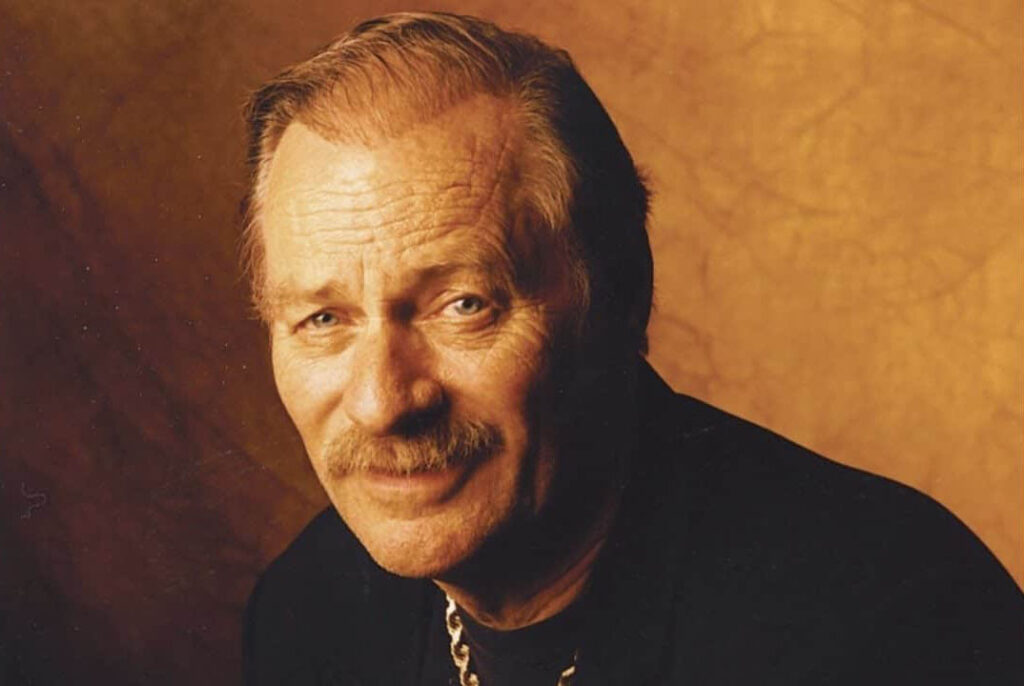
A Song Where Grief Is Not Performed but Lived, and Love Is Remembered Through Silence
On April 28, 2009, country music quietly lost one of its most truthful voices when Vern Gosdin passed away at the age of 74. There was no spectacle attached to his legacy, no larger than life mythmaking. What remained was something rarer and more enduring: a body of work that spoke plainly about love, regret, loneliness, and the emotional cost of living honestly. Known widely as “The Voice of Broken Hearts”, Gosdin occupied a singular place in country music, and no song defines that place more clearly than “Chiseled in Stone.”
Released in 1988 as the title track of the album Chiseled in Stone, the song reached No. 6 on the Billboard Hot Country Singles chart upon its release. Commercial success, however, tells only a fraction of the story. In 1989, “Chiseled in Stone” was awarded Song of the Year by the Country Music Association, a rare honor for a song so understated, so resistant to polish or theatrical sentiment. Its impact came not from clever turns of phrase, but from emotional restraint and devastating clarity.
The story behind the song is as grounded as the performance itself. Written by Max D. Barnes and Vern Gosdin, the lyric unfolds as a conversation between two men in a bar. One is drowning in fresh heartbreak, convinced that his pain is unmatched. The other listens quietly, then offers a simple line that changes everything: he lost his wife, and her name is chiseled in stone. In that moment, romantic sorrow is placed beside permanent loss. The song does not diminish heartbreak, but it contextualizes it. Love lost through separation still breathes. Love lost through death becomes memory, carved into time.
What made Vern Gosdin uniquely suited to deliver this song was his refusal to dramatize pain. His voice carried weight without force. He sang as if he were remembering rather than performing, letting pauses speak as loudly as words. The production on Chiseled in Stone reflects that philosophy. Sparse instrumentation, restrained tempo, and a vocal mix that feels close and unguarded. Nothing distracts from the story. Nothing softens the truth.
By the late 1980s, country music was increasingly shaped by crossover ambitions and brighter surfaces. Gosdin moved in the opposite direction. He sang about divorce, regret, late night realizations, and the emotional residue that love leaves behind. Songs like “I Can Tell by the Way You Dance”, “Is It Raining at Your House”, and “Set ’Em Up Joe” reinforced his identity as a singer who understood the quiet aftermath of relationships rather than their beginnings. “Chiseled in Stone” stands at the center of that identity.
The song’s meaning has only deepened with time. It speaks to the way grief reshapes perspective, how some losses teach patience rather than anger, and how love does not vanish when it ends. It settles. It hardens. It becomes part of who we are. There is no bitterness in the song’s conclusion, only acceptance and humility. Pain is not denied, but it is no longer competing for attention.
When Vern Gosdin died in 2009, tributes focused less on chart statistics and more on emotional truth. Artists and listeners alike recognized that his work had offered companionship in moments when words were difficult to find. “Chiseled in Stone” remains his most enduring statement, not because it demands to be remembered, but because it mirrors real life too closely to forget.
In a genre often tempted by excess, this song endures through restraint. It does not ask for sympathy. It offers understanding. And in doing so, it reminds us that the deepest songs are not written to impress, but to endure.
 Music Legend