
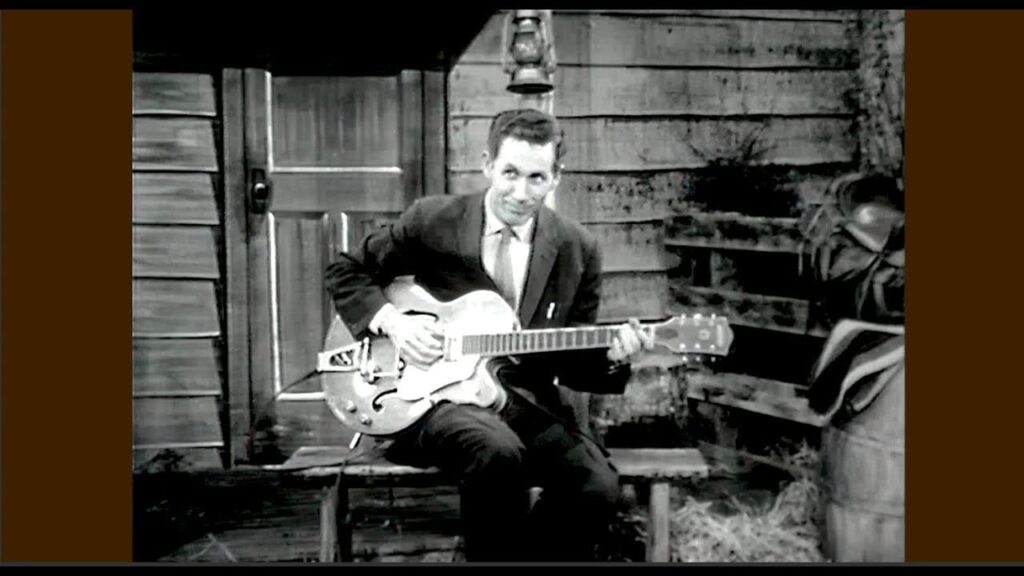
A timeless instrumental journey where virtuosity meets quiet reflection, capturing the restless spirit of American roots music without a single spoken word.
Chet Atkins and “Black Mountain Rag” occupy a singular place in the history of American instrumental music, not because of chart dominance, but because of enduring influence. When Atkins recorded “Black Mountain Rag” in 1949 for RCA Victor, the piece did not appear on the mainstream Billboard pop charts. Instrumental guitar recordings rarely did at the time. Yet its cultural reach would far outgrow any numerical ranking. What Atkins achieved with this performance quietly reshaped the language of country guitar, setting a standard that generations of musicians would study with reverence.
Originally composed by fiddler Leslie Keith “Lesh” White in the early twentieth century, “Black Mountain Rag” had long been part of Appalachian fiddle tradition before Atkins touched it. By the time it reached his hands, it was already a well traveled tune, passed along through dance halls, radio barn dances, and front porch sessions. Atkins transformed it from a rustic fiddle showcase into a refined guitar statement, blending folk roots with technical elegance in a way that felt effortless, even understated.
At the heart of “Black Mountain Rag” is movement. The melody travels like a winding road through hills and valleys, never settling too long in one place. Atkins approach was neither aggressive nor showy. Instead, he employed his signature fingerstyle technique, later known as the Atkins picking style, allowing melody, rhythm, and harmony to coexist in a single performance. This balance was revolutionary. It suggested that the guitar could speak in complete sentences, not merely fragments.
By the late 1940s, Chet Atkins was emerging as a defining figure in country music, both as a performer and as a visionary. His work at RCA would eventually help shape what became known as the Nashville Sound. Yet “Black Mountain Rag” belongs to an earlier chapter, when Atkins was still rooted in traditional forms, listening closely to the past while quietly nudging it forward. The recording reveals a young artist already in full command of his voice, even if that voice spoke through strings rather than lyrics.
The meaning of “Black Mountain Rag” lies in its emotional openness. Without words, it invites listeners to bring their own memories to the melody. There is joy in its bounce, longing in its turns, and a sense of perseverance woven into its rhythm. Atkins never rushed the tune. Each note feels placed with care, as though he understood that silence between notes mattered just as much as sound. This restraint gave the piece a reflective quality that transcended its origins as a dance tune.
Though it never occupied a numbered chart position, “Black Mountain Rag” became a rite of passage for guitarists. From country pickers to jazz stylists, countless musicians have attempted to capture its balance of clarity and warmth. Few succeed without acknowledging Atkins influence. His version remains the benchmark, not because it is the fastest or loudest, but because it feels complete.
The recording also reflects a broader moment in American music. Postwar audiences were rediscovering roots traditions while embracing new technical possibilities. Atkins stood at that intersection. He respected tradition deeply, yet he refused to be limited by it. “Black Mountain Rag” is evidence of that philosophy. It honors the fiddle heritage of the tune while presenting it through a modern guitar voice that felt both familiar and quietly forward looking.
Listening today, the piece carries a sense of calm confidence. There is no need for dramatic flourish. The beauty lies in its steadiness, its gentle swing, and the assurance that the melody will always find its way home. In a career filled with accolades and innovations, “Black Mountain Rag” remains one of Chet Atkins most revealing recordings. It shows an artist who understood that true mastery often speaks softly, trusting that those who listen closely will hear everything that needs to be said.