
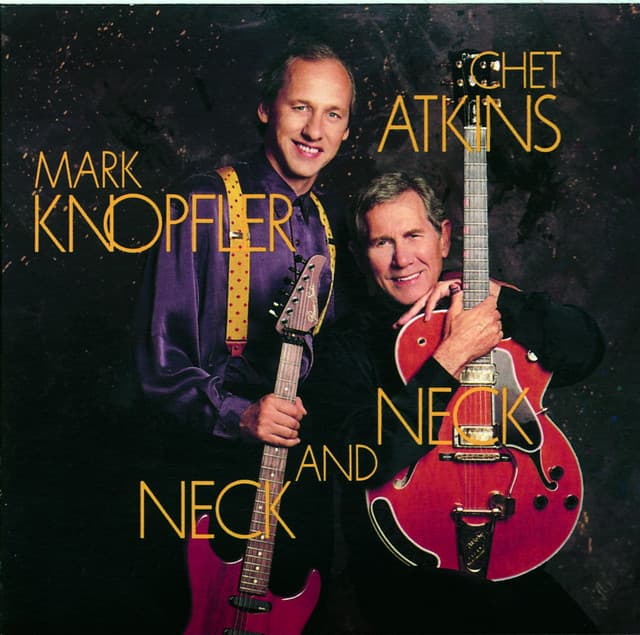
A masterful dialogue of strings — where two guitar legends speak without words, yet say everything
When Mark Knopfler & Chet Atkins joined forces for the instrumental collaboration often referred to as the “Instrumental Medley” from their 1990 album Neck and Neck, it was far more than a meeting of two virtuosos. It was a conversation between generations, between continents, between two philosophies of guitar playing that somehow felt destined to meet. Released in October 1990, Neck and Neck climbed to No. 27 on the Billboard 200 in the United States and reached No. 5 on the UK Albums Chart, a remarkable achievement for a largely instrumental record built around subtlety rather than spectacle.
By that time, Chet Atkins had long been established as the architect of the Nashville Sound — a refined, polished approach that reshaped country music in the late 1950s and 1960s. His fingerstyle technique was pristine, controlled, elegant. Across the Atlantic, Mark Knopfler, best known as the frontman of Dire Straits, had already carved out a distinct voice in rock music with his fluid, fingerpicked electric guitar style. Though separated by age and genre, Knopfler had always cited Atkins as a profound influence. Their collaboration felt less like a novelty and more like a long-overdue handshake.
The Instrumental Medley encapsulates the spirit of that album: a seamless weaving of country standards, swing-inflected passages, and melodic improvisation. While the album features standout tracks such as “Poor Boy Blues” and “When I Am Sixty-Four,” the medley format allowed both artists to showcase their ability to listen as much as to play. There is an almost courtly politeness in the way they trade phrases — one offering a melodic line, the other responding with a gentle harmonic embellishment. It is not a duel; it is a duet in the truest sense.
The story behind Neck and Neck began with mutual admiration. Knopfler had reached out to Atkins years earlier, and what started as correspondence gradually evolved into sessions in Nashville. The recording atmosphere was reportedly relaxed, intimate, and free of ego. That ease is palpable in the music. There are no overproduced layers, no grand studio theatrics — just two guitars, two sensibilities, and decades of accumulated musical wisdom.
What makes the medley so resonant is its restraint. In an era when guitar heroics often leaned toward volume and speed, this collaboration leaned toward nuance. Atkins’ thumb maintains a steady bass foundation while his fingers articulate crystalline melodies. Knopfler, known for his expressive vibrato and lyrical phrasing, adapts beautifully to Atkins’ disciplined precision. Together, they create something balanced — a meeting point between American country sophistication and British blues-inflected storytelling.
Listening now, the emotional power lies not in dramatic crescendos but in the quiet assurance of craftsmanship. The medley format suggests continuity — musical themes flowing into one another, much like memories stitched together over time. Each passage carries echoes of earlier eras: the dance halls, the radio broadcasts, the front-porch picking sessions. Yet it never feels antiquated. Instead, it feels timeless, as though the guitars are preserving something precious before it fades.
There is also a subtle poignancy in the collaboration itself. Chet Atkins, already in the later stage of his storied career, brings a lifetime of discipline and refinement. Mark Knopfler, at the height of his international fame, approaches with humility and reverence. The dynamic feels symbolic — the torch not passed, but shared. And in that sharing, something enduring is created.
Critically, Neck and Neck was warmly received, particularly among musicians who recognized the technical brilliance at work. It later earned a Grammy Award for Best Country Instrumental Performance, underscoring the industry’s recognition of its artistry. Yet beyond awards and chart positions, what lingers is the mood: unhurried, generous, reflective.
The Instrumental Medley reminds us that music does not always need lyrics to convey history, affection, and mutual respect. Sometimes the truest dialogue happens in the spaces between notes — in the soft brush of steel strings and the gentle pulse of a thumb on bass strings.
As the final harmonics shimmer and fade, one senses not an ending but a quiet affirmation: that craftsmanship, humility, and genuine admiration can create something far greater than virtuosity alone. It is the sound of two masters listening to each other — and in doing so, inviting us to listen more closely as well.