
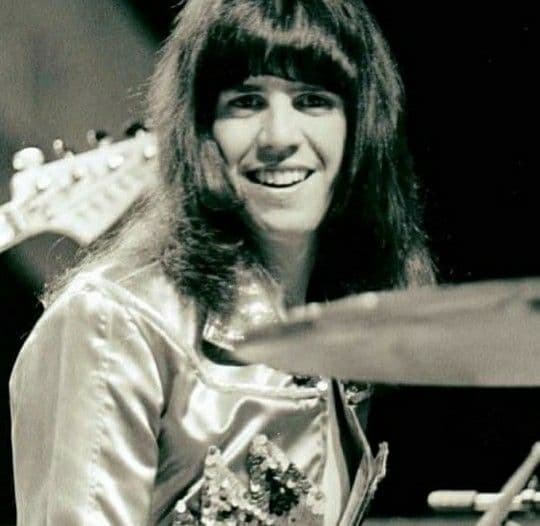
A thunderous salute to rhythm itself where drums speak louder than words and precision becomes poetry
When discussing the great drummers of 1970s rock, the name Mick Tucker deserves to be spoken with a particular kind of reverence. Best known as the powerhouse behind the British glam rock band Sweet, Tucker was not merely a timekeeper — he was a showman, a technician, and a musician whose instrument could command the stage. Among his most celebrated live moments was his explosive drum solo rendition of “The Man with the Golden Arm.”
Originally, “The Man with the Golden Arm” was composed by Elmer Bernstein as the theme for the 1955 film of the same name starring Frank Sinatra. The composition, driven by its dramatic jazz rhythm and urgent percussion, became a standard for drummers seeking to demonstrate both speed and control. It was not a charting single for Mick Tucker, nor was it a studio release under his name. Rather, it lived primarily in concert halls — especially during Sweet’s peak touring years in the early to mid-1970s — where it became a centerpiece of their live performances.
By the time Sweet reached international fame with hits like “Ballroom Blitz” (UK No. 2 in 1973) and “Fox on the Run” (UK No. 2 in 1975), Tucker had already built a reputation for his dramatic, extended drum showcases. His interpretation of “The Man with the Golden Arm” was often performed during live shows as a virtuosic solo segment, sometimes lasting several minutes. It allowed audiences to witness not just volume and spectacle, but astonishing dexterity.
Tucker’s performance was not a simple replication of Bernstein’s jazz composition. He reimagined it through the lens of glam rock energy. With double bass drums, rapid-fire snare rolls, thunderous tom fills, and precisely executed cymbal crashes, he transformed the piece into a rhythmic storm. Yet beneath the bombast was discipline. Tucker had a deep respect for swing and jazz phrasing, and that influence could be heard in the syncopation and subtle dynamic shifts throughout the solo.
There is something almost theatrical about watching archival footage of Mick Tucker performing this piece. His posture was upright, focused, rarely indulgent in exaggerated movements. Unlike some contemporaries who relied on flash, Tucker’s drama came from control. Every strike had intention. Every crescendo felt earned. The solo would often build from tight, intricate snare patterns into a full-bodied percussive eruption, leaving audiences stunned not simply by loudness, but by structure.
The emotional weight of “The Man with the Golden Arm” in Tucker’s hands lies in its symbolism. In the original film, the music underscored themes of struggle and tension. In concert, Tucker’s solo became a celebration of mastery — a declaration that rhythm itself could carry narrative power. It was a reminder that rock music, for all its guitars and flamboyant costumes, rests upon the heartbeat of the drums.
During the 1970s, when rock concerts were becoming grand spectacles, drum solos were often expected. Yet many were indulgent interludes. Tucker’s performance stood apart because it felt composed, almost architectural. It had beginning, development, and climax. The audience could sense the journey. There was anticipation in the quieter passages and exhilaration in the explosive peaks.
In hindsight, Tucker’s interpretation of “The Man with the Golden Arm” represents a bridge between jazz heritage and rock modernity. He paid homage to the technical rigor of big band drumming while infusing it with the raw energy of arena rock. It reflected an era when musicianship mattered deeply, when instrumental skill could command as much admiration as vocal hooks.
Today, revisiting those performances brings back the atmosphere of packed venues, dimmed lights, and the collective hush before the first drum strike. It recalls a time when a single musician, armed only with sticks and skins, could hold thousands in breathless attention.
Mick Tucker’s solo on “The Man with the Golden Arm” endures not because it topped charts, but because it showcased something rarer — the artistry of rhythm elevated to storytelling. It reminds us that behind every unforgettable rock anthem lies a pulse, steady and fierce, guided by hands that understood both power and restraint.