
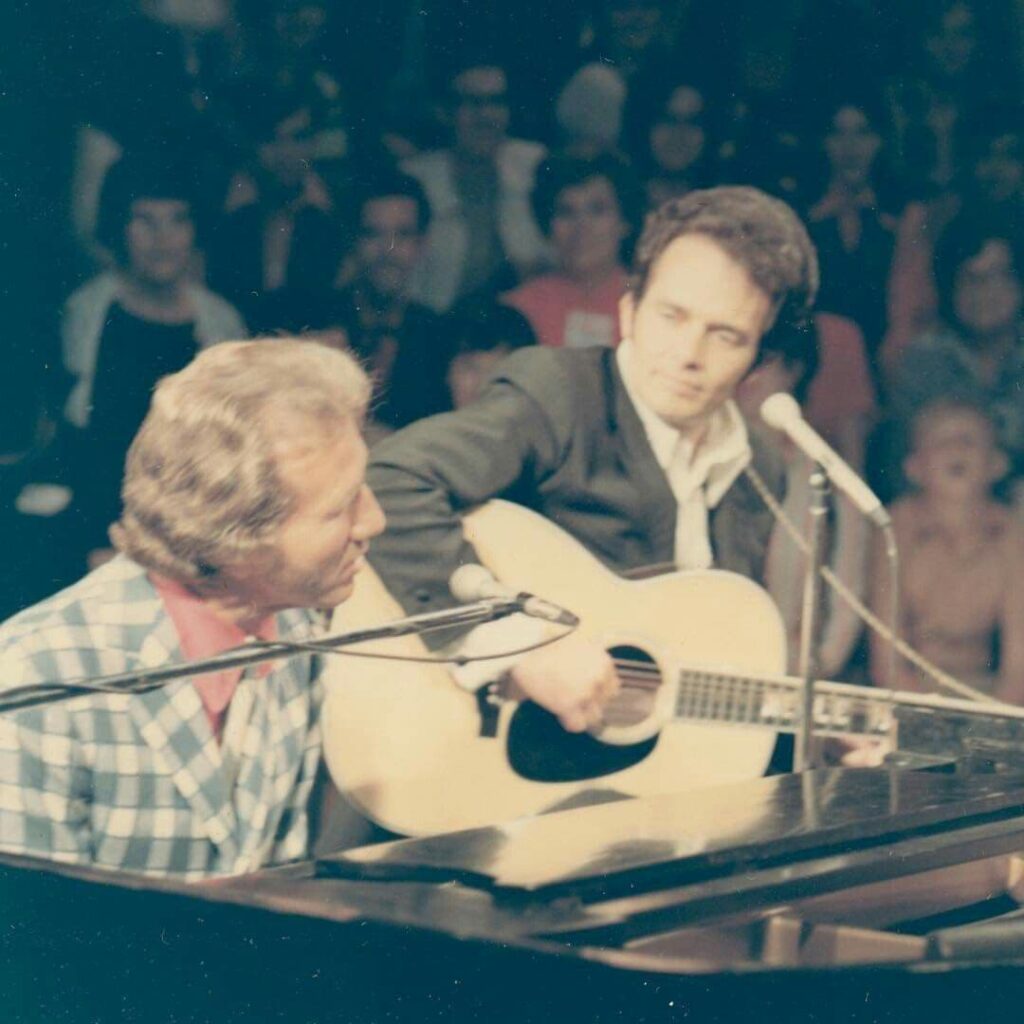
Merle Haggard & Marty Robbins – Devil Woman: A Timeless Duel of Two Legends Under the Spell of Temptation
For those of us who have walked the long, winding road of country music history, the mere mention of Marty Robbins and Merle Haggard together feels like a gathering of titans. While Marty Robbins originally immortalized “Devil Woman” in 1962—sending it soaring to number 1 on the Billboard Hot Country Songs chart where it reigned for eight weeks—the song took on a haunting new life through the various collaborations and tributes shared between him and The Hag. This composition represents the pinnacle of the “Darker Side of Love” balladry, a song that captured the struggle between the domestic hearth and the siren call of the unknown. It is a track that resonates with anyone who has ever felt the tug-of-war between duty and desire, a sentiment that only grows more profound as we look back on the choices of our youth.
To listen to these two voices today is to hear the very soul of the 20th century. Marty’s original version was a masterclass in the Nashville Sound, featuring a Spanish-guitar influence that added an exotic, dangerous flair to the airwaves. When Merle Haggard—the poet laureate of the common man—later lent his rugged, honest baritone to the legacy of this song, it bridged the gap between the “Country Gentleman” and the “Working Man’s Hero.” It evokes memories of neon lights reflecting in puddles outside a honky-tonk, the smell of rain on hot asphalt, and the realization that some people are simply “vines that bind,” holding us in a grip that no amount of logic can loosen.
The Story Behind the Bewitching Melody
The history of “Devil Woman” is a tale of artistic daring. Written by Marty Robbins himself, the song was recorded during a session at Columbia Records where Marty wanted to experiment with a “Caribbean-Western” fusion. The iconic, buzzing guitar sound—which some say was a happy accident of a faulty pre-amp—became one of the first instances of “fuzz” in country music, adding to the song’s eerie, hypnotic quality. Years later, Merle Haggard would often speak of his immense respect for Marty, eventually recording his own versions and performing it as a tribute. Their mutual admiration was a rare bond in a competitive industry, rooted in their shared Arizona and California desert influences and a deep-seated commitment to authentic storytelling.
A Reflection on the Struggle for the Soul
The meaning of “Devil Woman” strikes a deep, resonant chord for the mature listener. It is a psychological drama set to music, detailing a man’s desperate attempt to break free from a toxic attraction and return to the “good woman” waiting at home. For those of us who have seen the complexities of life unfold, the “Devil Woman” isn’t just a person; she represents the internal shadows we all face—the temptations that threaten the things we hold most dear. There is a weary, lived-in wisdom in the lyrics; it acknowledges that humans are fragile and that sometimes, our greatest battles are fought against our own hearts.
As we revisit this track, it stirs a powerful, bittersweet nostalgia for the era when country music was unafraid to explore the darker corners of the human condition. It reminds us of the power of a single voice to capture a universal truth and the dignity found in admitting one’s own weaknesses. Marty Robbins and Merle Haggard didn’t just give us a hit; they gave us a mirror for our own survival. “Devil Woman” remains a timeless reminder that while we may be haunted by the ghosts of our past mistakes, there is a certain redemptive beauty in the struggle to do what is right. It is a song for the quiet hours, for the reflection in the mirror, and for the enduring legacy of two men who understood the heart better than anyone.
 Music Legend