
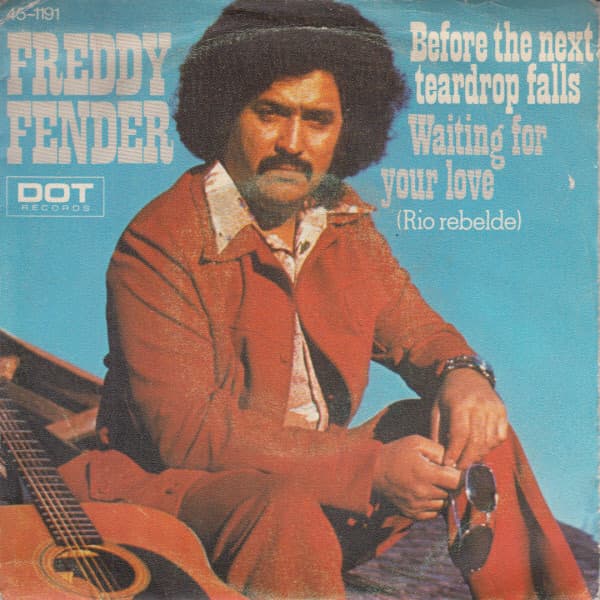
A Tender Promise of Love Beyond Language and Heartache
When Freddy Fender released “Before the Next Teardrop Falls” in late 1974, few could have predicted that this gentle, bilingual ballad would become one of the defining country hits of the mid-1970s. By March 1975, the song had reached No. 1 on the Billboard Hot Country Singles chart, and in a remarkable crossover achievement, it also climbed to No. 1 on the Billboard Hot 100. For an artist who had spent years in obscurity, battling personal struggles and industry indifference, this triumph felt almost miraculous. It was not merely a hit; it was redemption set to melody.
Included on the album Before the Next Teardrop Falls (1975), the song itself was not new. Written by Vivian Keith and Ben Peters and originally recorded by Duane Dee in 1967, it had enjoyed modest attention before. Yet in the hands—and voice—of Freddy Fender, it found its true emotional home. Fender’s interpretation transformed it into something intimate and universal, a confession whispered across the quiet spaces of a lonely room.
What made this version so unforgettable was not just its chart performance, though that was historic, but the profound sincerity of its delivery. Fender sang the verses in English, then tenderly shifted into Spanish for the final lines of each chorus. That bilingual refrain was not a gimmick; it was an extension of his identity. Born Baldemar Huerta in Texas, Fender carried the soul of both Anglo country and Mexican bolero traditions within him. In “Before the Next Teardrop Falls,” those worlds did not clash—they embraced.
The story behind the recording has become part of its quiet legend. Fender reportedly recorded the song quickly, almost casually, in a Nashville session. The Spanish lines were added spontaneously, drawn from an earlier recording he had made in the 1960s. There was no grand design for crossover glory. And perhaps that is precisely why the performance resonates so deeply. It feels uncalculated, unguarded—like a man singing not to conquer charts, but to ease a wounded heart.
Lyrically, the song is disarmingly simple. The narrator offers comfort to someone who is suffering in love, promising that before the next teardrop falls, he will be there. There is no boastful bravado, no dramatic flourish. Instead, there is patience, humility, and steadfast devotion. It speaks to a quieter kind of love—the kind that waits in the shadows, willing to step forward only when needed. That emotional restraint is what gives the song its lasting power. It understands heartbreak not as spectacle, but as something deeply personal and tender.
Listening to Freddy Fender sing this song is to hear vulnerability without shame. His voice carries a soft tremor, a hint of longing that suggests lived experience. There is warmth in his tone, but also fragility. One senses a man who knows what it means to lose—and therefore understands what it means to promise.
The cultural impact of “Before the Next Teardrop Falls” cannot be overstated. At a time when country music was still largely segregated from mainstream pop, Fender’s success bridged audiences. His Mexican-American heritage, once seen as a barrier, became part of his strength. The song opened doors not just for him, but for other bilingual and Latino artists seeking recognition in American country and pop music.
Yet beyond its industry significance, the song endures for more intimate reasons. It evokes memories of slow dances beneath dim lights, of radio stations playing softly through the night, of letters written and never sent. It reminds us that love is often less about grand declarations and more about quiet assurances. The promise to be there—before the next tear falls—is small in words, but immense in meaning.
More than five decades later, the song still carries its gentle ache. It does not demand attention; it invites reflection. And in that invitation lies its timeless grace.
 Oldies Songs