
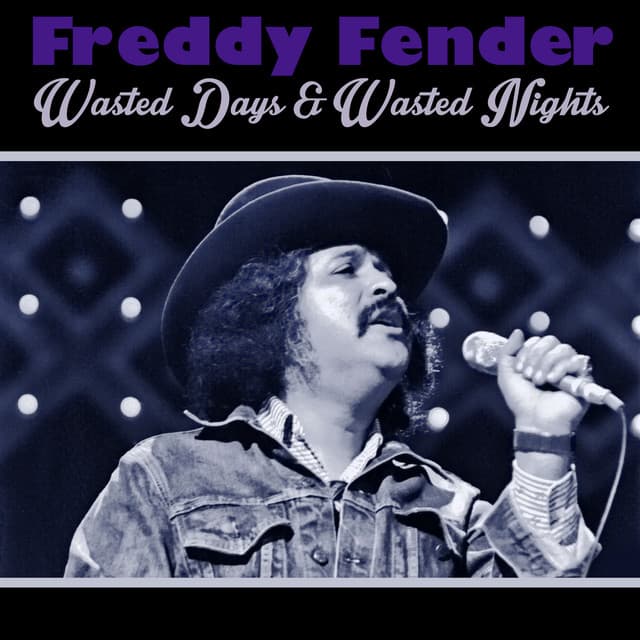
A Lament for Lost Time and Love That Refuses to Fade
When “Wasted Days and Wasted Nights” first climbed to No. 1 on the Billboard Hot Country Singles chart in 1975 and reached No. 8 on the Billboard Hot 100, it felt less like a commercial triumph and more like a long-delayed vindication. For Freddy Fender, this was not merely a hit record—it was redemption pressed into vinyl. Released on the album Before the Next Teardrop Falls, the song became one of the defining country crossover successes of the mid-1970s, carrying with it the ache of regret and the weight of a man who had lived every word he sang.
The remarkable irony is that “Wasted Days and Wasted Nights” was not new in 1975. Fender had first recorded it in 1959. That earlier version had shown promise, brushing the lower regions of the pop charts before his career was derailed by legal troubles and prison time. For years, the song lingered like an unfinished sentence. When he re-recorded it in 1975—after the unexpected, meteoric success of “Before the Next Teardrop Falls”—the world finally heard it as it was meant to be heard: seasoned, weathered, and painfully sincere.
There is something haunting about the opening lines. Fender does not rage; he reflects. The song is built not on accusation, but on realization. “Wasted days and wasted nights…” he sings, and the words hang in the air like cigarette smoke in a dimly lit dance hall. This is not youthful heartbreak; it is the sorrow of hindsight. The narrator recognizes that devotion was misplaced, that love was poured into a vessel that could not hold it. Yet there is no bitterness—only a quiet vow never to repeat the same mistake.
Musically, the record is a masterclass in restraint. The arrangement leans on a gentle shuffle rhythm, tender steel guitar accents, and Fender’s unmistakable tenor—a voice that blends country plainspokenness with a subtle Tex-Mex inflection. Born Baldemar Garza Huerta in Texas, Freddy Fender carried his Mexican-American heritage proudly, and his phrasing often bore the emotional directness of bolero tradition. In “Wasted Days and Wasted Nights,” that cultural blend enriches the performance, giving it a soulful undercurrent that separates it from standard Nashville fare of the time.
The mid-1970s were fertile ground for country crossover artists, yet Fender’s success felt uniquely personal. His rise was improbable. After years of obscurity, working odd jobs and playing small clubs, he suddenly stood atop both the country and pop charts. The song’s ascent to No. 1 on the country chart was swift and decisive, while its Top 10 pop placement confirmed its universal appeal. It resonated far beyond traditional country audiences, touching anyone who had ever looked back and wondered about the roads taken—or the love given too freely.
Behind the charts and sales figures lies the deeper significance of the song. It speaks to the universal human reckoning with time. We measure our lives not only by triumphs but by missteps, by relationships that taught us more through failure than success. Fender’s delivery suggests he understands that wasted time is not entirely wasted if it leads to wisdom. That subtle transformation—from regret to resolve—is the quiet moral core of the song.
Listening today, decades removed from its chart dominance, the record still feels intimate. It evokes images of jukeboxes glowing in corner bars, of couples slow-dancing under soft neon lights, of solitary drives down empty highways with the radio turned just loud enough to drown out lingering thoughts. There is a maturity in the song that deepens with age. Its melody does not shout; it lingers. Its message does not accuse; it accepts.
In many ways, Freddy Fender embodied the spirit of the song itself. His career had its wasted years—lost opportunities, false starts—but when his moment finally came, it arrived with grace and gratitude. “Wasted Days and Wasted Nights” stands as both confession and comeback, a reminder that the past may shape us, but it does not have to define our ending.
And perhaps that is why the song continues to endure. Not because it once topped charts, though it did. Not because it crossed genres, though it succeeded brilliantly. It endures because it understands something fundamental: that love, even when misplaced, is never entirely wasted. It leaves behind lessons, scars, and, sometimes, songs that echo long after the last note fades.
 Oldies Songs