
A Journey from Heartbreak to Dignity — “From a Jack to a King” Finds Renewed Life in Ricky Van Shelton’s Quiet Authority
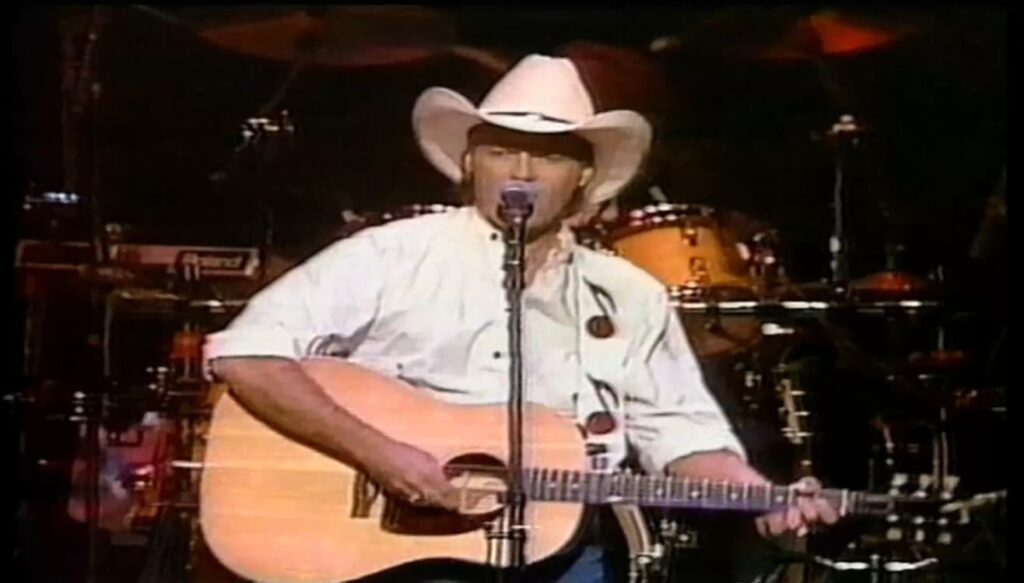
When Ricky Van Shelton stepped into the spotlight to perform “From a Jack to a King” on Stone Cold Country Music, the song carried with it a history far older than the man singing it. Yet in Shelton’s hands, it did not feel like a relic. It felt lived in, understood, and gently restored. His voice, steady and unhurried, seemed to recognize something within the song that only time can reveal — that love, when lost and found again, rarely returns in the same form.
Originally written and recorded by Ned Miller in 1962, “From a Jack to a King” became one of the most enduring crossover hits of its era. Miller’s version reached No. 2 on the Billboard Hot Country Singles chart and climbed to No. 6 on the Billboard Hot 100, an impressive achievement at a time when country and pop audiences often remained separate. The song’s success lay in its simplicity — a narrative of transformation, of moving from rejection and uncertainty to acceptance and belonging.
The imagery of cards within the lyric is both accessible and quietly profound. To be a “jack” is to feel overlooked, underestimated, perhaps even disposable. To become a “king” is not merely to gain status, but to be chosen, valued, and seen. It is a metaphor that resonates far beyond romance, touching on the universal human desire to matter in someone else’s world.
By the time Ricky Van Shelton recorded his version in the late 1980s, he was already emerging as one of the most authentic voices within the neotraditional country movement. His debut album Wild-Eyed Dream (1987) had produced multiple hits, including “Somebody Lied,” which reached No. 1 on the Billboard Hot Country Singles chart. Shelton’s style stood apart from the increasingly polished sound of mainstream country at the time. His voice carried a traditional weight, influenced by earlier artists such as Lefty Frizzell and George Jones, yet delivered with a clarity that felt unmistakably his own.
When he approached “From a Jack to a King,” Shelton did not attempt to reinvent the song. Instead, he honored its original spirit while allowing his own vocal character to shape its emotional center. His phrasing is deliberate, each line given space to settle. There is no rush, no need to impress. The confidence lies in restraint.
The performance on Stone Cold Country Music further emphasizes this approach. Stripped of excessive production, the arrangement allows the steel guitar and gentle rhythm to support the vocal without distraction. It feels closer to a conversation than a performance, as though the singer is recalling something deeply personal rather than presenting a well known classic.
What distinguishes Shelton’s interpretation is the subtle shift in perspective. Where Ned Miller’s original carries the hopeful tone of someone newly embraced by love, Ricky Van Shelton brings a sense of reflection. His version feels like it comes from someone who understands that such transformations are rare, and perhaps fragile.
The joy within the song is still present, but it is tempered by experience.
This is where the performance resonates most strongly. It acknowledges that becoming a “king” in someone’s life is not a permanent state. It is a moment, a recognition, something to be valued precisely because it may not last forever.
That awareness does not diminish the song’s optimism. Instead, it deepens it.
In the broader landscape of country music, “From a Jack to a King” remains a reminder of a time when storytelling was central, when songs spoke in clear images and direct emotions. Through Ricky Van Shelton’s interpretation, that tradition is not only preserved but quietly extended.
Listening today, the performance feels less like a revival and more like a continuation. The song moves forward, carried by a voice that understands both its history and its meaning.
And in that understanding, “From a Jack to a King” becomes something more than a story of love gained. It becomes a reflection on how, in certain moments of life, recognition arrives softly — and changes everything without needing to say very much at all.