
A Joyful Anthem of Youth and Rebellion That Captured the Spirit of 1970s Pop Rock
When “That’s Rock ’n’ Roll” burst onto the airwaves in 1977, it carried with it a kind of infectious energy that felt both nostalgic and immediate. Performed by Shaun Cassidy, the song quickly became one of the defining hits of his career, reaching No. 3 on the Billboard Hot 100 — a remarkable achievement that confirmed his place not just as a teen idol, but as a genuine presence in the pop-rock landscape of the late 1970s.
What many listeners may not have realized at the time is that “That’s Rock ’n’ Roll” was originally recorded by Eric Carmen in 1975. While Carmen’s version had its own charm, it was Cassidy’s interpretation — brighter, more youthful, and undeniably charismatic — that transformed the song into a cultural moment. Released as part of his self-titled debut album “Shaun Cassidy” (1977), the track arrived at a time when audiences were eager for music that felt uncomplicated, joyful, and full of life.
And that is precisely what this song delivered.
From the very first notes, “That’s Rock ’n’ Roll” feels like an open invitation — a celebration of simple pleasures, of radio singalongs, of nights that seemed endless. There is nothing overly complex in its structure, and that is part of its enduring strength. The melody is direct, the rhythm is lively, and the chorus carries a sense of carefree abandon that is difficult to resist.
But beneath that surface lies something more meaningful.
At its core, the song is about connection — about the way music becomes intertwined with memory. Lines referencing turning on the radio or hearing a favorite song echo a universal experience: those quiet, personal moments when a melody becomes part of one’s life story. In that sense, Shaun Cassidy wasn’t just performing a song; he was giving voice to a feeling that many already understood but rarely articulated.
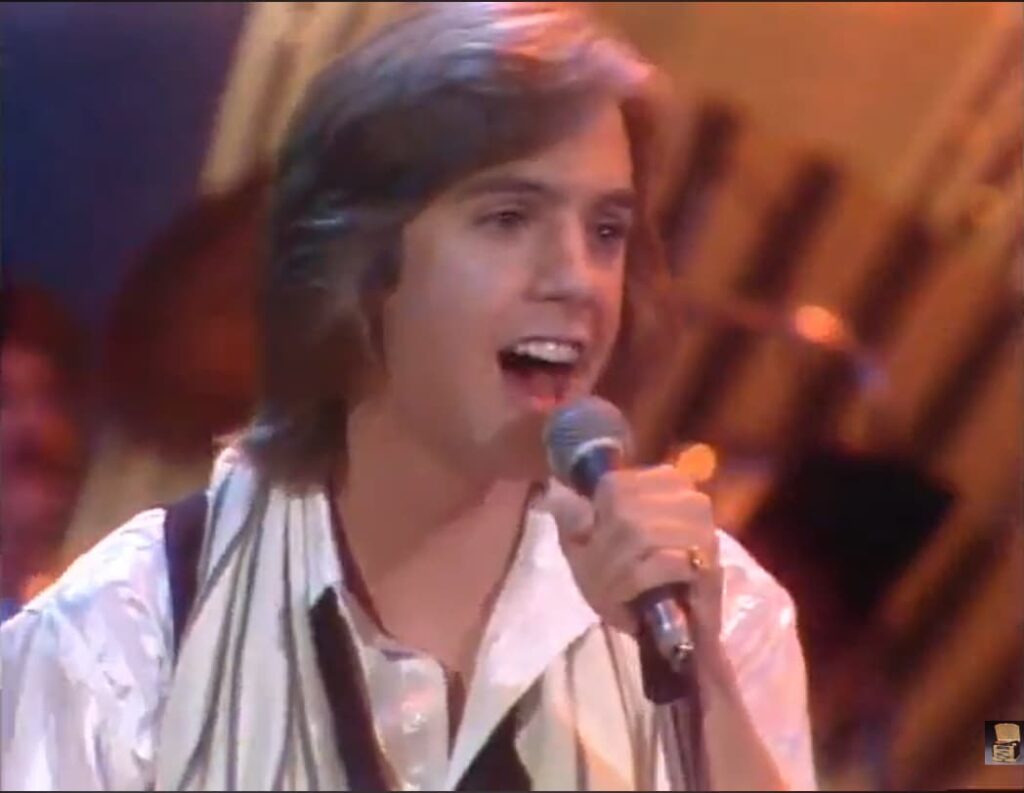
His performance on “The Midnight Special” further cemented this connection. In an era when televised music shows played a crucial role in shaping public perception, Cassidy’s appearance was more than just a performance — it was a moment of shared experience. Standing under studio lights, backed by a tight band, he delivered the song with an ease and sincerity that felt genuine rather than manufactured. There was a certain lightness in his presence, a sense that he wasn’t trying to be anything other than himself — and that authenticity resonated deeply.
It is also worth remembering the cultural context in which this song thrived. By the late 1970s, rock music had already gone through waves of transformation — from the raw energy of early rock ’n’ roll to the experimentation of the late 1960s and early ’70s. In that landscape, “That’s Rock ’n’ Roll” felt like a return to something simpler, almost a reminder of what made the genre so powerful in the first place.
And perhaps that is why the song endures.
Listening to it now, decades later, one cannot help but feel a gentle pull backward in time. It recalls a world where music was discovered through radio dials, where anticipation built as favorite songs climbed the charts, and where a three-minute track could carry an entire emotional landscape.
Shaun Cassidy may have been labeled a teen idol, but songs like “That’s Rock ’n’ Roll” reveal something deeper — an artist who, even within the framework of pop success, understood how to connect with listeners on a personal level.
In the end, the song is not just about rock ’n’ roll itself.
It is about the moments that music creates — fleeting, vivid, and unforgettable. And like all great songs, it doesn’t simply belong to the past. It continues to live on, quietly, every time it is played. 🎶