
A Heart Turned to Stone by Regret — “Statue Of A Fool” as a Quiet Confession of Love Lost Too Late
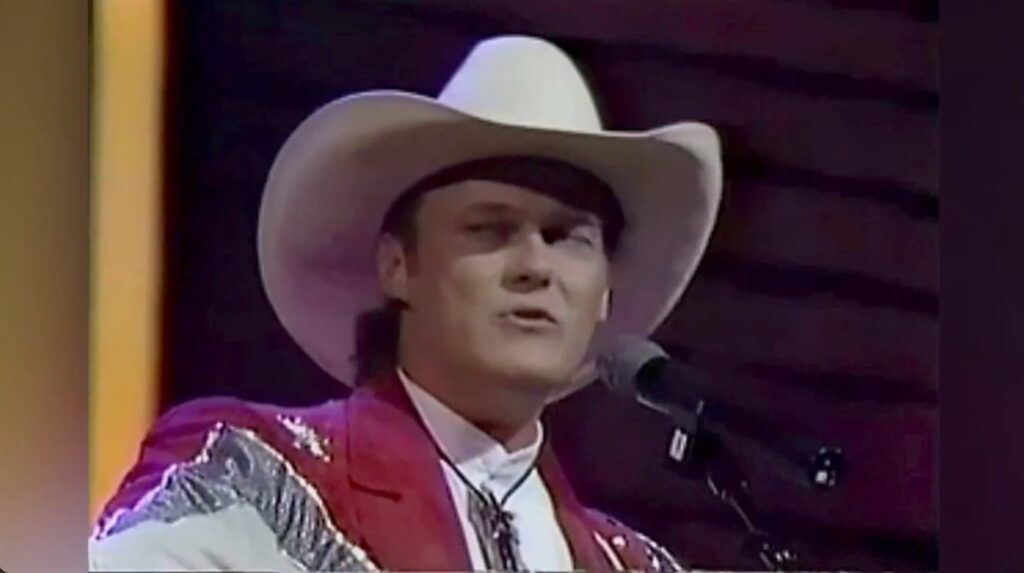
When Ricky Van Shelton stepped onto the stage of the 23rd CMA Awards in 1989 to perform “Statue Of A Fool,” he was carrying more than just a song. He was carrying the weight of a country tradition—one built on regret, reflection, and the kind of emotional honesty that does not fade with time.
Originally written by Jan Crutchfield, “Statue Of A Fool” first became a major hit for Jack Greene in 1969, reaching No. 1 on the Billboard Hot Country Singles chart. Two decades later, Ricky Van Shelton would breathe new life into the song, recording it for his 1989 album RVS III. His version climbed to No. 2 on the Billboard Hot Country Singles chart, reaffirming the song’s enduring power and introducing it to a new generation without losing any of its original sorrow.
By the time of that CMA performance, Shelton was at the height of his career. Known for his rich baritone and traditionalist approach, he had already established himself as one of the leading voices in the late 1980s country revival. Yet, rather than chasing contemporary trends, he chose to anchor himself in songs like “Statue Of A Fool,” where storytelling mattered more than style.
And on that stage, under the soft glow of the awards show lights, he did not simply perform the song—he inhabited it.
There is something striking about the way Shelton approaches the lyric. He does not overreach. He does not attempt to dramatize what is already deeply felt. Instead, he allows the words to settle, almost as if he is remembering them rather than singing them.
The story itself is simple, but its simplicity is what gives it such lasting resonance. A man stands in quiet reflection, comparing himself to a statue—a figure frozen in time, unable to undo the mistakes that led to his loneliness. The metaphor is direct, almost stark, yet within it lies a profound truth: regret has a way of stilling the heart, of turning living emotion into something fixed and unchangeable.
In Shelton’s voice, that regret feels lived-in.
There is no anger here, no attempt to shift blame. Only acceptance. The kind that comes slowly, often too late, when the realization settles that what was once within reach has already slipped away. It is this emotional restraint that gives the performance its power. Shelton understands that the song does not need embellishment. It needs sincerity.
The arrangement remains faithful to the traditional country sound—gentle steel guitar, steady rhythm, and space enough for the vocal to breathe. It is a sound that does not rush, that allows each line to unfold with quiet dignity. In a time when country music was beginning to expand in new directions, this performance felt like a return to something essential.
A reminder of where the music came from.
What makes “Statue Of A Fool” endure across decades is not just its melody, but its perspective. It does not speak from the height of romance, but from its aftermath. It is a song about looking back, about recognizing the moments that might have changed everything if only they had been understood sooner.
And perhaps that is why it continues to resonate so deeply.
There are songs that celebrate love, and there are songs that mourn it. But “Statue Of A Fool” does something more delicate. It lingers in the space between—where memory and regret meet, where the past cannot be altered, yet refuses to be forgotten.
In that 1989 CMA performance, Ricky Van Shelton does not attempt to rewrite the song’s history. He honors it. He steps into its silence and lets it speak again, not louder, but clearer.
And when the final note fades, what remains is not just the echo of a performance, but the quiet understanding that some lessons arrive only after the moment to act has already passed.
In that stillness, the figure of the “fool” no longer feels distant.
It feels familiar.