
A Love That Lives Beyond Time, Where Harmony Becomes the Language of Devotion
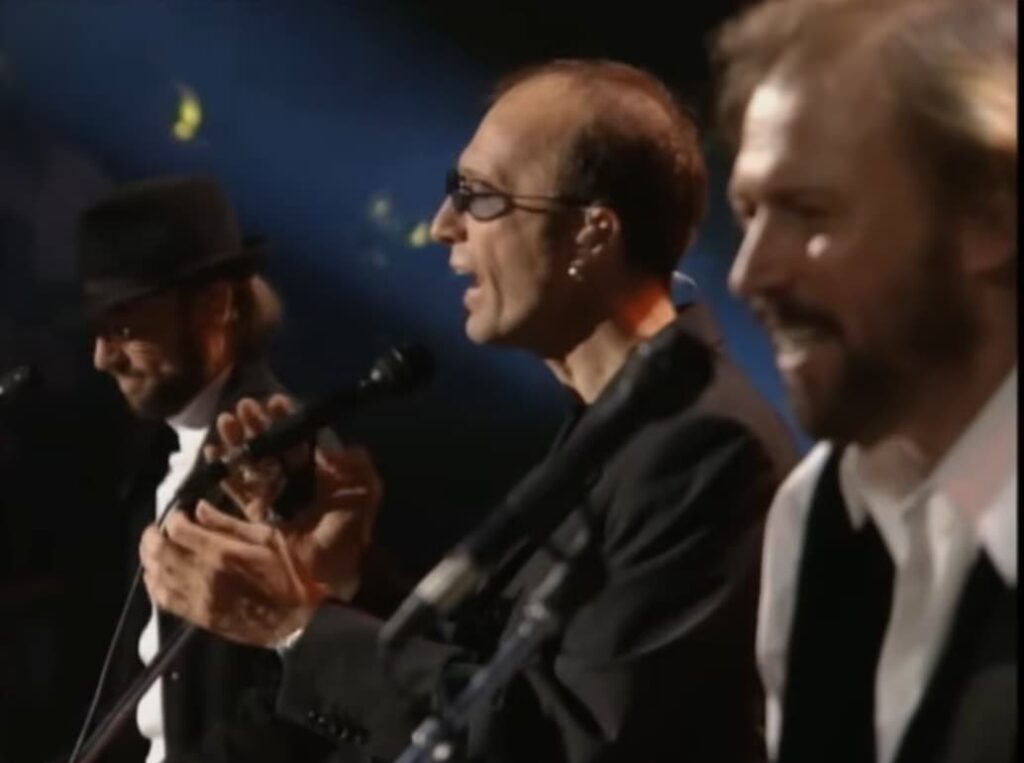
When Bee Gees returned to the stage in Las Vegas in 1997 for the landmark concert “One Night Only,” their performance of “More Than a Woman” stood as a quiet yet powerful reminder of a song that had already traveled far beyond its original moment. First released in 1977 as part of the “Saturday Night Fever” soundtrack—one of the best-selling albums in music history—the song was never issued as a major single in the United States, yet it became one of the most enduring compositions in the group’s catalog. While it did not chart prominently on its own upon release, its presence within an album that spent 24 consecutive weeks at No. 1 on the Billboard 200 ensured its place in the cultural fabric of its time.
Written by Barry, Robin, and Maurice Gibb, “More Than a Woman” was born during an extraordinary creative period for the Bee Gees, when their songwriting reshaped not only their own career, but the sound of popular music itself. Originally recorded in two versions—one by the Bee Gees and another by Tavares for the film—the song carries a melodic sophistication that sets it apart even within the rich landscape of the Saturday Night Fever soundtrack.
By 1997, however, the context had changed. The disco era had long passed, trends had shifted, and yet the music endured. The “One Night Only” concert was not merely a reunion with past success—it was a reaffirmation. And in that setting, “More Than a Woman” revealed a different kind of depth.
From the opening moments of the Las Vegas performance, there is a noticeable shift in tone compared to the original studio recording. The rhythm, once closely tied to the pulse of disco, is softened. The arrangement leans more toward elegance than urgency. This is not the sound of a crowded dance floor—it is the sound of reflection.
Barry Gibb’s voice, matured and slightly weathered by time, carries the melody with a deeper emotional weight. The famous falsetto remains, but it is no longer used as a display of vocal technique. Instead, it feels integrated, natural, as though it has become part of the story rather than its centerpiece. The harmonies—always the defining signature of the Bee Gees—are as precise as ever, yet they now carry a sense of history within them.
What makes this performance particularly resonant is the way it transforms the meaning of the song. In its original form, “More Than a Woman” is a declaration—direct, romantic, and immediate. But in 1997, it becomes something quieter, more reflective. The words do not change, yet they seem to hold more within them. Love is no longer just a feeling in the present tense; it is something that has endured, something that has been tested and carried forward.
There is a subtle understanding in the way the song is delivered—an awareness that time has passed, and with it, perspectives have shifted. The urgency of youth gives way to a kind of steady certainty. The performance does not attempt to recreate the past; it acknowledges it, and then moves gently beyond it.
Visually, the Las Vegas setting adds its own layer of meaning. The stage is polished, the production refined, yet the focus remains firmly on the music. There is no need for excess. The presence of the Bee Gees themselves—three voices that had once defined an era—is enough.
It is also worth noting that by the time of “One Night Only,” the group had already experienced decades of both immense success and personal loss. That history, though unspoken, seems to linger in the performance. It gives the harmonies a certain gravity, a sense that each note carries more than just sound—it carries memory.
Over time, “More Than a Woman” has come to represent more than its origins in the disco era. It has become a testament to the enduring power of melody and harmony, to the idea that certain songs can evolve alongside those who listen to them.
And in this 1997 performance, that evolution is quietly complete.
As the final harmonies fade into the Las Vegas night, there is no sense of finality—only continuation. The song does not belong to a single moment in 1977 or 1997. It exists somewhere in between, carried forward by every voice that remembers it.
Because “More Than a Woman” was never confined to the time in which it was written.
It was always meant to last—softly, steadily, and without needing to prove it ever again.