
A Song That Turns Strangers Into One Voice, Where Memory and Melody Meet in Unison
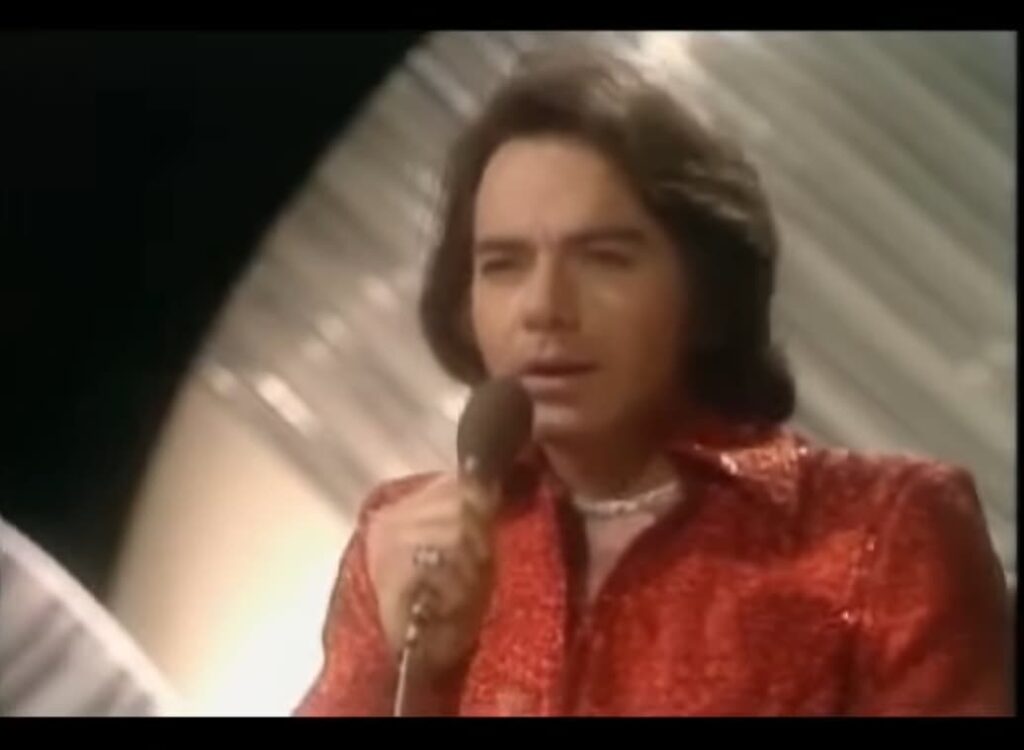
When Neil Diamond performed “Sweet Caroline” on The Shirley Bassey Show in 1974, he was already carrying a song that had quietly transformed into something far greater than its original chart success. First released in 1969 and later included on the album “Brother Love’s Travelling Salvation Show,” “Sweet Caroline” reached No. 4 on the Billboard Hot 100 in the United States. At the time, it was a strong hit—but not yet the cultural landmark it would eventually become. What gives this 1974 performance its enduring significance is the way it captures the song in transition, moving from popular success into shared memory.
By the mid-1970s, Neil Diamond had firmly established himself as a songwriter who understood emotional immediacy. His songs were not built on complexity alone, but on connection—simple phrases that carried deeper feeling with each repetition. “Sweet Caroline” stands as perhaps the clearest example of this gift. Written with producer Tom Catalano, and inspired—according to Diamond—by a photograph of Caroline Kennedy as a young child, the song blends personal inspiration with universal appeal.
On The Shirley Bassey Show, the setting offers a different kind of intimacy compared to Diamond’s larger concert performances. There is a closeness to the arrangement, a sense that the song is being shared rather than projected. Yet even in this more contained space, the essence of “Sweet Caroline” remains unmistakable.
From the opening lines, Diamond approaches the song with a calm assurance. There is no need to overstate its importance. By this point, the melody already carries its own weight. His voice—warm, slightly textured—moves through the verses with a deliberate ease, allowing each line to settle before moving on.
What becomes most striking in this performance is the way anticipation builds—not through dramatic instrumentation, but through familiarity. The listener knows what is coming. The chorus, with its now-iconic phrasing, is already part of the collective ear. And when it arrives, it does so not as a surprise, but as a return.
Though the famous audience response—those spontaneous “ba ba ba” and “so good, so good, so good” refrains—would become more prominent in later years, one can already sense their presence here, almost waiting just beneath the surface. The structure of the song invites participation, even when none is explicitly given. It is built not just to be heard, but to be shared.
This is where the deeper meaning of “Sweet Caroline” reveals itself. On its surface, it is a love song—simple, direct, and unguarded. But over time, it has come to represent something broader: a moment of collective feeling, where individual voices blend into something larger. It speaks to the idea that certain melodies do not belong to a single performer, but to everyone who carries them forward.
In 1974, Neil Diamond stands at an interesting point in his career. He is no longer the emerging songwriter of the 1960s, yet he has not fully entered the later phase of stadium-scale performances that would define his legacy. This performance sits between those eras, capturing an artist who understands both the intimacy of songwriting and the reach of a growing audience.
There is also a quiet discipline in the way he presents the song. He does not attempt to reshape it or reinterpret it dramatically. Instead, he honors its structure, its pacing, its emotional arc. This restraint allows the song’s natural warmth to come through without distraction.
Over the decades, “Sweet Caroline” has taken on a life far beyond its original recording. It has become a staple at gatherings, a song that bridges generations without effort. Yet watching this 1974 performance, one is reminded that its power was always there, present from the beginning—even before it fully revealed itself.
As the final notes settle, there is no sense of closure, only continuation. The song does not end so much as it lingers, ready to be picked up again whenever it is needed.
Because “Sweet Caroline” was never just about a single moment in time.
It was about creating a feeling that could be returned to—again and again—each time with the same quiet certainty that some songs are meant to stay.
 Oldies Songs