
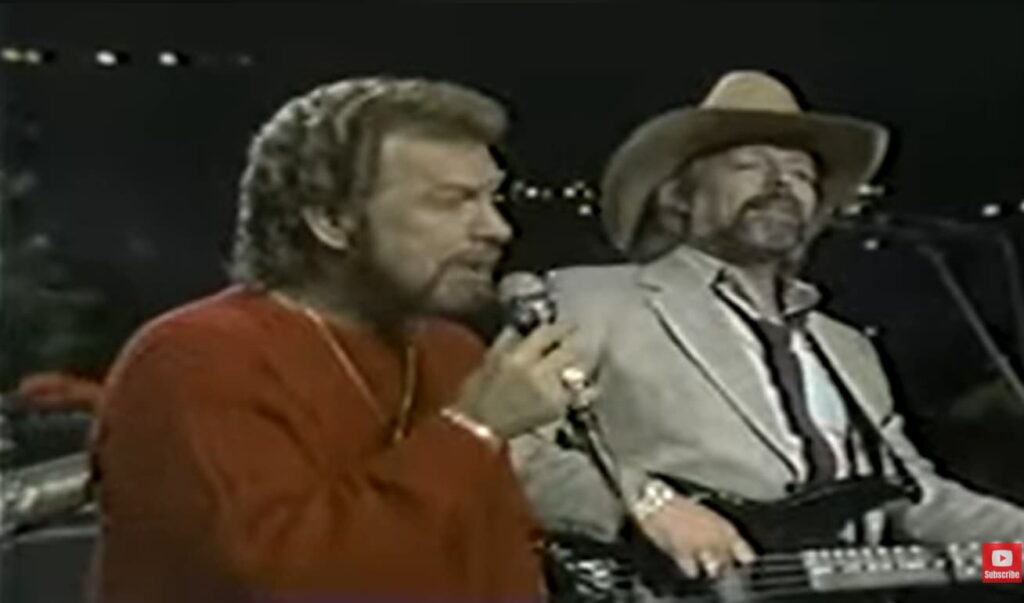
A final toast to love and regret, where dignity meets heartbreak in one last quiet gathering.
When Gene Watson released “Farewell Party” in 1979, it did not storm the charts with overwhelming force, but it carved something far more lasting into the fabric of country music. The song reached No. 5 on the Billboard Hot Country Singles chart, a respectable position by any measure, yet its true legacy has never been tied to numbers alone. Over time, “Farewell Party” has come to be regarded as one of the most emotionally complete performances in Watson’s career—and, for many, one of the finest examples of traditional country storytelling ever recorded.
Written by Lawton Williams, the song carries a premise both simple and devastating: a man attends the farewell gathering of a love he cannot keep. There are no grand confrontations, no dramatic ultimatums. Instead, the heartbreak unfolds quietly, almost politely, within the boundaries of a social ritual. It is this restraint that gives the song its extraordinary power. In the hands of Gene Watson, every line feels measured, every note deliberate, as though the singer understands that true sorrow rarely announces itself loudly—it lingers, unspoken, in the spaces between words.
By the late 1970s, Watson had already built a reputation for his pure, controlled vocal style, often compared to the great traditionalists who valued clarity and emotional honesty over embellishment. Yet “Farewell Party” stands apart even within his own catalog. His voice here is neither pleading nor bitter. It carries a quiet resignation, the sound of someone who has already accepted what the heart still struggles to release. There is no attempt to change the outcome, only a desire to endure it with dignity.
The arrangement mirrors this emotional landscape. Steel guitar lines drift gently through the background, never overwhelming the vocal but always reinforcing its mood. The tempo remains steady, almost unchanging, as if time itself has slowed for this moment of parting. Unlike many country songs of heartbreak that lean into dramatic crescendos, “Farewell Party” resists that impulse. It remains grounded, intimate, and deeply human.
What makes the song particularly enduring is its perspective. Instead of focusing on confrontation or blame, it captures the quiet aftermath—the moment when everything has already been decided, and all that remains is to say goodbye. The setting of a “party” adds a subtle irony, a contrast between the outward appearance of celebration and the inward reality of loss. It is a scene many can recognize: standing among others, exchanging polite words, while carrying a weight that cannot be shared.
For listeners, the song often feels less like a performance and more like a memory. It recalls moments when farewells were spoken with composure, when emotions were held just beneath the surface, when leaving was done not with anger but with a kind of reluctant grace. That universality is what allows “Farewell Party” to transcend its era. Though rooted firmly in the traditional country sound of the late 1970s, its emotional truth remains untouched by time.
Over the years, the song has been covered by various artists, but none have matched the quiet authority of Gene Watson’s original recording. His interpretation does not seek to impress; it seeks to understand. And in doing so, it invites the listener into a shared space of reflection—one where loss is acknowledged, but not dramatized, where acceptance arrives slowly, almost imperceptibly.
In the end, “Farewell Party” is not just a song about goodbye. It is about how we carry ourselves in the face of it. It is about the strength found in restraint, the grace found in letting go, and the unspoken understanding that some endings do not need to be explained—they simply need to be endured.
And long after the music fades, that quiet understanding remains, like the echo of a final toast raised not in celebration, but in remembrance.