
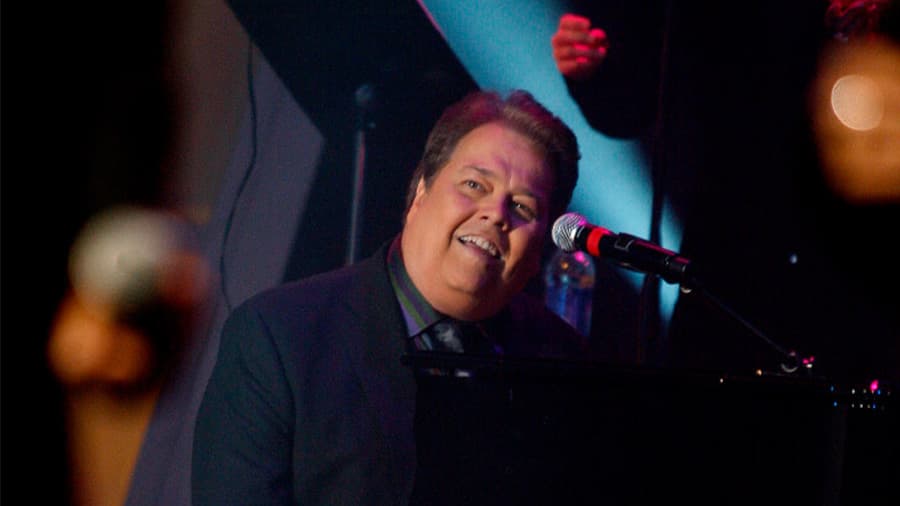
A quiet farewell to the eldest voice, where strength, faith, and music carried a family through time
The passing of Alan Osmond at the age of 76 does not arrive as a moment of noise, but as a stillness—one that settles gently over a long, remarkable journey. As the eldest of The Osmonds, Alan was never simply another voice in harmony. He was the foundation upon which the harmony was built, the steady presence guiding a group that would come to define an era of family-centered pop music.
Long before the bright lights of television and the certainty of chart success, there was a quieter beginning. Alan, alongside his brothers, performed not out of ambition alone, but out of necessity, out of belief, out of something deeply rooted in family and faith. In those early years, his role was already clear. He was the organizer, the protector, the one who understood that music was not just sound, but structure—something that needed discipline to survive.
When The Osmonds rose to international prominence in the late 1960s and early 1970s, with hits like “One Bad Apple” reaching No. 1 on the Billboard Hot 100, the world often saw the smiles, the synchronized movements, the effortless charm. What it did not always see was Alan’s quiet hand behind it all. He was not always at the center of attention, but he was always at the center of purpose.
Unlike some of his younger brothers, Alan’s path was not defined by lead vocals or teen idol status. Instead, he shaped the identity of the group from within. He played guitar, he managed arrangements, and more importantly, he carried a sense of responsibility that extended beyond the stage. In many ways, he was the one holding the line, ensuring that success did not come at the cost of who they were.
Yet his story is not only one of music. It is also one of endurance. In the 1980s, Alan was diagnosed with multiple sclerosis, a condition that gradually limited his ability to perform. For many, this would have marked an ending. For Alan, it became a different kind of continuation. He stepped away from the spotlight, but not from the meaning of what he had built. His strength took on a quieter form—less visible, perhaps, but no less significant.
There is something deeply moving in that transition. The stage lights fade, the applause softens, but the essence of a life in music does not disappear. It changes shape. It becomes memory, influence, legacy. Alan understood this in a way that few do. He never seemed to chase recognition. He accepted his role, embraced it, and carried it with a kind of quiet dignity.
To speak of Alan Osmond now is to speak of beginnings. Of the early harmonies sung not for an audience, but for something more personal. Of a time when music was still being shaped in living rooms and small venues, long before it reached the world.
And there is, inevitably, a sense of reflection. Not in sorrow alone, but in recognition. The recognition that behind every familiar song, behind every polished performance, there are individuals whose contributions are not always fully seen, yet deeply felt. Alan was one of those individuals.
His passing does not close a chapter as much as it reveals its full weight. The years, the music, the quiet sacrifices—all of it comes into focus with a kind of clarity that only time allows.
In the end, Alan Osmond’s life was not defined by a single moment, or even by a series of successes. It was defined by consistency, by care, by a belief in something larger than himself.
And perhaps that is what remains most clearly now. Not just the songs, but the sense of purpose behind them. A presence that does not disappear, but lingers—softly, steadily—like a harmony that continues long after the final note has faded.