
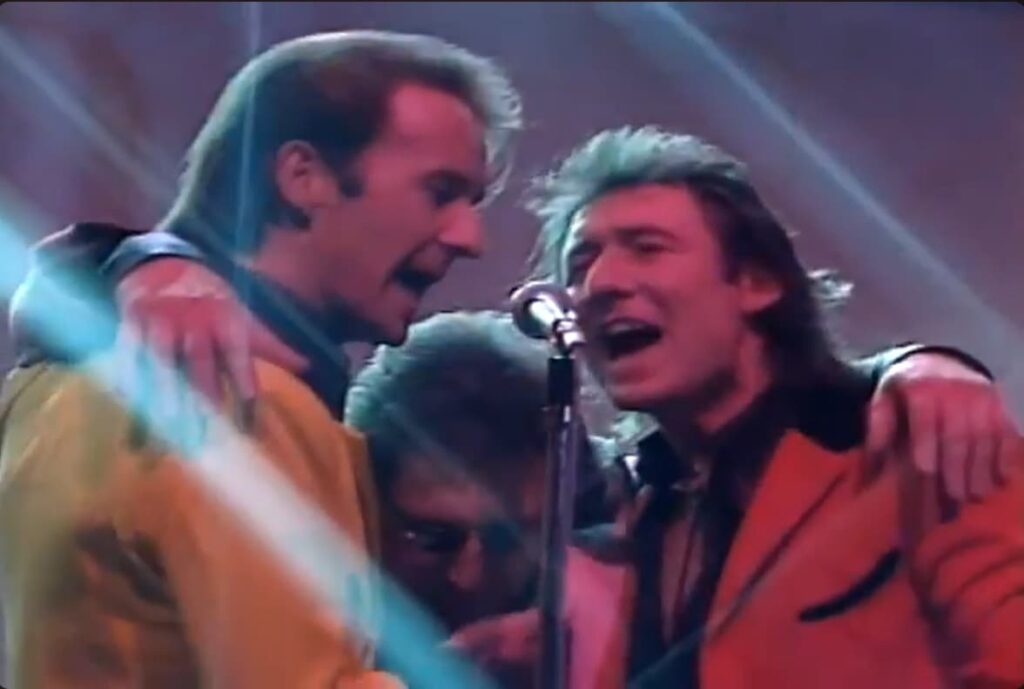
A song of labor and longing reborn with warmth, where echoes of hardship are softened into shared memory
By December 1980, when Showaddywaddy released their version of “Chain Gang”, the song already carried nearly two decades of history within it. Their recording reached No. 63 on the UK Singles Chart—a modest chart position compared to their earlier successes, yet one that still reflected the enduring appeal of their nostalgic approach. This was not a song chosen for commercial certainty. It was chosen for what it represented.
Originally written and recorded by Sam Cooke in 1960, “Chain Gang” was far more than a rhythm driven single. It climbed to No. 2 on the Billboard Hot 100 and No. 2 on the R&B chart, becoming one of Cooke’s most recognizable recordings. The inspiration came from a real experience—Cooke had witnessed a group of prisoners working on a chain gang while on tour, their synchronized movements and the haunting sound of their tools striking against metal leaving a deep impression. What he created from that moment was not simply a song, but a reflection of labor, confinement, and quiet endurance.
In Cooke’s original, the rhythm carries a weight that feels almost physical. The clanking sound, mimicking the tools of the prisoners, becomes part of the structure itself. It is not decorative. It is central. The voices rise and fall with a sense of repetition, echoing the endless cycle of work. Beneath the melody lies something heavier, something that cannot be easily separated from its historical context.
When Showaddywaddy approached “Chain Gang”, they did not attempt to replicate that weight in its entirety. Their version, released in 1980, shifts the tone subtly but significantly. The arrangement is smoother, the harmonies more pronounced, the rhythm less oppressive. It is not that the original meaning disappears, but it becomes reframed—less about the immediate reality of hardship, and more about the memory of it, filtered through time.
This transformation reflects the broader identity of Showaddywaddy. Throughout their career, they were less concerned with recreating the past exactly as it was, and more focused on preserving how it felt. Their music often carried a sense of distance, as though viewed through a lens softened by years. In “Chain Gang”, that approach creates a version that is more accessible, yet inevitably less stark.
There is something complex in that balance. On one hand, the song becomes easier to listen to, its harmonies inviting rather than confronting. On the other, the original tension—the sense of struggle embedded in Cooke’s version—becomes less immediate. What remains is an echo, a reminder rather than a direct expression.
Listening to Showaddywaddy’s “Chain Gang” now, there is a sense of reflection that extends beyond the song itself. It speaks to how music evolves, how meaning shifts as it passes from one artist to another. A song born from observation and empathy becomes, in another time, a tribute shaped by nostalgia.
The late 1970s and early 1980s were a period of transition in popular music. New sounds were emerging, production techniques becoming more refined, and audiences increasingly drawn to innovation. Yet Showaddywaddy remained anchored in an earlier tradition. Their choice to revisit “Chain Gang” was not an attempt to compete with contemporary trends, but a reaffirmation of their connection to the roots of rock and soul.
There is also a quiet respect in their interpretation. They do not exaggerate the song’s themes, nor do they attempt to overshadow its origins. Instead, they present it with a kind of restraint, allowing the listener to sense what lies beneath without forcing it into the foreground.
In the end, “Chain Gang” in the hands of Showaddywaddy becomes something different, yet still meaningful. It is no longer a direct window into a moment of hardship, but a reflection of how such moments are remembered. Softer, perhaps. Less immediate. But still present.
And perhaps that is its lasting significance. Not as a replacement for the original, but as a continuation—a reminder that even songs rooted in struggle can travel through time, changing shape while carrying something essential within them.