
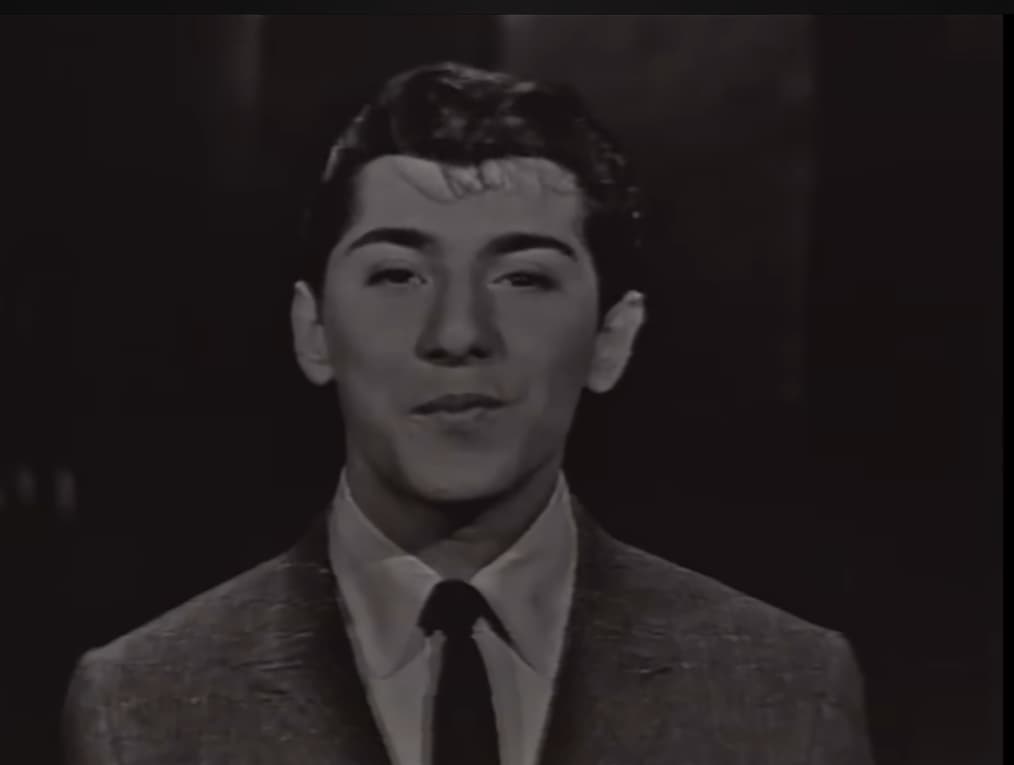
A tender promise carried in a quiet voice, where closeness becomes the only language that matters
When Paul Anka stepped onto the stage of The Ed Sullivan Show to perform “Put Your Head On My Shoulder”, the moment felt disarmingly simple. There were no elaborate gestures, no dramatic flourishes—only a voice, a melody, and a feeling so familiar it hardly needed explanation. Yet beneath that simplicity was a song that had already secured its place in the fabric of late 1950s popular music.
Released in 1959, “Put Your Head On My Shoulder” climbed to No. 2 on the Billboard Hot 100, held back from the top spot only by “Mack the Knife” by Bobby Darin. In Canada, it reached No. 4, further confirming Paul Anka’s growing influence as both a performer and a songwriter. By that time, he was no longer just a young voice emerging from the crowd. He was becoming one of the defining figures of a generation that valued melody, clarity, and emotional sincerity.
Unlike many songs of its era, “Put Your Head On My Shoulder” was written by Paul Anka himself. That detail matters. It gives the song a sense of personal intention, as though the words were not crafted to fit a trend, but to express something quietly understood. The lyrics do not attempt to impress. They do not reach for complexity. Instead, they settle into something more enduring—a moment of closeness, of reassurance, of gentle certainty.
On The Ed Sullivan Show, this quality becomes even more apparent. The performance is restrained, almost understated. Anka does not push his voice beyond what is necessary. He allows the melody to unfold naturally, trusting that its emotional weight does not require emphasis. There is a stillness in the way he delivers each line, a sense that the song is not being performed for an audience alone, but for a feeling that exists beyond the room.
Musically, the arrangement reflects the transitional nature of the late 1950s. It carries elements of traditional pop—lush orchestration, steady rhythm—while also hinting at the emerging sensibilities of rock and roll balladry. The result is a sound that feels both rooted and forward looking, bridging two eras without fully belonging to either.
What gives “Put Your Head On My Shoulder” its lasting resonance is not innovation, but intimacy. The song does not seek to redefine anything. It simply captures a moment with such clarity that it becomes timeless. There is a softness in its structure, a willingness to pause, to linger, to let the listener remain within its atmosphere.
In the broader context of Paul Anka’s career, the song represents a defining balance. He was capable of writing upbeat, energetic hits, yet here he chose restraint. He chose to explore the quieter side of connection, the kind that does not need to be declared loudly to be understood.
Watching the performance now, there is a sense of distance, yet also of immediacy. The setting belongs to another time, the presentation shaped by the conventions of early television. But the emotion remains unchanged. It moves through the years without losing its clarity, as if untouched by the shifts in style and taste that followed.
There is also something deeply reflective in how the song endures. It does not rely on nostalgia alone. It continues to resonate because it speaks to something fundamental—the desire for closeness, for reassurance, for a moment where the world feels smaller and more certain.
In the end, “Put Your Head On My Shoulder” is not simply a love song. It is a gesture. A quiet invitation to rest, to trust, to remain still for a while. And in the voice of Paul Anka, especially in that performance on The Ed Sullivan Show, that gesture feels as sincere now as it did when it was first offered.
 Great Songs