
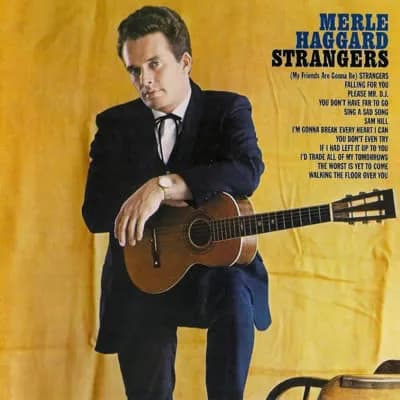
Merle Haggard – Silver Wings: A Haunting, Lyrical Masterpiece of Departure and the Loneliness of the Left Behind
In the vast landscape of American music, few voices carry the weight of lived experience quite like that of Merle Haggard. He was the undisputed poet of the common man, a storyteller who didn’t just sing about life’s hardships—he wore them in the lines of his face and the gravel of his baritone. Among his many legendary compositions, “Silver Wings” stands as perhaps his most evocative and enduring ballad of heartbreak. It is a song that captures the precise moment of loss, framed by the cold, metallic glint of a departing airplane. For those of us who have stood on a metaphorical or literal tarmac, watching a part of our heart disappear into the clouds, this song is a timeless companion in our solitude.
Originally released in 1969 as a standout track on the album A Brand New Day, and later immortalized on the iconic live album Okie from Muskogee, “Silver Wings” is a masterclass in simplicity and emotional resonance. Interestingly, while it is now considered one of the greatest country songs of all time, it was never actually released as a standalone single by Haggard. Instead, it grew in the hearts of fans through his live performances, eventually becoming a staple of his repertoire and a required cover for any aspiring country artist. Its popularity is rooted in a universal truth: there is a specific, hollow ache that comes when technology—those “silver wings”—facilitates the permanent departure of a loved one.
The imagery within the song is both beautiful and devastating. Merle Haggard paints a picture of a clear blue sky that feels mocking in its serenity. The lyrics, “Silver wings shining in the sunlight / Roaring engines headed somewhere high / They’re taking you away and leaving me lonely,” perfectly capture the contrast between the majesty of flight and the grounded, heavy despair of the person left behind. It is a song about the finality of a choice. Unlike a train, which lingers with a whistle, or a car that fades in the distance, a plane represents a total, vertical disappearance. One moment the person is there; the next, they are a mere speck against the sun. For a mature audience, this speaks to the various departures we face in life—not just in romance, but the ways in which life’s progress inevitably takes pieces of our world away.
When Merle Haggard performed this song during his final years, particularly in the lead-up to his passing in 2016, the performance took on a supernatural weight. In those later concerts, his voice had matured into a rich, weathered instrument that seemed to vibrate with the history of the twentieth century. Watching him on stage during his final tours, one didn’t just hear a song; one witnessed a man reflecting on a lifetime of arrivals and departures. The slow, steady tempo of the song allowed every syllable to land with purpose.
In the twilight of his career, “Silver Wings” wasn’t just about a woman leaving on a jet; it became a metaphor for the passage of time itself. The “silver wings” began to represent the fleeting nature of fame, health, and the era of the outlaw country legends. As he sang it one last time for his adoring fans, there was a shared understanding in the room: we were all watching a legend prepare for his own final flight. This song remains a profound, reflective anchor for anyone who understands that the most painful part of love isn’t the argument or the anger—it’s the quiet, shimmering moment when you realize they are truly gone.
 Music Legend