
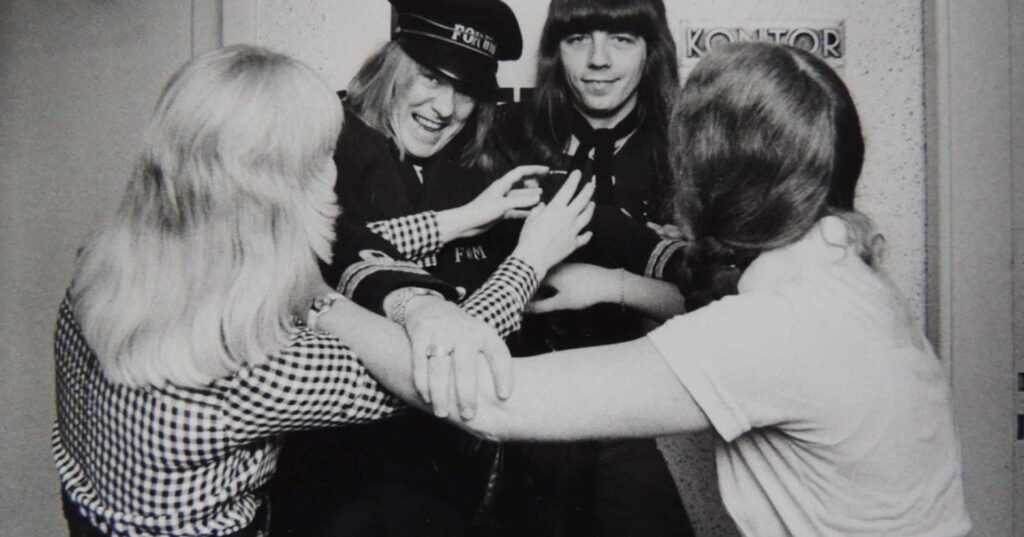
Not every band survives the weight of fame—yet between Brian Connolly and Andy Scott, something endured long after the spotlight faded
When the name Sweet is mentioned, it almost inevitably brings back the electrifying pulse of glam rock in the 1970s—bright stage lights, theatrical presence, and a string of unforgettable hits. Songs like “Ballroom Blitz” and “Fox on the Run” were not just successful; they defined a moment. “Ballroom Blitz” reached No. 2 on the UK Singles Chart in 1973 and broke into the Top 5 on the Billboard Hot 100, while “Fox on the Run” climbed to No. 2 in the UK and No. 5 in the US in 1975. These were records built for impact—immediate, loud, and impossible to ignore.
But behind that impact, behind the amplified guitars and carefully constructed image, there was a quieter, more fragile story—one that centered on two figures whose connection shaped much of what the band became: Brian Connolly and Andy Scott.
They were, in many ways, opposites. Brian Connolly, as the lead vocalist, carried the emotional weight of the band’s public identity. His voice—distinct, expressive, and often edged with vulnerability—gave Sweet’s music a human center beneath its glittering surface. There was something unguarded in the way he performed, as though each note required something personal in return.
Andy Scott, on the other hand, stood in a different space. As guitarist and one of the band’s key musical architects, he brought structure where there might otherwise have been excess. His presence was steadier, less visible perhaps, but no less essential. Where Connolly embodied the emotional immediacy of the music, Scott ensured its continuity.
During the early years, when success arrived quickly and with overwhelming force, this balance held. Sweet’s rise was not gradual—it was immediate. Chart success, international tours, and constant visibility created an environment where everything moved faster than it could be fully understood. And as often happens in such conditions, the pressures beneath the surface began to build quietly.
Fame, while elevating the band, also introduced fractures that were not immediately visible. The demands of touring, the expectations of the industry, and the personal challenges that come with sustained success began to take their toll. For Brian Connolly, these pressures manifested in ways that gradually pulled him away from the center of the band. His health declined, and his relationship with the group became increasingly strained.
By the late 1970s, the separation was no longer subtle. Connolly’s departure from Sweet marked not just a professional shift, but an emotional one. The voice that had once defined the band’s sound was no longer part of its present. And yet, what is most telling about this period is not simply the division itself, but how it was remembered afterward.
Andy Scott, who continued with the band in various forms, never reduced Connolly to a past chapter. Instead, he spoke of him as something inseparable from Sweet’s identity. This distinction matters. In an industry where former members are often treated as replaceable or transitional, Scott’s perspective suggested something deeper—a recognition that the band’s history could not be fully told without acknowledging the bond that had once held it together.
There is a particular kind of sadness in stories like this, but it is not rooted in the breakup alone. Bands dissolve, careers shift—that is part of the natural rhythm of music history. What lingers is something more personal: the image of two individuals who once shared the same stage, the same sound, the same sense of direction, and who, over time, found themselves moving apart in ways neither entirely intended nor fully controlled.
And yet, within that distance, there remains a form of continuity. Every time “Ballroom Blitz” surges forward with its unmistakable opening, or “Fox on the Run” unfolds with its polished urgency, the connection between Brian Connolly and Andy Scott is still present. Not visibly, not explicitly—but structurally, emotionally, undeniably.
Because in the end, the legacy of Sweet is not defined solely by its chart positions or its role in shaping glam rock. It is defined by the relationships that made that success possible, and by the ways those relationships endured, even as circumstances changed.
There is something quietly enduring in that idea—that beyond the lights, beyond the noise, beyond the inevitable shifts of time, there can remain a recognition of what once was shared.
And perhaps that is why, when people return to the music of Sweet, they are not only revisiting songs. They are revisiting a connection—one that may have changed, may have fractured, but never entirely disappeared.