
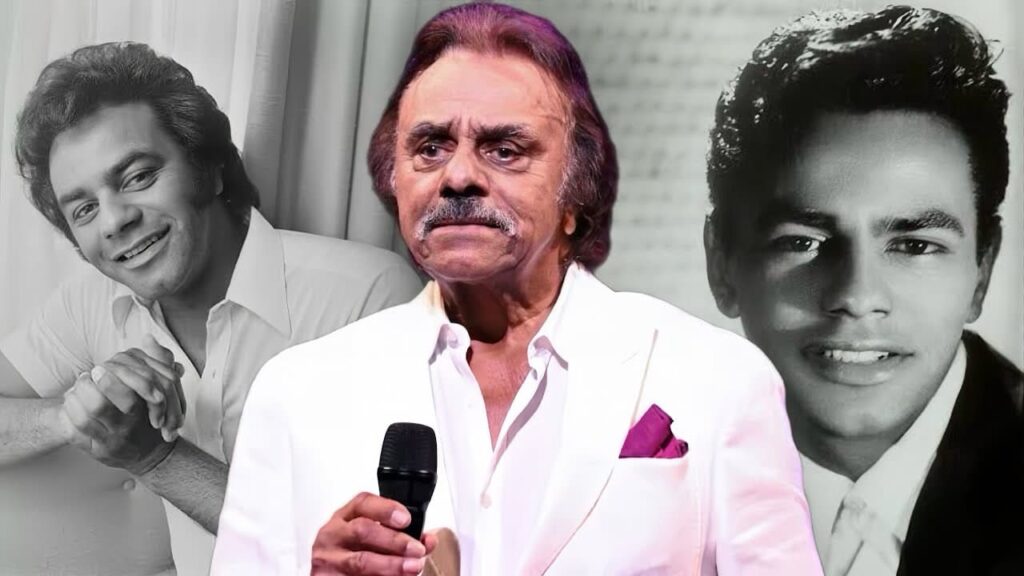
A Voice That Outlived Time: Johnny Mathis and the Gentle Farewell of a Romantic Era
There are voices that entertain, and then there are voices that accompany a lifetime. For nearly seventy years, Johnny Mathis belonged unmistakably to the latter. And on that final evening at the Bergen Performing Arts Center, as he closed the last show of his farewell tour, it became clear that this was not merely the end of a concert—it was the quiet conclusion of one of the most enduring legacies in American popular music.
From the very beginning, Johnny Mathis was never just another singer riding the wave of mid-century pop. His breakthrough came in 1957 with “Chances Are”, a single that climbed to No. 1 on the Billboard Most Played by Jockeys chart and reached No. 4 on the Billboard Top 100. That same year, “Misty” rose to No. 12 on the Billboard Hot 100, eventually becoming one of the most beloved standards in the American songbook. These were not fleeting hits—they were songs that settled into the emotional fabric of listeners, songs that seemed to understand love in all its quiet complexity.
By the time of this final performance, the numbers alone told a staggering story: over 360 million records sold worldwide, more than 70 albums on the Billboard charts, and dozens of gold and platinum certifications. Yet, as impressive as these achievements are, they hardly explain the depth of feeling that filled the room that night in New Jersey.
When Johnny Mathis stepped onto the stage, time was visible. The youthful elegance that once defined his presence had softened, shaped by the passing decades. But the moment he began to sing, something extraordinary happened. The years seemed to recede—not erased, but gently folded into the music itself. His voice, still tender and controlled, carried the same unmistakable warmth that had once turned simple melodies into lifelong companions.
There was a particular stillness in the air, the kind that only comes when an audience realizes they are witnessing something irretrievable. This was not just another performance of “The Twelfth of Never” or “Misty”. It was the final time these songs would be delivered by the voice that first gave them their emotional weight. Each phrase felt deliberate, almost reflective, as though Mathis himself was revisiting the path that had brought him here.
What has always set Johnny Mathis apart is not technical brilliance alone, though his phrasing and breath control have long been studied and admired. It is the sincerity—the ability to make every lyric feel personal, intimate, and unguarded. In an era that often favored grand gestures, Mathis mastered restraint. He understood that sometimes the softest note carries the deepest truth.
As the concert moved toward its closing moments, there was no dramatic declaration of farewell. No grand theatrical ending. Instead, there was a sense of quiet completion. When he sang the final lines, they did not feel like a goodbye in the conventional sense. There was no finality in his tone, no attempt to draw a clear line between past and present.
Rather, it felt like the closing of a long, beautifully written chapter—one that had never rushed, never demanded attention, but simply existed, steady and unwavering, across generations.
And perhaps that is why the silence that followed was so profound. It was not the silence of absence, but of recognition. Recognition that something rare had just reached its natural end.
In that moment, Johnny Mathis was no longer just a performer concluding a tour. He was the embodiment of an entire era—an era where romance was expressed with elegance, where songs were built to last, and where a voice could become a lifelong companion.
Time, as it always does, had moved forward. But for a brief, unforgettable evening in Englewood, it also stood perfectly still.