
A Quiet Song of Light and Reflection: Gordon Lightfoot’s “Morning Glory” as a Gentle Passage Through Time
There are songs that arrive loudly, demanding attention with chart-topping ambition—and then there are songs like “Morning Glory” by Gordon Lightfoot, which seem to exist outside of time altogether. First released in 1968 on the album “Did She Mention My Name?”, the song was never designed to dominate the Billboard Hot 100, nor did it chase commercial triumph. Instead, it found its place in something far more enduring: the quiet corners of memory, where music becomes deeply personal.
By the time Gordon Lightfoot performed “Morning Glory (Live 1987)”, he was no longer simply the rising Canadian troubadour of the late 1960s. He had already carved his name into music history with major chart successes like “Sundown” (No. 1 on the Billboard Hot 100 in 1974) and “If You Could Read My Mind” (No. 5 in 1971). Yet, what made this 1987 performance so compelling was not its connection to those commercial peaks—but rather its distance from them.
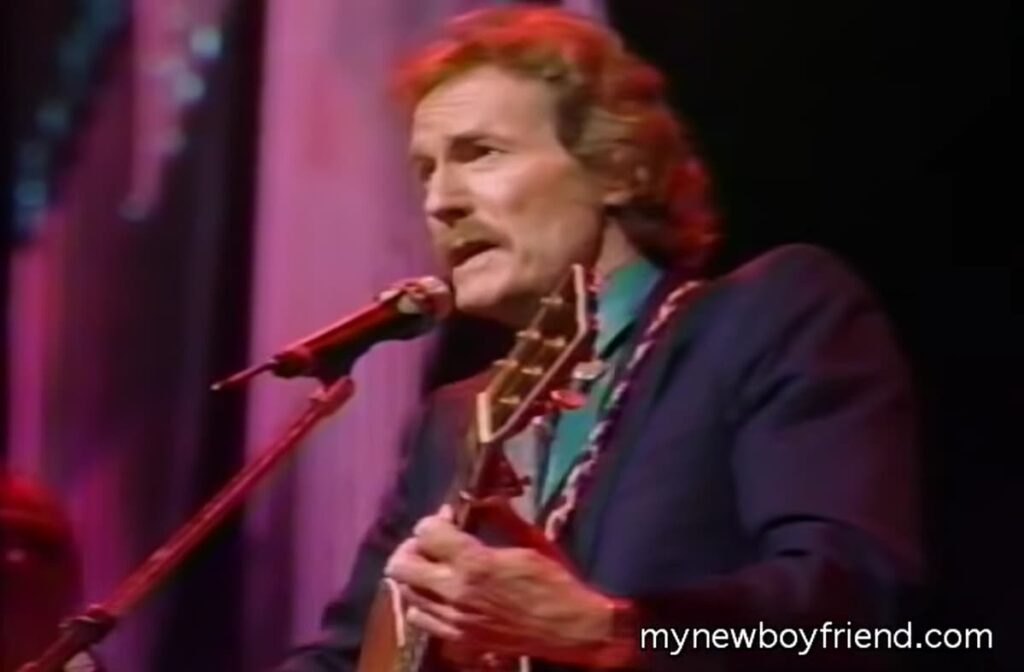
On that stage in 1987, Lightfoot stood as an artist shaped by years, by stories, by roads traveled both literally and emotionally. His voice, slightly weathered compared to the pristine clarity of his early recordings, carried something richer: experience. And “Morning Glory”, with its simple melody and introspective lyrics, became the perfect vessel for that transformation.
The song itself is deceptively modest. Built on gentle acoustic arrangements and Lightfoot’s unmistakable phrasing, it speaks of renewal, of fleeting beauty, and of the quiet hope that arrives with each new day. There is no dramatic climax, no overwhelming declaration. Instead, it unfolds like the morning it describes—softly, gradually, almost imperceptibly.
What makes “Morning Glory” so enduring is its sincerity. Written during a period when folk music was evolving into more personal and introspective territory, the song reflects Lightfoot’s gift for storytelling without excess. He does not impose meaning; he invites the listener to find their own.
By 1987, when he revisited the song live, that invitation felt even more profound. The performance carried an unspoken dialogue between past and present. Each lyric seemed to echo not only the optimism of youth but also the understanding that comes with time—the realization that mornings, like moments, are precious precisely because they do not last.
Unlike his chart-topping hits, “Morning Glory” never needed statistical validation. It did not climb rankings or collect certifications. Yet, it became something arguably more significant: a companion piece, a song that listeners return to in quieter moments, when reflection feels more important than celebration.
In the broader context of Gordon Lightfoot’s career, this song reveals the essence of his artistry. While many of his contemporaries leaned toward grander production as the decades progressed, Lightfoot remained rooted in simplicity. His strength was never in spectacle, but in truth—the kind that emerges when an artist trusts both the song and the silence around it.
Watching or listening to “Morning Glory (Live 1987)”, one senses a kind of stillness that is increasingly rare. There is no urgency, no attempt to impress. Only a man, a guitar, and a song that has aged alongside him.
And perhaps that is why it lingers so deeply. Because in that performance, Gordon Lightfoot is not trying to recreate the past. He is simply inhabiting it, allowing it to breathe in the present.
In the end, “Morning Glory” is less about the morning itself and more about what it represents: continuity, resilience, and the quiet beauty of carrying on. Long after the applause fades, the song remains—like the first light of day—gentle, familiar, and endlessly reassuring.