
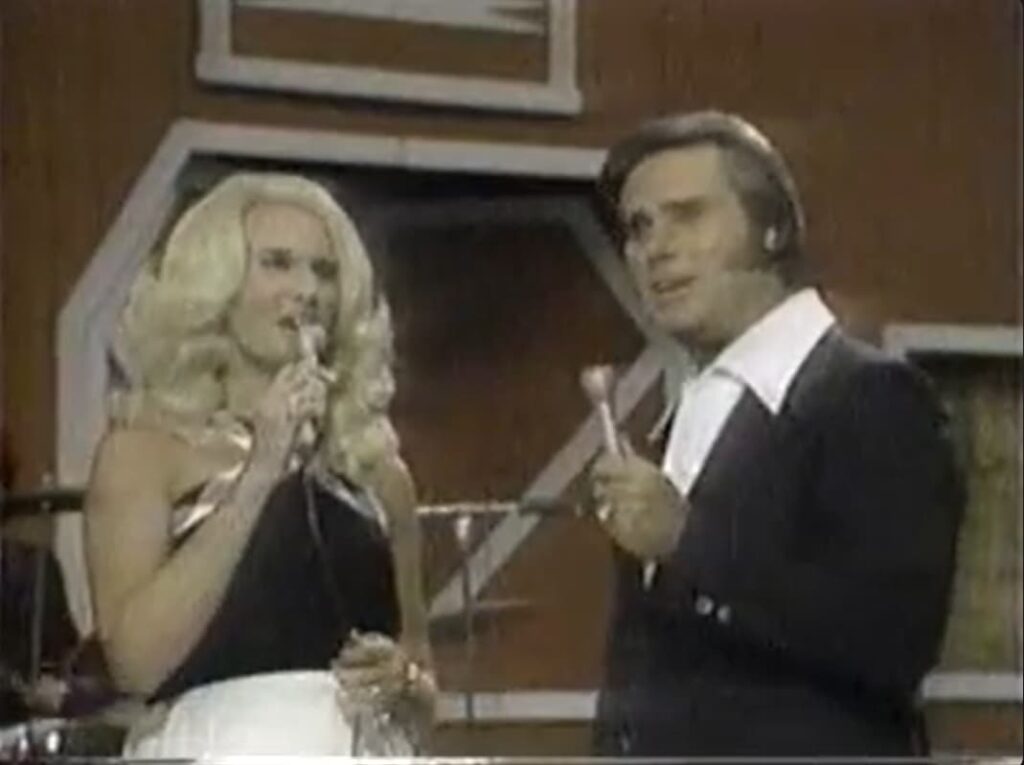
A tender reflection on love tested by distance and illusion, where glamour fades but devotion quietly endures
When “Jet Set” (1974) was released, it arrived as another poignant chapter in the deeply intertwined musical and personal story of Tammy Wynette and George Jones—two voices that seemed destined to meet somewhere between heartbreak and honesty. Issued as a single from their collaborative album George & Tammy & Tina, the song quickly found its place on the Billboard Hot Country Singles chart, where it climbed to a respectable No. 28. While not among their biggest chart-toppers, its emotional resonance has proven far more enduring than its numerical peak might suggest.
What makes “Jet Set” so compelling is not its chart position, but its quiet truth—a truth that feels lived-in, almost confessional. Written by Bobby Braddock and Curly Putman, the song tells the story of a couple separated by the demands of a fast-moving, high-profile lifestyle. One partner is constantly on the road, caught up in the glamour of the “jet set” world, while the other remains behind, grounded in longing and emotional absence. It is a theme that mirrored, perhaps too closely, the real-life struggles of George Jones and Tammy Wynette, whose marriage was famously marked by turbulence, distance, and reconciliation.
Listening to the song today, one cannot help but hear more than just lyrics and melody. There is a subtle ache in Tammy Wynette’s voice—restrained yet deeply expressive—contrasted by the weary sincerity in George Jones’ delivery. Together, they do not merely perform the song; they inhabit it. Their harmonies feel less like a studio arrangement and more like a conversation between two souls drifting apart, yet still tethered by something unspoken.
The arrangement itself is understated, allowing the storytelling to take center stage. Gentle guitar lines, soft pedal steel, and a steady rhythm create a backdrop that never overwhelms. Instead, it frames the narrative with a sense of intimacy, as if the listener has been invited into a private moment. This restraint is precisely what gives “Jet Set” its lasting power—it does not demand attention; it earns it quietly.
There is also a deeper layer beneath the surface: a reflection on the illusion of glamour. The “jet set” life, often romanticized as exciting and liberating, is here revealed as isolating and emotionally costly. The song gently questions whether success and constant motion can truly replace the warmth of shared presence. In that sense, it speaks not only to musicians on tour, but to anyone who has ever felt the distance grow between themselves and someone they love.
In the broader context of country music in the early 1970s, “Jet Set” stands as a testament to the genre’s commitment to storytelling rooted in real human experience. At a time when country music was beginning to evolve and expand its boundaries, artists like Tammy Wynette and George Jones remained anchored in emotional authenticity. Their collaborations, including this song, helped define what a duet could be—not just a blending of voices, but a meeting of lives, with all their imperfections laid bare.
Over time, “Jet Set” has become something of a hidden gem in their catalog. It may not carry the immediate recognition of hits like “We’re Gonna Hold On” or “Golden Ring,” but for those who return to it, the song offers something quieter and perhaps more profound. It is a reminder that not all love stories are triumphant or neatly resolved. Some are defined by distance, by longing, and by the fragile hope that understanding might still bridge the gap.
And perhaps that is why the song lingers—because in its gentle, unadorned way, it tells a truth that never really grows old.