
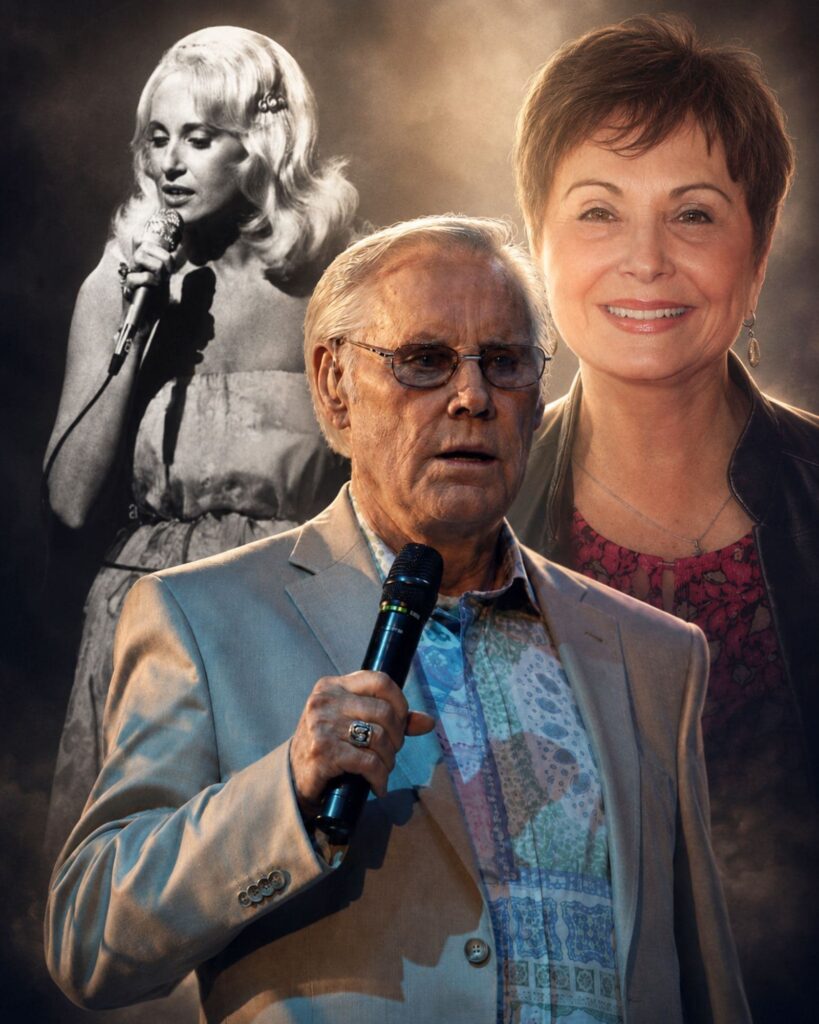
A love story split between passion and endurance—where music remembers the fire, but life remembers who stayed through the ashes
There are stories in country music that feel less like history and more like something remembered—half song, half scar. The story of George Jones is one of those rare narratives where love, music, and personal struggle are so tightly woven together that it becomes impossible to separate the man from the melodies he left behind. And at the center of that story stand two names that continue to stir quiet debate: Tammy Wynette and Nancy Jones.
In the late 1960s and early 1970s, when George Jones and Tammy Wynette came together, something extraordinary happened. Their marriage, which lasted from 1969 to 1975, was far from stable, yet their musical partnership produced some of the most emotionally charged recordings country music had ever known. Songs like “We’re Gonna Hold On” (1973), which reached No. 1 on the Billboard Hot Country Singles chart, and “Golden Ring” (1976), another chart-topping duet released after their divorce, carried a kind of emotional realism that could not be manufactured in a studio.
They did not sound like two polished performers carefully blending harmonies. Instead, George Jones and Tammy Wynette sang as if they were trying to hold onto something that was already slipping through their fingers. There was tension in their voices, but also longing. There was tenderness, but also fatigue. It was this fragile balance that made their duets unforgettable. Listeners were not just hearing songs—they were witnessing something deeply human unfold in real time.
Behind the music, the story was far more complicated. Their relationship was marked by intense love, but also by instability, fueled in part by George Jones’s struggles with alcohol and personal demons. In many ways, the very qualities that made their music so powerful—the honesty, the vulnerability, the sense of emotional exposure—were reflections of a relationship that was difficult to sustain in everyday life. Love, in their case, burned brightly, but not always steadily.
And yet, despite the turbulence, Tammy Wynette remained, for many, the emotional center of George Jones’s artistic legacy. She was not just a collaborator; she was the voice that seemed to understand him in ways few others could. When they sang together, there was an unspoken dialogue—a shared recognition of pain, forgiveness, and the complicated nature of devotion. It is perhaps why so many listeners still feel that she was the great love of his life. Not because the marriage endured, but because the music did.
Then, as the years moved forward and the spotlight shifted, another presence entered the story: Nancy Jones. If Tammy Wynette represented the storm—the intensity, the passion, the heartbreak—then Nancy Jones became something else entirely. She was the one who stood beside George Jones during the later years, when the applause was softer and the struggles were harder to ignore.
Married in 1983, Nancy Jones played a crucial role in helping him confront the very demons that had once threatened to destroy both his career and his life. She was not part of the myth that had already been written. Instead, she helped shape the ending. Through her support, George Jones found a measure of stability that had long eluded him. His later successes, including the iconic “He Stopped Loving Her Today” (1980)—widely regarded as one of the greatest country songs ever recorded—were made possible, in part, by the foundation she helped rebuild.
And so, the question lingers quietly: who mattered more?
But perhaps that is the wrong question entirely.
Because Tammy Wynette gave the world the sound of George Jones’s heart breaking—raw, exposed, unforgettable. She was there when the music was being written in real time, when every note felt like a confession. Their duets remain etched in memory not because they were perfect, but because they were real.
Nancy Jones, on the other hand, gave him something the world rarely sees but deeply needs: time. Time to heal, to endure, to continue. She stood beside the man when the legend was no longer enough to carry him.
In the end, one became the voice of his most profound emotional expression. The other became the quiet strength that allowed him to keep living long enough for that expression to matter.
And maybe that is why the story never truly resolves itself. Because some lives are not defined by a single love, but by the different ways love arrives—sometimes as a fire that consumes, and sometimes as a hand that refuses to let go when everything else begins to fade.