
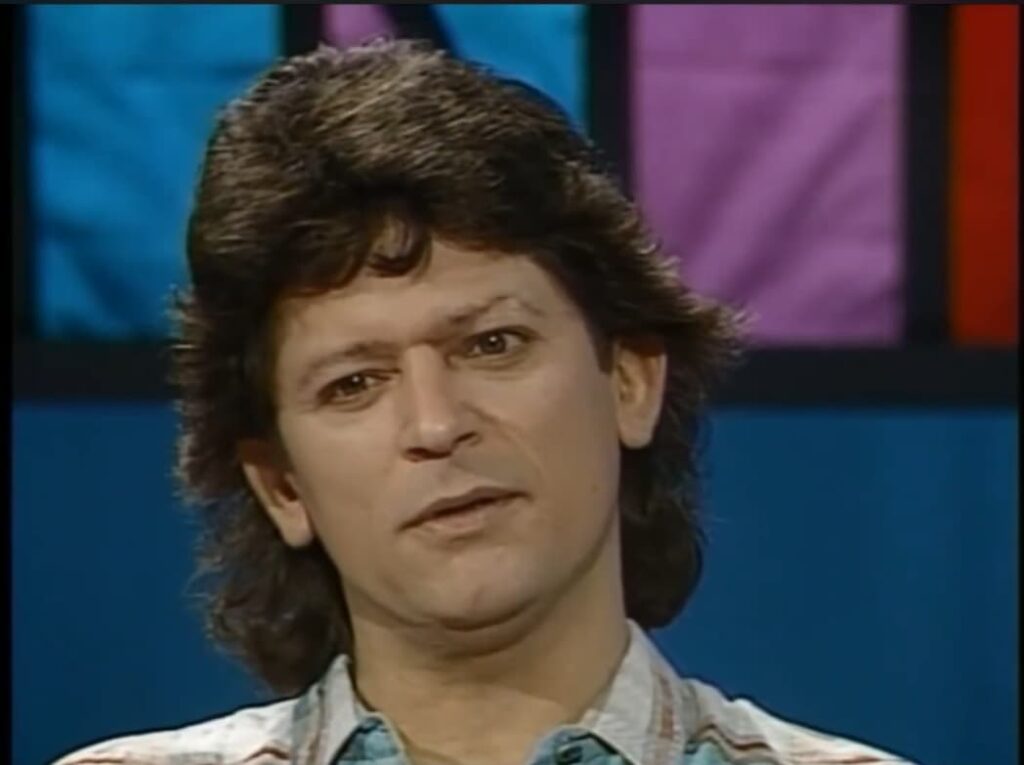
A voice that carried both home and distance—where tradition met quiet transformation on a distant stage
There is something deeply moving about seeing a familiar voice travel far from where it began, yet still sound unmistakably like home. When Johnny Rodriguez appeared on “Down Home Down Under” (Show #10), it was more than just another television performance—it was a quiet reminder of how far country music had traveled, and how certain voices could carry its soul across oceans without losing a single ounce of authenticity.
By the time of this appearance, Johnny Rodriguez was no longer the uncertain young man standing nervously in a Nashville audition room. He had already carved his place in country music history during the early 1970s, becoming one of the genre’s most distinctive and groundbreaking voices. His debut album, Introducing Johnny Rodriguez (1973), had already produced a No. 1 hit on the Billboard Hot Country Singles chart with “You Always Come Back (To Hurting Me)”, followed by a remarkable string of successes including “Ridin’ My Thumb to Mexico” (No. 1, 1973) and “That’s the Way Love Goes” (No. 1, 1973). These were not just popular songs—they were statements of identity, blending traditional country storytelling with subtle Spanish phrasing that gave his music a warmth and individuality rarely heard before in Nashville.
And yet, watching him on “Down Home Down Under”, there is a sense that the journey had become less about proving something and more about simply being present in the music. The setting itself—far from the familiar stages of America—adds a layer of quiet reflection. Here was a Texas-born artist, shaped by the sounds of border culture and honky-tonk tradition, performing for an audience thousands of miles away. And still, nothing felt out of place.
That is the remarkable quality of Johnny Rodriguez. His voice does not demand attention through force or spectacle. Instead, it draws listeners in gently, almost conversationally. There is a relaxed sincerity in the way he delivers a song—a sense that he is not performing at the audience, but sharing something with them. On a show like “Down Home Down Under”, where the atmosphere leans toward intimacy rather than grandeur, this quality becomes even more apparent.
One cannot help but reflect on how unlikely this path once seemed. In the early days, his bilingual style—effortlessly moving between English and Spanish—was not the norm in country music. It was, in many ways, a quiet challenge to the boundaries of the genre. But rather than resisting, audiences embraced it. Perhaps because it never felt forced. It was simply who he was.
And that authenticity is what resonates most in performances like this one. There is no sense of reinvention, no attempt to follow trends. Instead, there is continuity—a steady thread connecting the young man who first captured Nashville’s attention to the seasoned artist standing comfortably on an international stage.
The songs themselves, whether drawn from his early hits or later repertoire, carry a familiar emotional weight. Themes of love, regret, longing, and resilience—hallmarks of classic country music—are delivered with a voice that has grown richer over time. There is a slight wear in the tone now, a subtle deepening that speaks not of decline, but of experience. It is the sound of someone who has lived the stories he sings.
In a broader sense, “Down Home Down Under” (Show #10) represents something quietly significant. It reflects a period when country music was expanding beyond its traditional borders, reaching audiences who may not have grown up with its roots but could still feel its truth. And artists like Johnny Rodriguez played an essential role in that expansion—not by changing the music, but by bringing their own identity into it.
Watching this performance today, there is a gentle nostalgia that settles in. Not just for the era, but for a time when music felt less hurried, more personal. When a song could unfold slowly, allowing its meaning to reveal itself without urgency.
And perhaps that is what lingers most. Not a single note or lyric, but a feeling—that somewhere, across distance and time, a voice remains steady. Familiar. Honest. Still carrying the sound of where it all began.