
A Journey of Love, Regret, and Return—Where Every Step Echoes with Longing and Quiet Hope
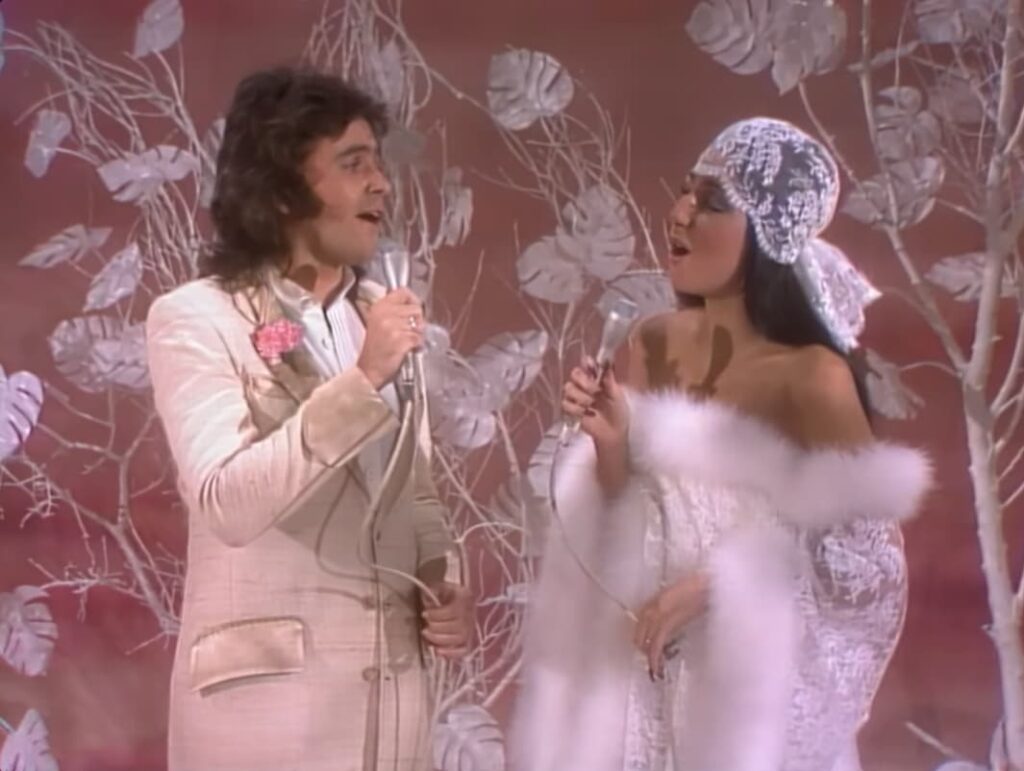
There is something profoundly intimate about a song that does not rush its emotions, that allows each note to linger like a memory unwilling to fade. “The Long and Winding Road”, performed in a special televised duet by Cher and David Essex on The Cher Show (November 30, 1975), stands as one of those rare moments where music, television, and emotional storytelling converge into something quietly unforgettable.
Originally written by Paul McCartney and released by The Beatles in 1970, the song reached No. 1 on the Billboard Hot 100, becoming the band’s final chart-topping single in the United States. Its legacy was already firmly established by the time Cher revisited it in her variety show setting. Yet, rather than simply covering a classic, she reshaped it—transforming the song into a dialogue, a shared emotional journey between two voices that seemed to meet somewhere along that long and winding path.
By 1975, Cher had entered a new chapter in her career. Following the immense success of her earlier television work and her musical partnership with Sonny Bono, she had emerged as a solo figure of remarkable versatility. The Cher Show was not merely entertainment; it was a stage where she could reinterpret familiar songs through her own emotional lens. Inviting David Essex, whose own career was flourishing in the UK with hits like “Rock On,” added a subtle contrast—his youthful intensity balancing Cher’s seasoned, deeply expressive tone.
Their rendition of “The Long and Winding Road” is striking not for vocal extravagance, but for its restraint. The arrangement remains faithful to the song’s orchestral roots, yet the interplay between the two singers introduces a sense of conversation. It feels less like a performance and more like a quiet exchange between two souls who have traveled different roads, only to find themselves reflecting on similar regrets and hopes.
The story behind the original song lends additional weight to this interpretation. Written during a period of internal tension within The Beatles, McCartney’s composition has often been viewed as a metaphor for the band’s impending dissolution. The “long and winding road” becomes not just a romantic image, but a symbol of distance, miscommunication, and the yearning for reconciliation. That emotional complexity remains intact in Cher’s version, perhaps even amplified by the duet format. Here, the road is no longer solitary—it is shared, yet still uncertain.
Listening to this performance, one cannot help but feel the passage of time embedded in every phrase. Cher’s voice carries a certain gravity, a sense of having lived through the very emotions the song describes. Essex, in contrast, brings a touch of vulnerability, as though still searching for answers. Together, they create a delicate balance—one voice grounded in reflection, the other reaching forward.
What makes this rendition particularly memorable is its setting. In an era when television variety shows were central to musical culture, moments like this were experienced collectively, yet felt deeply personal. The simplicity of the staging, the focus on the voices, and the absence of distraction allow the song’s emotional core to shine through. It is a reminder of a time when music on television was not about spectacle, but about connection.
The meaning of “The Long and Winding Road” has always been open to interpretation, but at its heart lies a universal truth: the journey of love is rarely straightforward. It is filled with detours, misunderstandings, and moments of quiet realization. Yet, despite its twists and turns, there remains a persistent hope—that the road, however long, might still lead back to where the heart belongs.
In revisiting this song, Cher and David Essex do more than honor a classic—they breathe new life into it. Their performance does not attempt to surpass the original; instead, it offers a different perspective, one shaped by time, experience, and the subtle art of emotional restraint. It is a rendition that does not demand attention, but gently invites it, drawing the listener into a space where memory and melody intertwine.
And perhaps that is the true beauty of this performance. It reminds us that some songs are not meant to remain fixed in a single moment. They evolve, much like the lives of those who listen to them. And in that quiet evolution, they continue to find new meaning—one verse, one memory, one winding road at a time.