
A Timeless Confession of the Heart—When “Secret Love” Becomes a Whisper Carried Across Fifty Years of Song
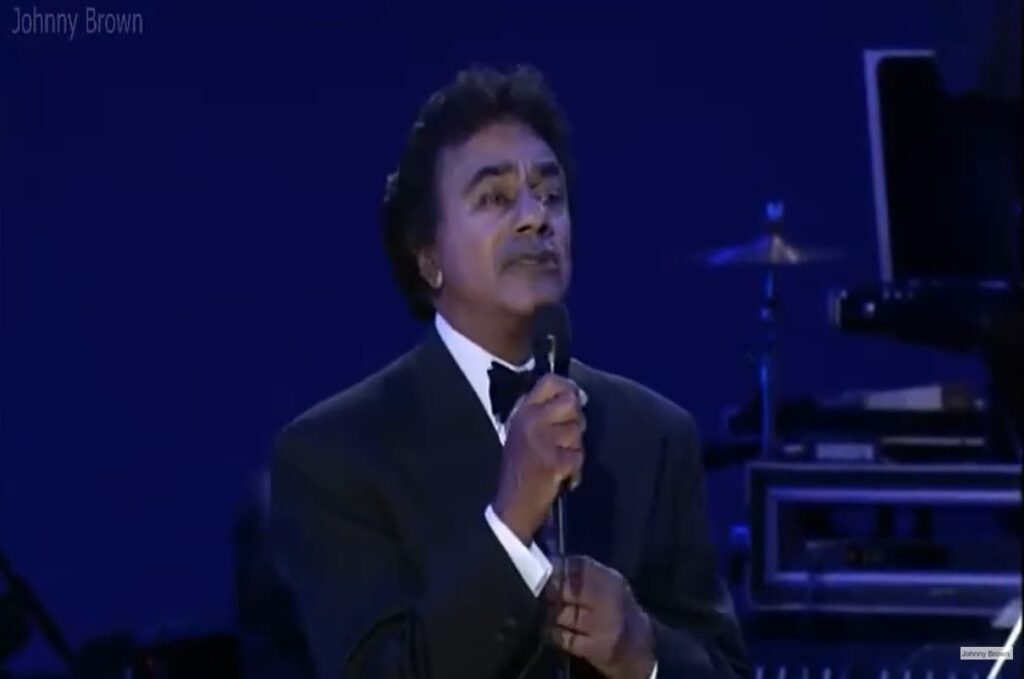
In the autumn of 2006, inside the elegant surroundings of the Tropicana Hotel in Atlantic City, Johnny Mathis delivered a performance that felt less like a concert and more like a quiet conversation with time itself. Among the many highlights of that 50th Anniversary Celebration, his live rendition of “Secret Love” stood out as a moment of profound emotional clarity—an interpretation shaped not only by vocal mastery, but by decades of lived experience.
To understand the weight of this performance, one must first return to the origins of the song. “Secret Love” was originally introduced by Doris Day in the 1953 film Calamity Jane, where it became an immediate success, winning the Academy Award for Best Original Song. Doris Day’s version reached No. 1 on the Billboard charts, establishing the song as a standard of romantic revelation. Over the years, it would be interpreted by countless artists, but in the hands of Johnny Mathis, it found a particularly intimate and enduring voice.
By 2006, Mathis was no longer simply a performer of songs—he had become a custodian of them. His career, which began in the mid-1950s, had already produced a remarkable string of successes, including classics like “Chances Are” and “Misty”, both of which secured high positions on the Billboard charts and helped define the romantic ballad tradition. His album “Johnny’s Greatest Hits” famously remained on the Billboard charts for nearly a decade, a record that speaks not just to popularity, but to lasting emotional connection.
In this live anniversary setting, however, chart positions and accolades fade into the background. What remains is the voice—mature, measured, and deeply expressive. When Mathis sings “Secret Love,” there is no sense of performance in the conventional sense. Instead, it feels like a recollection, as though the song has been carried quietly within him for years, waiting for the right moment to be shared once more.
The arrangement during this live performance is deliberately understated. Gentle orchestration allows the melody to unfold with patience, giving space for every nuance of phrasing. Mathis does not rush the song; he allows it to breathe. Each line is delivered with a softness that suggests reflection rather than declaration. Where earlier versions might have emphasized the joy of revelation, this interpretation leans into something more contemplative—the recognition of love discovered, perhaps later than expected, but no less meaningful for its delay.
There is a particular poignancy in hearing “Secret Love” at this stage of Mathis’s career. The lyrics, which speak of a love long hidden now brought into the light, take on new dimensions. They become less about youthful discovery and more about the quiet courage it takes to acknowledge one’s feelings after time has passed. In this way, the song transforms from a simple romantic confession into a meditation on honesty, vulnerability, and the passage of years.
The setting of the Tropicana performance adds another layer of resonance. Atlantic City, with its blend of glamour and nostalgia, mirrors the essence of the evening itself—a place where past and present meet. As Mathis stands on stage, there is an unspoken understanding that this is not merely a celebration of longevity, but of continuity. The songs remain, the voice endures, and the emotions they carry continue to find new meaning.
What makes this performance truly unforgettable is its restraint. There are no grand gestures, no dramatic flourishes. Instead, there is a quiet confidence, a trust in the material and in the audience’s ability to feel its depth. It is a reminder that music, at its most powerful, does not need to demand attention—it simply invites it.
In the end, Johnny Mathis’s live rendition of “Secret Love” during his 50th Anniversary Celebration is more than a performance. It is a moment suspended in time, where memory and melody intertwine. It speaks to the enduring nature of great songs and the artists who carry them forward, not as relics of the past, but as living expressions of emotion.
And as the final note lingers in the air, one is left with a quiet realization: some truths, like some melodies, may remain hidden for a time—but when they finally emerge, they do so with a beauty that feels both timeless and profoundly human.