
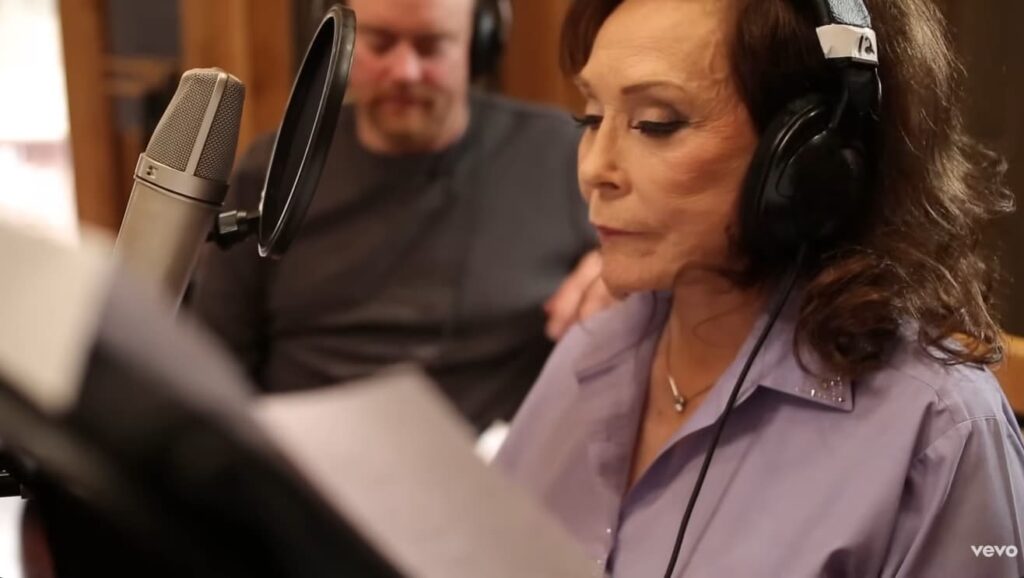
A gentle tide of longing and solitude, “Whispering Sea” carries the quiet ache of love remembered in the hush between waves and time.
Released in 1968 as part of the album “Fist City”, “Whispering Sea” is one of those lesser-known recordings that reveal the deeper emotional landscape of Loretta Lynn, far beyond her more assertive, chart-topping hits. While the song itself was not released as a single and therefore did not register on the Billboard Hot Country Singles chart, the album “Fist City” proved highly successful, reaching No. 1 on the Billboard Top Country Albums chart. It was during this period that Loretta Lynn firmly established herself as one of the defining voices of country music—uncompromising, authentic, and deeply human.
Unlike the bold, defiant tone of “Fist City” or the autobiographical strength of “Coal Miner’s Daughter” (1970, later a No. 1 hit), “Whispering Sea” moves in a quieter direction. It does not demand attention; instead, it invites the listener inward. Written with a sensitivity that feels almost fragile, the song unfolds like a private conversation—one that takes place not between two people, but between memory and the passage of time.
The sea, in this context, is more than a setting. It becomes a symbol—vast, constant, and indifferent. In “Whispering Sea”, the ocean does not roar; it whispers. And in that whisper lies the echo of something once held close but now distant. Loretta Lynn’s interpretation is key here. She does not overstate the emotion. Her voice remains measured, almost restrained, as if the story has already been lived through and is now being revisited with a quiet understanding.
This restraint is what gives the song its lasting power. At a time when many country recordings leaned into dramatic storytelling, Loretta Lynn chose subtlety. She allows the silence between phrases to carry as much weight as the words themselves. It is in those spaces that the listener finds meaning—not imposed, but discovered.
The late 1960s were a transformative period for country music. The genre was expanding, both in sound and in subject matter. Artists like Loretta Lynn were beginning to bring more personal, introspective themes into their work, moving beyond traditional narratives into something more nuanced. “Whispering Sea” fits quietly into this evolution. It does not announce itself as groundbreaking, yet it reflects a shift toward emotional honesty that would come to define much of Lynn’s later work.
There is also a sense of isolation woven into the song—a feeling that is not necessarily rooted in loneliness, but in reflection. The past is not portrayed as something to be reclaimed, but something to be acknowledged. The love that once existed is not denied, nor is it dramatized. It simply remains, like the tide—returning in memory, even as it recedes in reality.
Listening now, “Whispering Sea” feels almost timeless. Its themes are not tied to any specific era. The imagery of the ocean, the quiet acceptance of change, the gentle persistence of memory—these are elements that resonate regardless of when the song is heard. And perhaps that is why it endures, even without the recognition of chart success.
Within the broader context of “Fist City”, an album known for its strength and assertiveness, “Whispering Sea” offers a necessary contrast. It reminds us that Loretta Lynn was not defined solely by her boldness, but also by her ability to convey vulnerability with remarkable grace.
In the end, “Whispering Sea” is not about loss in the dramatic sense. It is about what remains after the moment has passed—the quiet, persistent echo of something once meaningful. And like the sea itself, it does not ask to be understood all at once. It simply continues, soft and steady, carrying its story in every whispered wave.