
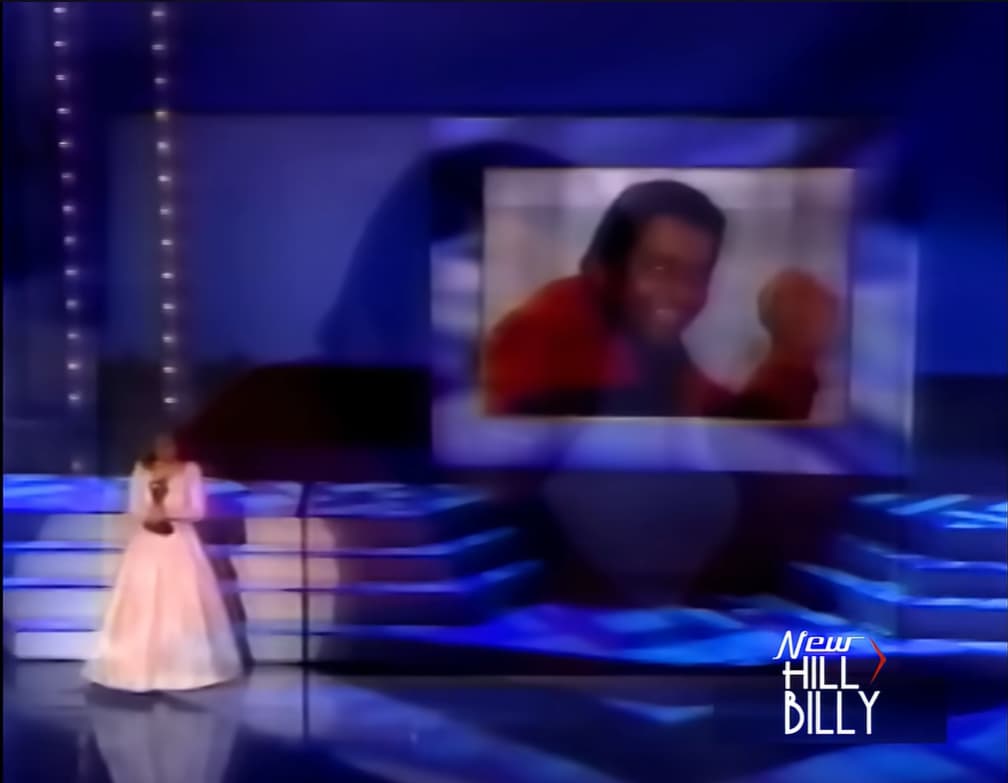
A moment of grace and recognition: when Loretta Lynn honors Charley Pride, celebrating a lifetime that reshaped country music with quiet strength and enduring dignity
There are evenings in the history of country music when the stage becomes more than a place for performance—it becomes a place of truth, gratitude, and memory. The 1997 presentation of the Living Legend Award, where Loretta Lynn surprised Charley Pride, stands as one of those rare, deeply human moments. It was not rehearsed in emotion, nor polished for spectacle. Instead, it unfolded with a sincerity that revealed something far more lasting: the recognition of a man whose journey had quietly altered the course of an entire genre.
By 1997, Charley Pride was already a towering figure in country music. His achievements were not simply impressive—they were historic. Between 1966 and 1987, he amassed an extraordinary 52 Top 10 hits on the Billboard Hot Country Songs chart, with 30 of those reaching the coveted No. 1 position. At the height of his career in the early to mid-1970s, Pride became the best-selling artist for RCA Records since Elvis Presley—a remarkable distinction that speaks not only to his popularity but to the universal appeal of his voice.
Songs like “Kiss an Angel Good Mornin’” (1971), which reached No. 1 on the country charts and crossed over into the Top 40 of the Billboard Hot 100, helped define his legacy. That same year, he was awarded Entertainer of the Year at the Country Music Association Awards, becoming one of the few artists to achieve such recognition during a time when the industry was undergoing significant cultural shifts. Yet, statistics alone cannot fully capture what Charley Pride represented.
Born on March 18, 1934, in Mississippi, Pride’s early life was far removed from the bright lights of Nashville. Before music claimed him fully, he pursued a career in professional baseball, even playing in the Negro Leagues and minor league systems. That chapter of his life, often overshadowed by his musical success, speaks volumes about his resilience and determination. It was a path shaped by perseverance—qualities that would later define his presence in country music.
What made Charley Pride’s rise truly extraordinary was not only his talent, but the context in which it emerged. In an era when country music was still largely segregated in both audience and industry, Pride’s success was groundbreaking. Yet he never allowed his identity to overshadow his artistry. He let the music speak first—his warm baritone, his effortless phrasing, his ability to convey both joy and sorrow with equal authenticity. Over time, audiences responded not to difference, but to sincerity.
This is what made the 1997 moment so powerful. As Loretta Lynn, herself a symbol of authenticity and strength in country music, stepped forward to present the Living Legend Award, there was an unspoken understanding in the room. When Pride realized that his name had been called, the surprise on his face was unmistakable—genuine, unguarded, almost childlike in its humility. It was as if, despite decades of success, he had never fully expected such recognition.
That brief expression—caught between disbelief and gratitude—told a story no speech could match. It spoke of years spent on the road, of songs recorded and sung, of barriers quietly broken without fanfare. It spoke of a man who had given so much to his craft, and who, in that moment, received something equally meaningful in return: acknowledgment.
The significance of this tribute extends beyond the award itself. It is a reminder of the lineage within country music—a passing of respect from one legend to another. Loretta Lynn and Charley Pride, though different in background, shared a common thread: a commitment to truth in storytelling. Both sang not for image, but for connection. And in that shared purpose, they found a mutual understanding that transcended words.
In the years that followed, Pride’s legacy continued to grow. He was inducted into the Country Music Hall of Fame in 2000, further cementing his place among the genre’s most influential figures. He also remained one of only three African-American members of the Grand Ole Opry, alongside DeFord Bailey and Darius Rucker—a testament to both his uniqueness and his enduring impact.
Looking back, the 1997 tribute feels less like a single event and more like a quiet culmination. A pause in time where the music industry, often so focused on what comes next, took a moment to honor what had already been given. It reminds us that true legacy is not built overnight, nor is it always loudly celebrated. Sometimes, it reveals itself in a single, unguarded expression—in the face of a man who, for a brief moment, is simply overwhelmed by the realization that he has been seen, remembered, and cherished. And perhaps that is the lasting beauty of that evening. Not the award, not the applause—but the quiet recognition of a life lived in music, and the gentle affirmation that it truly mattered.