
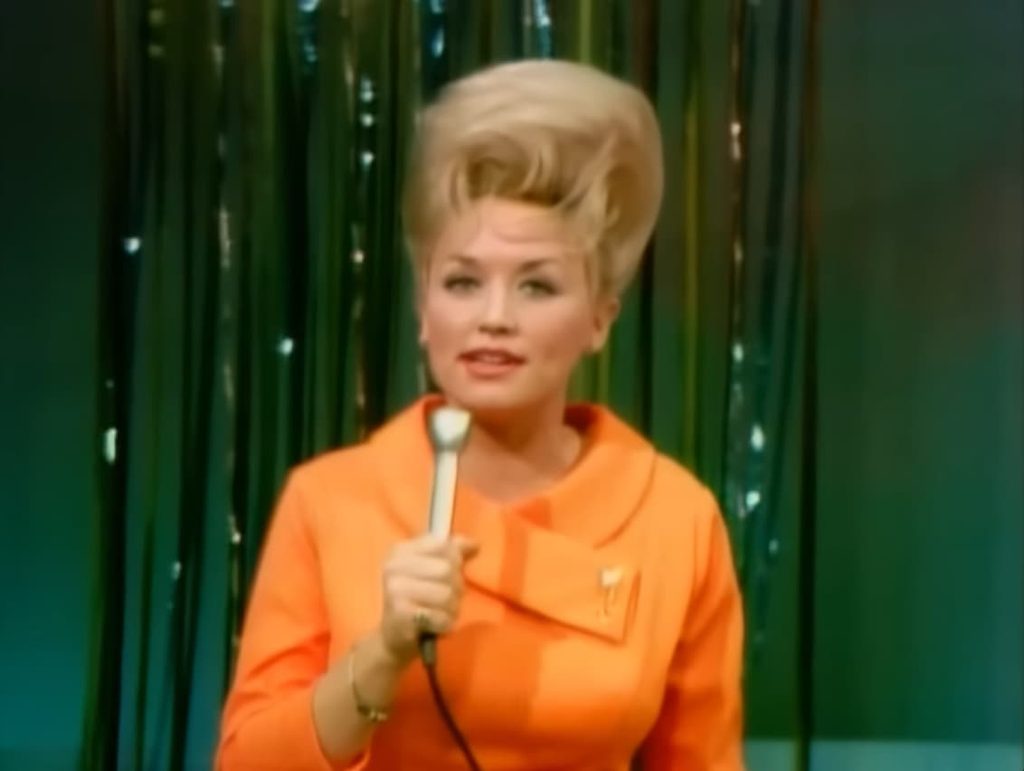
“Dumb Blonde” was the song that introduced Dolly Parton’s sharp wit to country music, proving from the very beginning that beneath the glamorous image was a woman nobody should ever underestimate.
Before “Jolene,” “I Will Always Love You,” and the countless No. 1 hits that would make her one of the most recognisable voices in popular music, there was “Dumb Blonde.” Released by Monument Records on November 7, 1966, the song became a crucial turning point in Dolly Parton’s early career. Written by legendary Nashville songwriter Curly Putman and produced by Fred Foster, it was Dolly’s first single to break through on the country charts. After several earlier recordings aimed more toward the pop market had failed to establish her, “Dumb Blonde” finally gave Nashville a glimpse of where her voice truly belonged. The record debuted at No. 64 on Billboard’s Hot Country Singles chart on January 21, 1967, then climbed to No. 24, spending a total of 14 weeks on the chart. It also reached an impressive No. 10 on the Cash Box Country Singles chart. For the first time, Dolly Parton was not simply a young singer with promise. Her name was beginning to appear where every aspiring country artist wanted it to appear: on the charts.
The story behind the song is particularly important because Dolly Parton had spent her early years with Monument Records trying to become something the music business believed might be more commercially successful: a pop singer. When Dolly signed with the label in 1965, producer Fred Foster reportedly felt that her high, distinctive voice could appeal to pop audiences. But the records did not find the breakthrough everyone hoped for. Dolly herself had always wanted country music. It was the music she had grown up with in the mountains of Tennessee, the music of family gatherings, radio programmes, old songs, banjos, fiddles, and stories carried from one generation to another. By 1966, the experiment with pop music had not worked, and “Dumb Blonde” offered her a chance to step into a sound that felt much closer to her natural identity. The irony of the title could not have been more appropriate. Dolly Parton would eventually become famous for playing with the glamorous blonde image while quietly demonstrating extraordinary intelligence as a songwriter, businesswoman, producer, actress, and performer. In “Dumb Blonde,” the joke was already there from the beginning: she might look like someone you could underestimate, but she was nobody’s fool.
The song itself is filled with the kind of playful defiance that would later become one of Dolly’s most familiar qualities. The woman in the song knows exactly what people are saying about her, and she knows the stereotype attached to the phrase “dumb blonde.” Instead of becoming hurt or defensive, she turns the idea upside down. There is humour in her voice, but there is also a warning. People may laugh at her appearance, make assumptions, or believe they understand her, yet she is always one step ahead. This mixture of sweetness and strength became one of the foundations of Dolly Parton’s public personality. Throughout her career, she would often make jokes about her looks before anyone else could, transforming criticism into comedy and refusing to allow other people to define her. “Dumb Blonde” was therefore more than an early country single. It was almost a small preview of the woman the world would later come to know.
The recording was made on September 23, 1966, at Fred Foster Sound Studio in Nashville. The session included some of Nashville’s finest musicians, including Lloyd Green on steel guitar, Buddy Harman on drums, Norbert Putnam on bass, Jerry Reed on guitar, and Dean Porter on guitar. Their playing gave the song a lively country sound with enough energy to match Dolly’s spirited vocal performance. The single’s B side, “The Giving and the Taking,” was written by Dolly herself with her uncle and longtime songwriting partner Bill Owens. Both songs would later appear on her debut album, Hello, I’m Dolly, released in 1967. The album became another important step forward, eventually reaching No. 11 on Billboard’s Top Country Albums chart, while the follow up single “Something Fishy” climbed even higher to No. 17, giving Dolly her first country Top 20 hit.
Looking back, “Dumb Blonde” feels almost prophetic. Dolly Parton had not yet become the superstar who would write “Coat of Many Colors,” conquer the country charts, cross into pop music, appear in Hollywood films, and build one of the most remarkable careers in entertainment history. In 1966, she was still a young woman trying to find the right door into Nashville. Yet the personality that would carry her through the decades was already unmistakably present. There was the humour, the determination, the playful confidence, and above all, the refusal to let anyone decide who she was supposed to be.
Perhaps that is why “Dumb Blonde” remains such an important song in the Dolly Parton story. It was not her biggest hit, and it did not reach No. 1. But it was the first record that told the country music world that Dolly Parton had arrived. The young singer with the unusual voice had finally found a song that allowed her personality to shine, and listeners responded. The road ahead would still be long, filled with difficult decisions, changing musical fashions, triumphs, and heartbreaks, but the journey had truly begun. And there is something wonderfully fitting about the fact that the woman who would spend the next six decades proving herself to be one of the smartest and most creative figures in music first reached the country charts with a song called “Dumb Blonde.”