
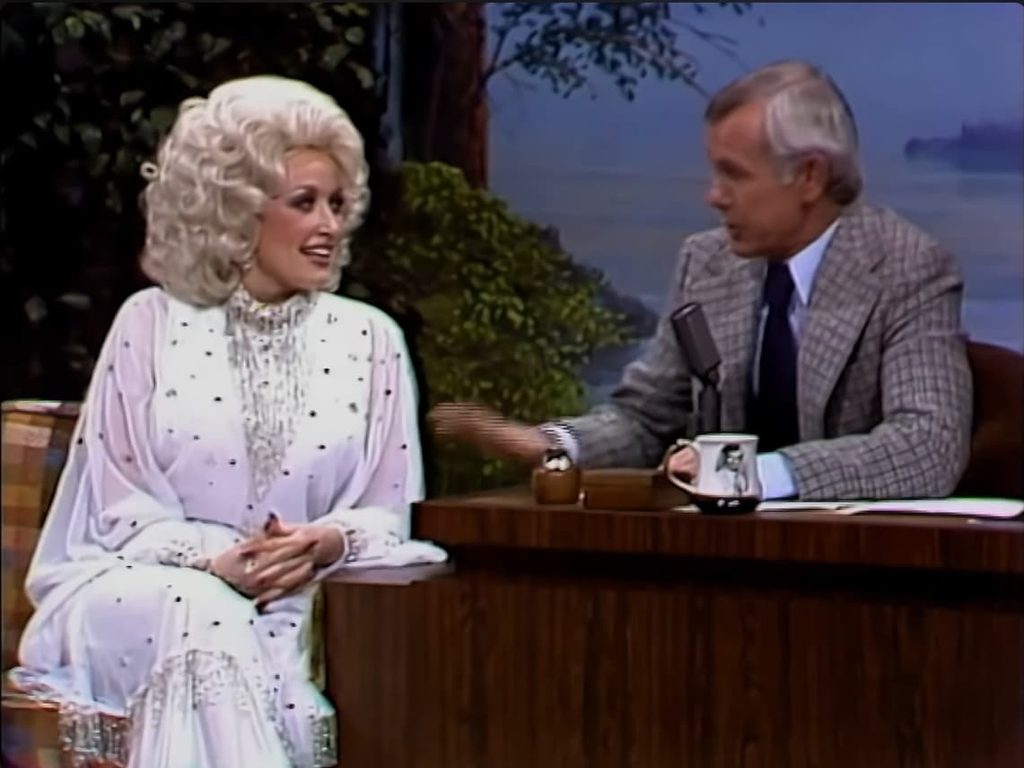
“Do I Ever Cross Your Mind” captured Dolly Parton at one of her most tender moments, long before the song became a familiar part of her recorded legacy
There is something wonderfully intimate about watching Dolly Parton sing “Do I Ever Cross Your Mind” on The Tonight Show Starring Johnny Carson on December 14, 1977. Dolly was already a major country star by then, but this performance feels almost removed from the machinery of fame. The television cameras are there, Johnny Carson is sitting nearby, and millions of people were watching, yet Dolly sings the song with the quiet concentration of someone addressing one particular person. The episode is documented by the Paley Center for Media as a December 14, 1977 Tonight Show broadcast featuring Carson, Charles Nelson Reilly, Dolly Parton and Lawrence Welk. The song itself had already been written and recorded by Dolly before this appearance. Her first released version came in 1976 as a duet with legendary guitarist Chet Atkins on The Best of Chet Atkins & Friends, with Dolly providing the vocal and guitar. But hearing her sing it alone in 1977 reveals another side of the composition. Without the identity of a duet partner, the question in the title becomes more personal: after love has ended, does the other person still remember?
That question is the heart of “Do I Ever Cross Your Mind.” Dolly does not write about dramatic betrayal or anger. Instead, she enters the quieter territory of memory, where the smallest things can suddenly bring somebody back. She remembers walking through fields where the couple once walked, notices that the flowers still grow, and remembers how they once seemed sweeter when they were connected to that relationship. It is a very Dolly kind of heartbreak, not because it is exaggerated, but because it is ordinary and recognizable. The song asks whether an old lover ever wakes up lonely, whether memories return unexpectedly, whether the feelings once shared still have a place in the other person’s heart. That emotional simplicity is precisely what gives the song its staying power. Dolly was extraordinarily gifted at taking an apparently simple country idea and finding the deeper human feeling underneath it. Here, she does not demand an answer. She simply wonders. That makes the performance feel less like a declaration and more like a private thought that accidentally found its way onto national television. The song would eventually receive a solo studio recording from Dolly for her 1982 album Heartbreak Express, and that version was issued in 1982 alongside “I Will Always Love You” as a double A-side single.
What makes the 1977 Carson performance especially fascinating is where it sits in Dolly’s career. She was still in the process of expanding far beyond the boundaries of country music, but she had not yet become the enormous crossover celebrity she would be only a few years later. She had already proved herself as a songwriter, performer and recording artist, and her television appearances were helping audiences who might never have walked into a country record store discover the woman behind the rhinestones and the famous blonde hair. Contemporary imagery from the December 14 appearance shows Dolly in one of the glamorous looks that were becoming part of her unmistakable public identity, yet the visual glamour does not overpower the song. That contrast is important. Dolly understood very early that her appearance could attract attention, but her songwriting had to give people a reason to keep listening. “Do I Ever Cross Your Mind” is exactly the kind of song that quietly proves the point. Beneath the sparkle is a songwriter paying close attention to the fragile afterlife of love.
There is also something special about the fact that Dolly was already performing this song live in 1977, even though her solo studio recording would not arrive until 1982. Music databases document a 1977 live recording from New York, and setlist records show that Dolly was performing the song during that period, with its first listed concert performance dating to April 15, 1977. In other words, the Carson appearance was not a one-off experiment with an obscure song. Dolly believed enough in the composition to carry it with her onto the stage while it was still years away from becoming part of her solo album catalog. That gives the performance a wonderful historical quality. We are hearing the song before the later studio arrangement, before its 1982 association with Heartbreak Express, and before the much later Trio II recording with Emmylou Harris and Linda Ronstadt. The song was still young, and Dolly was still discovering how much emotional weight it could carry in different settings.
And perhaps that is why this old Carson performance remains so affecting. Dolly Parton does not need to turn “Do I Ever Cross Your Mind” into a grand tragedy. Her voice carries the uncertainty naturally. There is tenderness in the phrasing, but also a little ache beneath it, the feeling of someone who has accepted that the past cannot be changed while still wondering whether the other person occasionally looks backward too. The title itself is almost painfully simple: Do I ever cross your mind? It is the question people ask when they have no way of knowing the answer. In Dolly’s hands, that uncertainty becomes music. Watching her sing it on Carson in December 1977, at a moment when her own star was rising rapidly, feels like finding a small, private window into the songwriter behind the celebrity. The rhinestones may catch the studio lights, but for a few minutes, the only thing that matters is that unanswered question.