
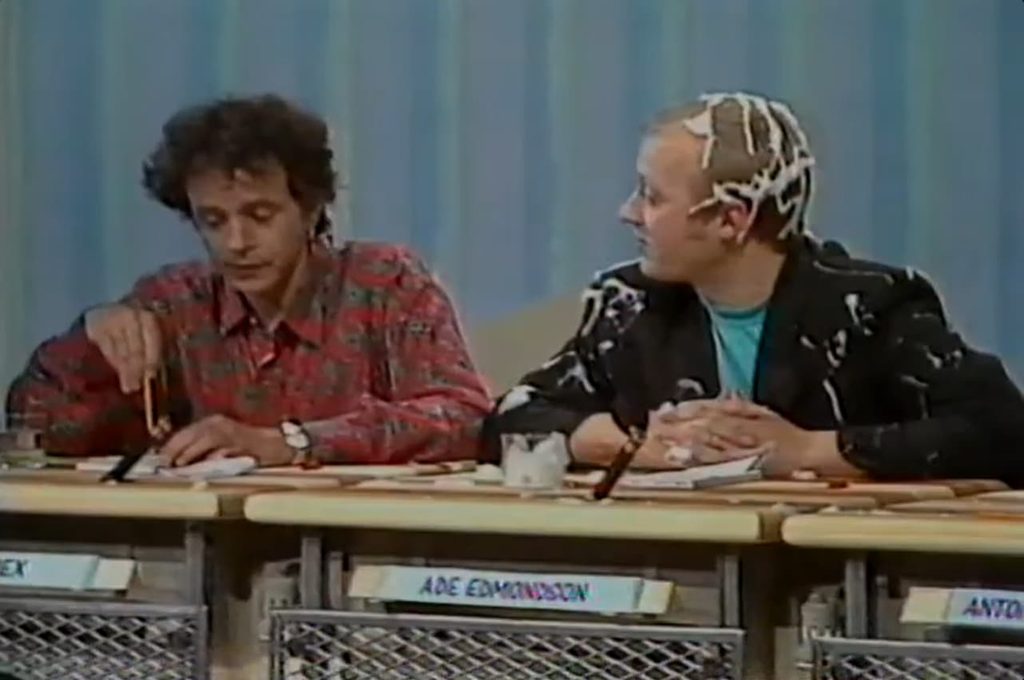
David Essex returned to television in 1989 as a judge of the next generation, sitting beside Rebel MC on a wonderfully eclectic Juke Box Jury panel
By 1989, David Essex had already lived several musical lives. The former teenage heartthrob of the 1970s had become a respected singer, actor and stage performer, with major hits such as “Rock On,” “Hold Me Close” and “A Winter’s Tale” firmly established in British popular culture. So there is something particularly enjoyable about seeing him in a completely different role on Juke Box Jury, the BBC music programme revived by Jools Holland in 1989. Essex appeared on the edition broadcast on 5 November 1989, alongside comedian and actor Ade Edmondson, French television personality Antoine de Caunes, and emerging British rapper Rebel MC, whose real name was Michael West. The format was wonderfully simple: the panel listened to recently released records and decided whether each one was likely to be a “hit” or a “miss.”
What makes this particular panel fascinating is the mixture of generations and musical worlds sitting around the same table. Essex represented a performer whose career had begun in the 1960s and exploded during the glam and singer songwriter era of the 1970s. Rebel MC belonged to something much newer. By 1989, British popular music was changing rapidly, with hip hop, house, dance music and new forms of club culture becoming increasingly important. Rebel MC was right in the middle of that movement. His breakthrough had come with “Street Tuff,” recorded with Double Trouble, which became a major British hit in 1989. Seeing him alongside David Essex therefore creates a wonderful little portrait of British pop culture at a crossroads. One man had already spent decades navigating the music business; the other was helping push it somewhere entirely new.
And that is precisely what made Juke Box Jury so entertaining. The programme was never simply about whether a song was good. The panel had to make a prediction. Would the record connect with the public? Would people remember it? Could it survive beyond the week of its release? The 1989 revival, filmed in Newcastle upon Tyne and hosted by Jools Holland, deliberately brought together people from very different corners of British entertainment. The result was much less predictable than a conventional music programme. A singer like Essex could approach a new record with the instincts of someone who had spent years watching audiences respond to music, while Rebel MC could hear it through the ears of an artist coming from the rapidly developing dance and rap scene.
There is also something rather lovely about David Essex’s presence here because he had already experienced the strange cycle that comes with popular fame. His enormous success in the 1970s had made him one of Britain’s most recognizable entertainers, but by the end of the decade the musical landscape had changed considerably. He had continued working through television, theatre, film and recording rather than trying to freeze himself in the image of the young man who had once sent audiences into a frenzy. His career had become broader and more durable. Sitting on Juke Box Jury therefore feels almost like seeing an experienced craftsman observing the new generation coming through. He was no longer simply the young star whose records were being judged. He was now one of the people doing the judging.
Beside him, Rebel MC gives the programme a completely different energy. His presence is a reminder of how quickly British music was evolving at the end of the 1980s. Only a decade earlier, the idea of placing a rapper and a singer famous for “Rock On” on the same pop panel would have seemed almost impossible. Yet by 1989, it was perfectly natural. That contrast is one of the reasons the footage is so enjoyable today. It captures a moment before the musical map had completely redrawn itself, when established stars, alternative personalities, comedians, DJs and emerging dance artists could all be thrown together and asked the same deceptively difficult question: Hit or miss?
Looking back, the appearance has another layer of charm because Juke Box Jury itself was a piece of television history being brought back to life. The original programme had been a major BBC institution from 1959 to 1967, before revivals in 1979 and then the two Jools Holland series of 1989 and 1990. The 1989 version lasted only a short time, but its panels became fascinating snapshots of the personalities and musical tastes of the period. The 5 November episode, with David Essex and Rebel MC sitting side by side, now feels like exactly that: a small time capsule from the end of the 1980s, preserving two very different generations of British music in the same room. And there is David, with that familiar face and unmistakable presence, no longer the young idol of “Hold Me Close,” but still completely at home in the world of popular music.