
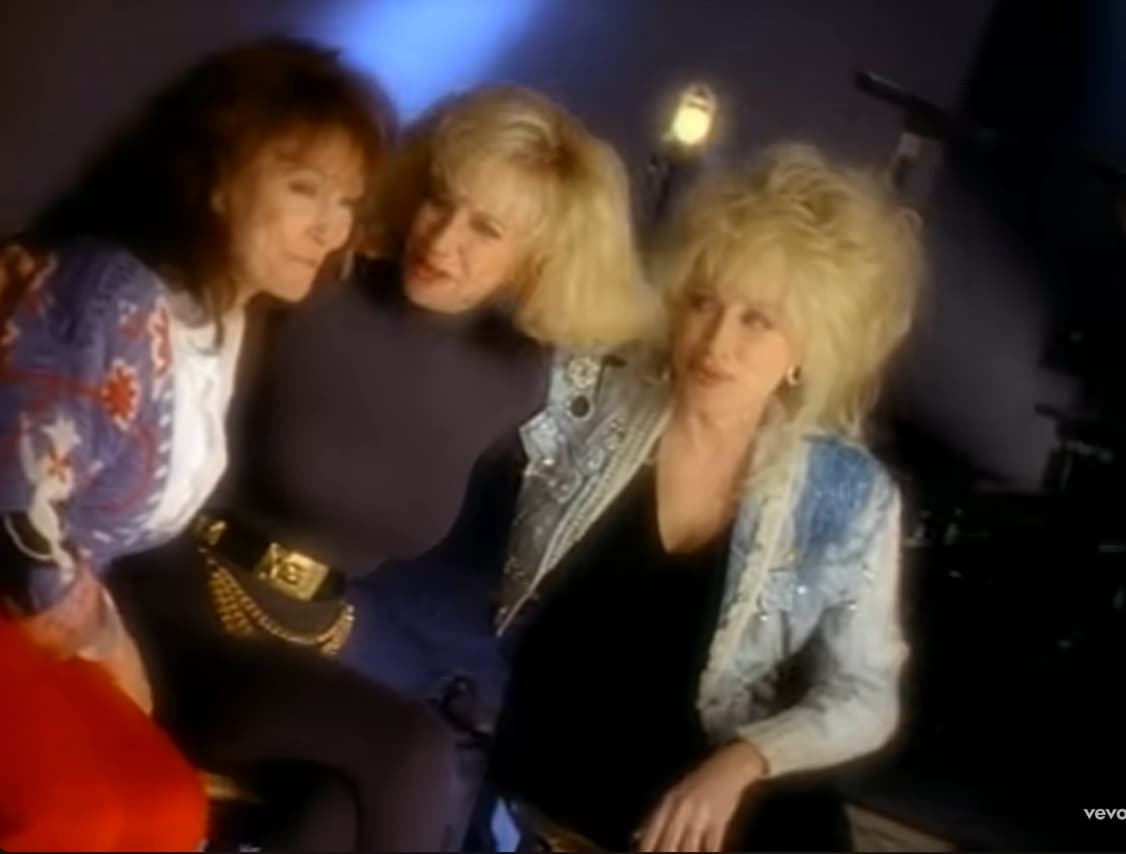
Three legendary women, one unforgettable country song, and a performance that brought three generations of heartbreak together
On September 29, 1993, the stage of the 27th Country Music Association Awards in Nashville became the meeting place for three of the most important women in country music: Dolly Parton, Tammy Wynette and Loretta Lynn. Together, they performed “Silver Threads and Golden Needles,” a song that already carried decades of history before their voices ever met. The performance came as part of the album Honky Tonk Angels, released on November 2, 1993, a remarkable collaboration that brought Dolly, Tammy and Loretta together to revisit some of the songs that had shaped country music. The Country Music Hall of Fame archives preserve the CMA performance, placing the trio’s rendition at 46:31 into the second tape of the 1993 awards broadcast. After singing, the three women remained together to present the Entertainer of the Year award to Vince Gill.
“Silver Threads and Golden Needles” was written by Jack Rhodes and Dick Reynolds, and its history stretches back to the 1950s. Wanda Jackson was among the earliest artists to record it, and over the years the song passed through very different musical worlds. The Springfields helped establish it within the folk revival, while Linda Ronstadt later transformed it into a country-rock favorite, taking her 1973 recording to No. 20 on the Billboard country chart and No. 67 on the Hot 100. By the time Dolly, Tammy and Loretta approached it in 1993, the song had already lived several musical lives. Yet its central idea remained wonderfully simple and devastating: money, luxury and material things cannot repair a heart that has been broken by love. The narrator does not want a lonely mansion or a wealthy man’s name. She wants the love that was promised to her, and she refuses to pretend that money can replace it. That theme made the song particularly appropriate for three women whose careers had been built around songs about marriage, betrayal, loneliness, devotion and the complicated emotional lives of women.
What makes the 1993 performance so fascinating is that the three singers do not sound interchangeable. Loretta Lynn brings the directness of a woman who could make a country lyric feel like something overheard across a kitchen table. Tammy Wynette carries the deepest ache in her phrasing, and contemporary accounts note that Tammy’s distinctive delivery served as the lead voice on the trio’s recording. Dolly Parton, meanwhile, adds her unmistakable brightness and emotional precision. Their voices belong to different shades of country music, but that is exactly what makes the combination work. There is no attempt to make them sound like a modern studio vocal group. Instead, each woman arrives carrying her own history. You hear three personalities meeting inside the same song. The official Dolly Parton timeline describes the CMA appearance as a memorable performance, and the trio’s recording later earned Grammy and CMA recognition, including a Grammy nomination for Best Country Vocal Collaboration and a CMA nomination for Vocal Event of the Year.
The album behind the performance, Honky Tonk Angels, was much more than a convenient superstar collaboration. Dolly co-produced the project, and the record deliberately brought together three women whose careers had helped define the possibilities for female artists in country music. Released by Columbia Nashville, the album reached No. 6 on Billboard’s Top Country Albums chart and No. 42 on the Billboard 200. Its song list reads almost like a conversation across country history, including “It Wasn’t God Who Made Honky Tonk Angels,” featuring the woman who originated that song’s legacy, Kitty Wells, along with Dolly’s own “Let Her Fly,” “Put It Off Until Tomorrow,” and other country standards. The collaboration therefore carried a sense of history even before the women walked onto the CMA stage. These were not three newcomers being introduced to one another. They were established voices looking backward at the music that had helped make them who they were.
The single version of “Silver Threads and Golden Needles” was released in November 1993 and entered the Billboard Hot Country Songs chart at No. 75, eventually reaching No. 68 in January 1994. Its chart run was brief, but chart statistics hardly explain why the recording has remained memorable. The real significance lies in the image of Dolly Parton, Tammy Wynette and Loretta Lynn standing together, each already carrying an extraordinary story of her own. By that point, all three had lived enough life to sing a lyric about love’s scars without having to decorate it. The song’s famous metaphor, silver threads and golden needles, suggests that time may change the hair and that wealth may glitter beautifully, but neither can stitch a damaged heart back together. On that September night in Nashville, the metaphor seemed almost perfectly suited to the three women singing it. They were not simply reviving an old country standard. They were giving it the accumulated weight of their own voices, their own histories, and their own understanding of what country music had always done best: telling the truth about love when there is no easy way to mend it.