
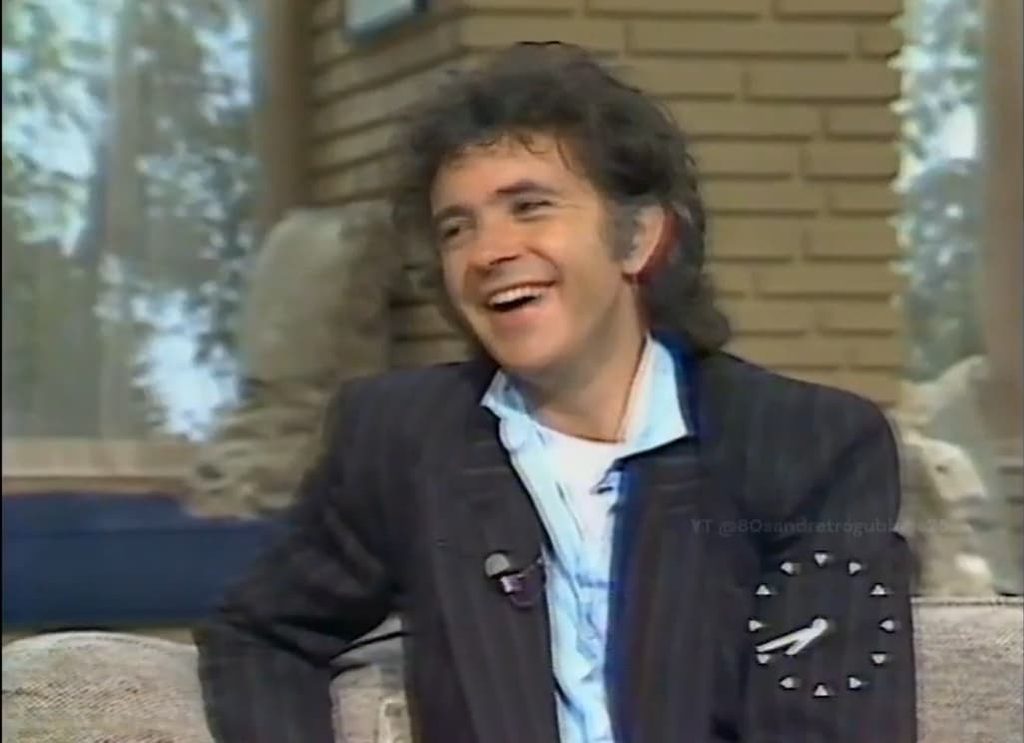
David Essex on TV-am in October 1983 captured a star who had already survived the 1970s and was still finding new ways to belong in the changing world of British entertainment
There is something particularly fascinating about seeing David Essex on TV-am’s Good Morning Britain in October 1983. The clip may look like a small piece of breakfast television history, but it catches Essex at an important point in his career. He was no longer simply the extraordinary young star who had exploded onto British popular culture with “Rock On” in 1973. A decade had passed, and he had already proved that his appeal was not confined to records. He had worked in film, theatre and television, built a substantial recording career, and continued to appear in front of audiences who had followed him since the early 1970s. The surviving television archive places David Essex on Good Morning Britain on October 11 and again on October 12, 1983, making this mid-October appearance part of a period when he was very much in the public eye. The surviving clip itself is now a wonderful time capsule of early breakfast television, with Essex appearing against the distinctly early-1980s atmosphere of TV-am.
And there was a very good reason for the timing. “Tahiti”, Essex’s current single, was enjoying a strong run in the British charts. Released in 1983 on Mercury, it had entered the UK chart in August and climbed steadily, eventually reaching No. 8. By the week of October 9 it was still at No. 10, having spent nine weeks on the chart, and on the October 16 chart it stood at No. 19 after reaching that No. 8 peak. That means the television appearance arrived while “Tahiti” was still a very visible part of the British pop landscape. It was not nostalgia for David Essex. He was still having current hits. In the mid-October chart, alongside artists such as Culture Club, David Bowie, Lionel Richie, UB40, Howard Jones and New Order, Essex’s name was still sitting comfortably among the major records of the moment. That detail matters because by 1983 British pop was changing rapidly. New technology, new fashions and new musical movements were reshaping the charts, yet Essex had retained enough audience loyalty and artistic identity to remain part of that conversation.
There is also a lovely contrast between the David Essex of 1973 and the David Essex of 1983. Ten years earlier, he had been the startling new figure with the famous smile, those striking eyes and the slightly mysterious quality that made him so compelling on stage and screen. “Rock On” had reached No. 3 in Britain, while That’ll Be the Day and Godspell had established him as a performer who could move between music and acting without looking as though he were merely visiting another profession. By 1983, that youthful image had matured. The man sitting in a breakfast television studio had already accumulated a decade of experience, including the film Silver Dream Racer, his stage work and numerous recordings. Even the fact that he was discussing his work on a morning programme says something about how television had changed. TV-am was part of the new breakfast-TV era, and David Essex, a star associated so strongly with the previous decade, was now appearing within this new broadcasting landscape without seeming out of place.
The timing also connects the interview to Mutiny!, the musical that had become another important part of Essex’s career. He had starred as Jack Absolute in the stage production, and the 1983 period found him continuing to balance recording and theatrical work. “Tahiti” itself came from the Mutiny! era, and the song’s chart success showed that his musical audience had not disappeared simply because he had become increasingly involved in acting and theatre. This was one of the qualities that made Essex unusual. His career was never neatly divided into “singer” and “actor.” The different sides continually overlapped. A record could grow out of a theatrical project, while his celebrity as a singer could help draw attention to his stage work. He had already learned how to live in several entertainment worlds at once.
Watching the 1983 Good Morning Britain footage today, the most striking thing is therefore not simply the clothes, studio or television technology, although all of those details immediately transport the viewer back to that particular morning-TV era. It is David Essex himself. There is still that familiar mixture of warmth and reserve, the bright smile appearing naturally rather than being constantly performed for the camera. By this stage he had nothing left to prove in the conventional sense. He had already experienced the extraordinary rush of 1973, the enormous popularity of “Hold Me Close,” the demands of film and theatre, and the pressures that came with being one of Britain’s most recognizable male stars. Yet here he was, promoting new work and speaking to another generation of television viewers. “Tahiti” would finish its chart run later that month, completing a 12-week stay and an impressive No. 8 peak, but the broader story was more enduring. This was David Essex entering the 1980s on his own terms, still unmistakably himself while the musical world around him was changing almost by the week. And that is what makes this modest breakfast-TV appearance so precious: it preserves him not as a distant 1970s idol looking backward, but as a living, working star still moving forward.