
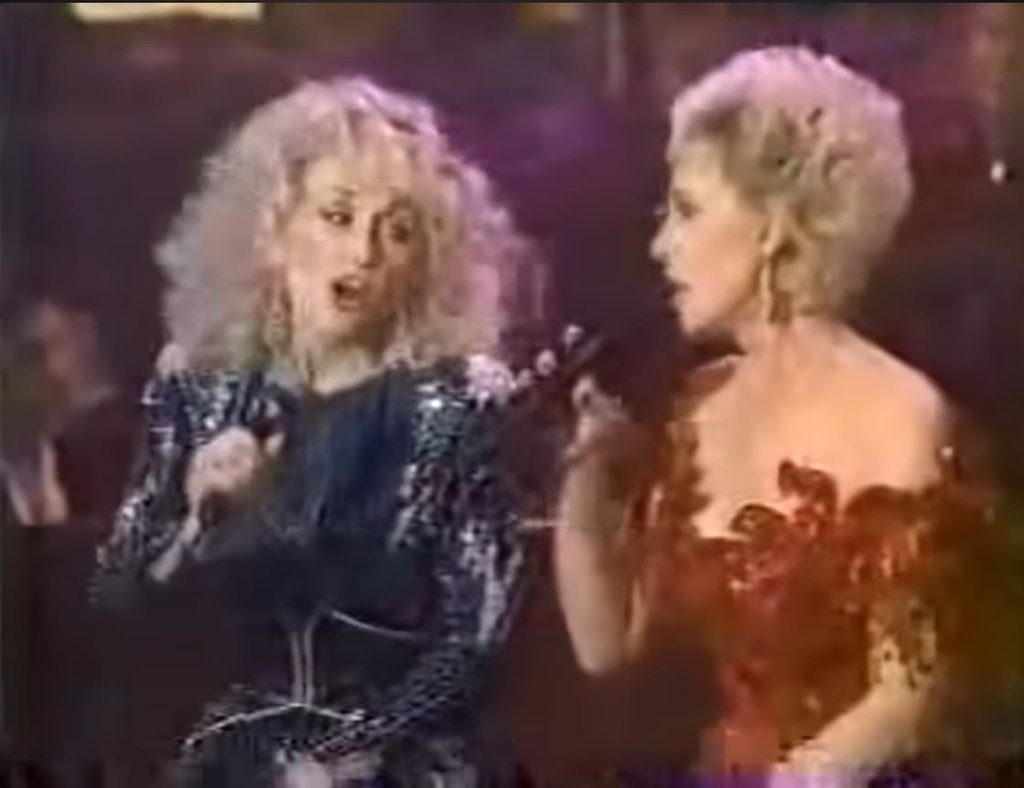
When Dolly Parton joined Tammy Wynette for “Stand By Your Man,” a country classic became a conversation between two women who understood how complicated love could be
In January 1988, the television audience of Dolly Parton’s own show, Dolly witnessed a particularly special meeting of two of country music’s most recognizable women. Tammy Wynette joined Dolly for a medley of some of her signature songs, beginning with “Stand By Your Man” and continuing through “Apartment #9,” “D-I-V-O-R-C-E,” “I Don’t Wanna Play House,” and “Your Good Girl’s Gonna Go Bad.” The episode’s soundtrack credits confirm that the medley was performed by Tammy and Dolly, making this more than a conventional guest appearance. It was a meeting between a woman whose voice had defined an era of country heartbreak and another superstar who had long admired her. There is something wonderfully relaxed about the performance because Tammy is not being presented simply as a legend being honored by Dolly. She is there as a friend and fellow artist, and Dolly treats her that way.
“Stand By Your Man” had been Tammy’s defining song since its release in 1968, written by Tammy Wynette and Billy Sherrill. It became one of the most recognizable songs in country music, reaching No. 1 on the country chart and crossing onto the Billboard Hot 100. But its meaning has always been more complicated than its title suggests. The song speaks about loyalty, forgiveness and standing beside a flawed partner, yet Tammy’s own life made those words impossible to hear as a simple instruction. She had experienced marriages, divorce, motherhood, extraordinary success and painful personal struggles, and the song followed her everywhere. At times it was treated as a statement about how women should behave; at other times, it was understood as a deeply personal expression of the emotional compromises that love can demand. That tension is part of what made Tammy’s delivery so powerful. As Dolly herself once recalled, she was amazed by Tammy’s ability to stand almost completely still and let such an enormous voice carry the entire drama. Dolly described Wynette as having “one of the greatest voices of all time,” a revealing glimpse of the admiration she had for her fellow country star.
And then there is Dolly’s harmony. Dolly does not attempt to imitate Tammy or take the song away from her. Instead, she settles naturally beside her, adding warmth and a lighter vocal color to Tammy’s deeper, more weathered sound. That contrast is what makes the duet so appealing. Tammy sounds as though she has lived every difficult word, while Dolly brings the sensitivity of a songwriter who understands that love is rarely as neat as a lyric can make it seem. Their voices create a kind of conversation without either woman needing to dominate the other. The same television medley then moves through “Apartment #9,” “D-I-V-O-R-C-E,” “I Don’t Wanna Play House,” and “Your Good Girl’s Gonna Go Bad,” almost like a miniature portrait of Tammy’s career. These were songs about loneliness, marriage, children, betrayal and the expectations placed upon women, themes that had become central to Tammy’s identity as an artist. Dolly knew exactly what those songs meant to country audiences, which makes her presence beside Tammy feel affectionate rather than ceremonial.
The timing is important too. By 1988, Tammy was no longer simply the woman who had ruled country radio in the late 1960s and 1970s. Her career had already passed through several chapters, and she had become one of the most recognizable figures in the history of the genre. Dolly, meanwhile, had moved far beyond her early country success into international stardom, film, television and crossover pop. Yet on Dolly, the difference in their careers seems to disappear. They are simply two women who know these songs. There is laughter, warmth and an almost familial ease between them. It feels less like a superstar interviewing another superstar and more like two old friends opening a songbook together. That quality is especially moving because their friendship was genuine. At Tammy’s 1998 memorial, Dolly remembered her as one of the “three queens in country music,” alongside Dolly and Loretta Lynn, a remark that captured the extraordinary place Tammy occupied in Dolly’s heart and in country history.
What makes this performance of “Stand By Your Man” linger is therefore not simply that two famous voices are singing a famous song. It is the history standing behind them. Tammy is singing the song that became inseparable from her name, while Dolly is beside her, not trying to modernize it or explain it, but simply helping her sing it. By then, both women had experienced enough of life to understand that love could contain devotion and disappointment at the same time. And when the medley moves onward into “D-I-V-O-R-C-E” and the rest of Tammy’s greatest songs, the television set suddenly feels like a little country-music time capsule, preserving two extraordinary women laughing, harmonizing and sharing songs that had accompanied them through very different chapters of their lives.