
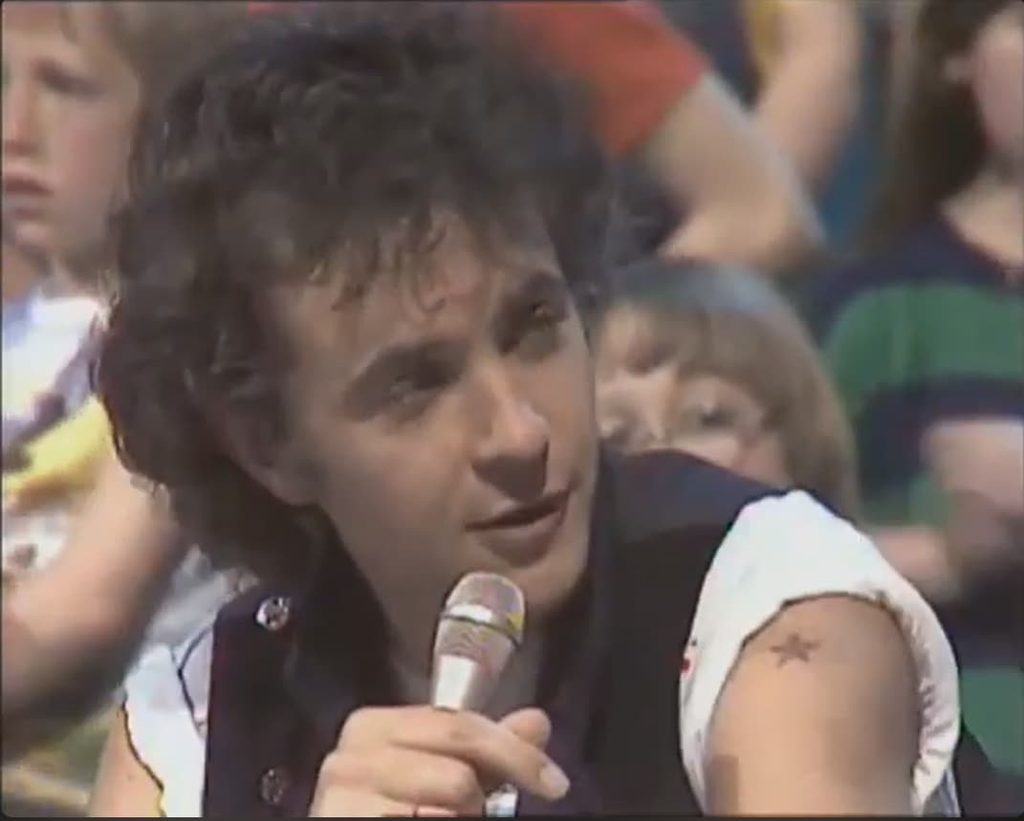
David Essex on Razzmatazz in June 1981 captured him at a fascinating crossroads, still a pop star to millions while quietly becoming something much more
On June 16, 1981, David Essex appeared on ITV’s Razzmatazz, the energetic music programme produced by Tyne Tees Television in Newcastle. The third episode of the show’s first series featured an unusually memorable collection of guests: Kim Wilde, Hot Gossip and David Essex, with Essex appearing for an interview before performing “Be-Bop-A-Lula.” Contemporary programme listings confirm the date and the sequence of the appearance, preserving a small but fascinating moment from a year in which Essex was already moving into a new chapter of his career. Razzmatazz itself had only launched on ITV two weeks earlier, on June 2, 1981, and was recorded at Tyne Tees Television’s studios in Newcastle before an audience largely made up of local schoolchildren. It was designed as a lively new kind of children’s pop programme, bringing established stars and current chart acts into the same brightly colored world. And David Essex, with his unmistakable face, smile and effortless stage presence, must have seemed like a very different kind of guest from the younger acts surrounding him.
What makes the appearance particularly interesting is where Essex was in his career at the time. The great explosion had happened eight years earlier. In 1973, “Rock On” had taken him to No. 3 in Britain and made him one of the most recognizable young performers in the country. He had followed that success with records, films and major stage roles, proving that his appeal was never dependent on a single medium. By 1981, however, he was no longer simply the young heart-throb associated with That’ll Be the Day. He had recently starred as Nick Freeman, the motorcycle racer at the center of Silver Dream Racer, a film for which he also wrote the music. Its title song, “Silver Dream Machine,” became another major hit, reaching No. 3 in the UK. The year before this Razzmatazz appearance, he had therefore been seen racing motorcycles on the big screen and singing a Top Five single, while now he was sitting in a children’s television studio talking about his work.
There is an even more intriguing side to 1981. David’s official career timeline records that during this year he saw Childe Byron in New York, became fascinated by the play and worked with director Frank Dunlop to bring it to the Young Vic, where he played the title role of Lord Byron. The production became a successful run and demonstrated that Essex was serious about establishing himself as a straight actor, rather than remaining dependent upon the familiar pop-star persona. That makes the Razzmatazz interview feel almost like a photograph taken between two worlds. The audience was still seeing David Essex the pop star, the man whose records had decorated the charts for years, while behind the scenes he was taking increasingly ambitious steps into theatre and dramatic acting. He was becoming harder to place in a single category, and that versatility would become one of the defining features of his career.
Then there is the wonderfully unexpected choice of song. After the interview, Essex performed “Be-Bop-A-Lula,” the Gene Vincent rock ‘n’ roll classic. It was a natural choice for a performer whose earliest musical identity had been shaped by rock ‘n’ roll, but it also connected the mature Essex with the young man who had first appeared on British screens and stages during the early 1970s. His version was later associated with the 1981 album Be-Bop the Future, a title that itself seems almost perfect for the moment. Essex was looking backward to one of rock’s foundational songs while simultaneously moving forward into a new decade and a broader career. That mixture of nostalgia and forward motion was very much David Essex.
The surviving Razzmatazz material is also valuable because it preserves the human reaction to Essex’s presence. Years later, presenter Lyn Spencer recalled that David’s arrival “caused quite a stir” among her female colleagues, a wonderfully revealing little detail about the enduring effect he had on people who encountered him in person. By 1981, the famous eyes and smile were already part of British pop culture, but there was something more substantial underneath them. Essex had spent the previous decade learning how to move between music, film and theatre, and he was now beginning another transformation. Watching him on Razzmatazz today, surrounded by the exuberant visual language of early-1980s children’s television, you can almost see both versions of him at once: the charismatic young idol who had once made teenage hearts race, and the increasingly seasoned performer who was quietly building a career much larger than pop stardom alone. It is a brief television appearance, but it catches David Essex at exactly the moment when the past was still visible in his face and the future was already beginning to take shape.